
[Because someone has to write new content around here. I wanted to add her as an author but she declares that to be 'too much bother', so I get these by email instead.
See also my Hierophant.]
The Hierophant is one of those cards that just about everyone who comments on Tarot is down on. The letter of the law as opposed to the spirit, organised religion crushing individual spirituality, etc. And I agree that that is part of him. But. It isn't all.
If you want to meet the Hierophant, get some idea of what he's all about, go to the library. Any old library. There's probably one in your town. Go to the non-fiction section. Don't get any books off the shelves or anything. Just stand there for a second, really take it in. Look at all those titles, those authors. The Dewey numbers on the spines for ease of reference.
That's him.
The Hierophant is a note-taker. An organiser. A lover of clipboards.(Ponder Stibbons of Discworld is in some ways very Hierophantic.)He's an absolute pest at times but you just can't do without him. He's not the one who does things-he writes them down. 'Hiero', remember? Writing. If all the trumps were having a discussion, he'd be the one keeping the minutes. It's terribly boring at times, but unfortunately we do often need that paperwork. He doesn't do things or invent things-he records them. It's pretty common knowledge that the Gospels were not written until quite a while after all the events recorded in them had happened. The Christian religion had been going awhile, and people were joining who hadn't actually met Jesus by this point. So some of the apostles decided to set down their version of events, so's to inform these new believers.
It's worth wondering how long Christianity would have lasted if they hadn't done that. But then, hey, if those particular men hadn't, someone in the congregation probably would've!
Now. Think of those Gospels. Think of the later New Testament stuff-preserved letters mostly, plus the long tripped-out vision of Revelation. Think of someone collating all that and putting it into more or less the form that we recognise today.
Then think of all the commentaries, the translations, scholarly essays on this or that point of theology or ethics or imagery, different interpretations...Everything that's ever been written about the New Testament and what it contains. All those riffs on one big theme. From the time they were first put on paper, to the present day. Some of it's been lost, manuscripts getting destroyed for one reason or another, but there is still so much of it all that is still available to us today. All those people talking...you just need to go to the library, and guess what, they're talking to you.
The Hierophant bothers about this sort of thing. The High Priestess, his opposite number (I always see these two trumps as a pair of complementary/antagonistic opposites, like the Empress and the Emperor) doesn't write things down; she dreams and smiles and keeps her counsel. She reckons that if you have to ask, you aren't ever going to know. There's that deep pool of water behind her veil, and she'll point the way to it...but don't ask her to lend you any scuba gear. She won't tell you where the sharks are, either.
Not that I'm making her out to be the bad guy. My point is, she's just limited, like all the cards. She does her thing, and that happens not to include much communication. The Hierophant is all about communication. In the Rider-Waite he's got these two monkish fellows listening to him or being blessed by him. Probably both. The whole system of the Church, of any church, is centred around passing on the teachings.
Now, here's the big thing. The Hierophant is in charge of the orthodoxy. But you don't have to believe him. He may try to make you, but when you get down to it, only you can make you believe something, and you always have the option of disagreeing.
You still need him though. All his information, his history, his commentary-that gives you a starting point. When you've studied it all, you can decide to disagree. But you're still reacting to him, you aren't operating in a vacuum.
So far I've been talking about the Hierophant in religious terms, but that's just one side of him. He's there in science, too-not in the whole idea of science, but in all the discoveries yet made, the body of knowledge amassed so far. A lot of the biggest discoveries of science have been debunking earlier bits. "No, I don't believe that, I don't think gravity is a 'force' per se," for instance. And Einstein goes on to describe gravity as the consequence of the curvature of space. Big chaos in the scientific community as they try to assimilate this new idea. But he didn't just pull it out of a top hat, you know. He looked at Newton's work, at the work of other physicists, and thought about it. Then he decided they were wrong. The best innovators always ground themselves in a tradition first-whether we're talking religion, science, art, whatever.
Here's a quote from Goethe for you. "He who cannot draw on three thousand years is living from hand to mouth."
Of course, the Hierophant makes muddles. Most people who read the Gospels are astounded by how utterly stupid the disciples manage to be a lot of the time. Even the believers often feel that Jesus must've needed Divine patience just to put up with them! The Hierophant is a follower, and sometimes he screws up. That happens, when you're only following the path, not inventing it. As I said earlier, he also has this tendency to try to pigeonhole people, to fit them into his worldview, and that can be harmful. But focusing solely on his negative aspects make it look like the pack and the world would be better off without him-that he's an aberration, a mistake, a useless bit of trouble. And this is not true. He's just as vital as any of the other trumps.
I think most Tarot commentators have a negative-skewed view of the Hierophant 'cause they've had bad experiences with official religion and so forth. Not trying to psychologise here, just pointing things out. Okay, slightly psychologising. But the point is valid.
For myself? I think my better-than-usual view of the Hierophant probably goes back to a few good books on Christian theology...particularly and centrally the books that got me into it in the first place, the apologetics tomes by C.S. Lewis. I started reading these books in my early teens, and I've never got tired of them. There's always something to agree with and something to disagree with. I love reading them because it makes me think about my own position, helps me formulate it.
Good old Jack. You and I will never agree on so many things, but you're still one of my all-time favourite authors and thinkers. And one thing we can both agree on is that the questions are important ones, whatever the answers are.
I finish this ramble with one last literary reference, this one for all those out there who've read Perdido Street Station. Remember Palgolak?
Best. Hierophant. EVAR.

Index
All cards / Latest Cards / All other posts / Notes from Agla
Major Arcana / Minor Arcana / Court Cards
Wands / Pentacles / Cups / Swords
(For a list of all card articles, open March 2008 on the sidebar).
Showing posts with label agla. Show all posts
Showing posts with label agla. Show all posts
Tuesday, 15 July 2008

Monday, 17 March 2008
On elements.
In tarot (and also in astrology) elements are often used to describe similarities between groups of symbols and properties. It is perhaps best to say that elements are a way of taking the giant mess of the world and framing it in four more-or-less neat boxes which can then be used to interpret life and steer it (though life steers like a cow).
The four Greek elements are Earth, Water, Fire and Air (other element systems exist, such as China's five elements); in tarot these are represented by Pentacles, Cups, Wands and Swords respectively. (Some readers refer to Court Cards in the same manner - Pages are earthy, Knights are fiery, Queens are watery and Kings are airy - but this is less common).
These elements are said to have the same qualities that their adjectives evoke:
Earth is about the body, and about work - both paid work and other labour, such as the care you take for your personal finances, your home and your health and the maintenance of your skills. Earth situations are those that call for practical thinking, hard work, and good planning. Earth may also refer to the Earthy parts of your life - work, your home life, possibly sex or money.
Water is about emotions, and about communicating; it asks you to be aware of the way you communicate, the way you express your feelings, and of the currents on which your feelings flow. It can describe your social and emotional life; a Water situation calls for recognition of needs, for compromise and above all for compassion.
[edit: Agla, who is much better than me at this stuff, sent this in email:
"It's odd that water means communication to you-to me it's always been more of something uncommunicated or hidden, if you know what I mean. Air's the message element for me-way traditional I know, but it seems to fit.
"A very long time ago I remember reading somewhere that the sea is often used in the Bible to symbolise the unknown and the terrifying. The place where people can't live and monsters lurk. God's power over the sea (Jesus calming the storm, etc) is seen as what you might call the opposite and complimentary side of his power over the world to the side invoked with the business of the water and wine or the feeding of the five thousand. In those miracles it's pointed out that God made and regulates all that sustains us. In the sea-calming it's made clear that he's holding the reins of all in the world that terrifies, too.(He calmed the storm, yeah. But that implies that if he wanted to he could whip it up again.) (Although the five-thousand were fed with fish as well as bread, so it's clear the sea is necessary as well as scary and that if you dare it you can bring back rewards!)"]
Fire is about the soul, and about taking what is in your soul and making it manifest. Fire tells you to explore your dreams and your deepest perceptions, and then to seek them out; it calls some to write, draw or craft, guides some through their religion, and sends some on impulsive and life-changing journeys. Fire describes your creative life and your religious life, and the dreams of adventure that you've always had burning in your core. In fire situations, you must follow your instincts and dreams, and if in doubt, always do rather than not do.
Air is about the mind. Air is learning and logic, debate and reasoned moral judgements. Air tells you to detach and do what's right; whether that's what adds up to the best outcome, or what you think your gods want you to do. Air could describe what you know in the cool of your mind - it can describe your academic life, or your most cerebral connections with others and with the world. In tarot, air often carries pain and conflict within it. Why is this? I don't know, but I do know that within the body (and all awareness starts with the body), air is the least stable element; homoeostasis can keep your body warm, wet and earthy even without shelter or sustenance, but our air needs to change over every few seconds.
But. But. This is how elements are in tarot - it's how tarot uses elements, rather than what the elements actually are, when you dig past their use for demarcation of little people's little lives.
If elements could be neatly defined in words, they wouldn't be elements. If you look for elements, and the feel of elements, in scrying and in energy work (and energy games, which are perhaps more important), if you explore what you're drawn to and what you're made of, then elements soon become more than ways to divide; they become the stuff the world is made of - deep-running, fuzzy-edged stuff that can be expressed in words or on card images, but can only be seen below all this.
[I originally put this in the Ace of Pentacles entry, but realised it needed its own. It's a technique I learned from someone who I haven't spoken to in a while, but who I hope is living well today.]
Here's something you can try, a way to bring element to the surface of your world:
Relax, and explore your proprioception - your awareness of having a body. Notice where in your body you seem to have the strongest sensations of awareness - places that feel as if they are ready to be touched. (I find these mostly in my feet and spine - YMMV.)
'Push' this awareness and sensitiveness toward your hands, until they feel a bit buzzy.
Put your hands close together (not touching), with the palms facing each other. Move them in circles.
Move your hands slowly further apart, to about 8 or 12 inches.
So, that thing between your hands now - what's it like? What does your imagination say it's made of? (Closing your eyes might make it easier to imagine this). YMMV, but, this is a way you might find that you know the feel of an element, or a mixture of elements.
The four Greek elements are Earth, Water, Fire and Air (other element systems exist, such as China's five elements); in tarot these are represented by Pentacles, Cups, Wands and Swords respectively. (Some readers refer to Court Cards in the same manner - Pages are earthy, Knights are fiery, Queens are watery and Kings are airy - but this is less common).
These elements are said to have the same qualities that their adjectives evoke:
Earth is about the body, and about work - both paid work and other labour, such as the care you take for your personal finances, your home and your health and the maintenance of your skills. Earth situations are those that call for practical thinking, hard work, and good planning. Earth may also refer to the Earthy parts of your life - work, your home life, possibly sex or money.
Water is about emotions, and about communicating; it asks you to be aware of the way you communicate, the way you express your feelings, and of the currents on which your feelings flow. It can describe your social and emotional life; a Water situation calls for recognition of needs, for compromise and above all for compassion.
[edit: Agla, who is much better than me at this stuff, sent this in email:
"It's odd that water means communication to you-to me it's always been more of something uncommunicated or hidden, if you know what I mean. Air's the message element for me-way traditional I know, but it seems to fit.
"A very long time ago I remember reading somewhere that the sea is often used in the Bible to symbolise the unknown and the terrifying. The place where people can't live and monsters lurk. God's power over the sea (Jesus calming the storm, etc) is seen as what you might call the opposite and complimentary side of his power over the world to the side invoked with the business of the water and wine or the feeding of the five thousand. In those miracles it's pointed out that God made and regulates all that sustains us. In the sea-calming it's made clear that he's holding the reins of all in the world that terrifies, too.(He calmed the storm, yeah. But that implies that if he wanted to he could whip it up again.) (Although the five-thousand were fed with fish as well as bread, so it's clear the sea is necessary as well as scary and that if you dare it you can bring back rewards!)"]
Fire is about the soul, and about taking what is in your soul and making it manifest. Fire tells you to explore your dreams and your deepest perceptions, and then to seek them out; it calls some to write, draw or craft, guides some through their religion, and sends some on impulsive and life-changing journeys. Fire describes your creative life and your religious life, and the dreams of adventure that you've always had burning in your core. In fire situations, you must follow your instincts and dreams, and if in doubt, always do rather than not do.
Air is about the mind. Air is learning and logic, debate and reasoned moral judgements. Air tells you to detach and do what's right; whether that's what adds up to the best outcome, or what you think your gods want you to do. Air could describe what you know in the cool of your mind - it can describe your academic life, or your most cerebral connections with others and with the world. In tarot, air often carries pain and conflict within it. Why is this? I don't know, but I do know that within the body (and all awareness starts with the body), air is the least stable element; homoeostasis can keep your body warm, wet and earthy even without shelter or sustenance, but our air needs to change over every few seconds.
But. But. This is how elements are in tarot - it's how tarot uses elements, rather than what the elements actually are, when you dig past their use for demarcation of little people's little lives.
If elements could be neatly defined in words, they wouldn't be elements. If you look for elements, and the feel of elements, in scrying and in energy work (and energy games, which are perhaps more important), if you explore what you're drawn to and what you're made of, then elements soon become more than ways to divide; they become the stuff the world is made of - deep-running, fuzzy-edged stuff that can be expressed in words or on card images, but can only be seen below all this.
[I originally put this in the Ace of Pentacles entry, but realised it needed its own. It's a technique I learned from someone who I haven't spoken to in a while, but who I hope is living well today.]
Here's something you can try, a way to bring element to the surface of your world:
Relax, and explore your proprioception - your awareness of having a body. Notice where in your body you seem to have the strongest sensations of awareness - places that feel as if they are ready to be touched. (I find these mostly in my feet and spine - YMMV.)
'Push' this awareness and sensitiveness toward your hands, until they feel a bit buzzy.
Put your hands close together (not touching), with the palms facing each other. Move them in circles.
Move your hands slowly further apart, to about 8 or 12 inches.
So, that thing between your hands now - what's it like? What does your imagination say it's made of? (Closing your eyes might make it easier to imagine this). YMMV, but, this is a way you might find that you know the feel of an element, or a mixture of elements.
Friday, 7 March 2008
The High Priestess
I knew you'd be here again
stood in the door between what was and the future
between one and another
between me and the veil
you're a line I can't cross and still remain myself
you're the yin and the yang,
you're proof that the world splits in two
you're a weaver
you show me two pieces, you bring them together again.
The Priestess is one of those cards with a mixed-up history; she began as the Popess or Papess, and there's a further question about whether said Papess is Pope Joan or Pope Maria. The former probably never existed, crossed a line, genderfucked, and got caught out by pregnancy, by an indiscretion that could never have harmed a man. The latter probably did exist, championed the Cathar duality of spirit and matter, and was burned for her troubles.
Either way, she exists to bring beliefs into question, and to remind us that there's something on the other side of all things.
The modern High Priestess imagery is based on Judaism (or rather, Judaism as appropriated by 19th-century Western qabalists). She sits between the black pillar and the white pillar with the comical initials, with a Torah on her lap; some say this is simply about wisdom. There is continuity in the veil; for Pope Joan, the veil was concealment, protection of her masculinity; for Pope Maria, the whole world was a veil that covered the divine spark within all human souls; the modern Priestess sits in front of the veil, perhaps telling you not to enter, perhaps lifting a corner and showing you the green world beyond.
The Priestess is that thin patch in a barrier; it shows you the barrier is there, and it shows you how to get across it, but it probably doesn't give you a clear look at the other side. We of the Unholy Three link this to fence-sitting in general; 'playing Priestess' meaning, being sat in the still place in the middle of conflict, trying to give the aid we want to give, collect the secrets others want us to take, without stepping into the line of fire.
Images of the Priestess
The Rider-Waite-Smith Priestess is heavy on moon imagery; I need to scan it, natch, but Amano's is all about the sun instead. The Roots Of Asia Priestess is both day and night. The Mythic Tarot shows Persephone at the steps to the underworld - a Priestess of death and of winter, not just of one turn of the earth.
There are many variant Rider-Waites, each with its own Priestess, but this is my favourite...
I love the One World Priestess. She's the main reason I still have the deck. That's the Priestess under your skin, dividing your energies into details and coming up with more than you originally had.
What I wrote about the Priestess in 2005
[NB: Since I wrote this I've been basically seeing Nemesis, veiled Nemesis, as a bridge between the Priestess and Justice. This precarious crossing is maintained by a fae personage whose name is(n't) Dras Ranatar. On this side of the bridge is Nemesis-As-Your-Special-Antiparticle-Who-Will-Destroy-You.
NB2, 08/2009: Whoever it is who keeps Googling after Dras Ranetar, don't bother - he's just one of the little spirits I know, and is not likely to get a mention anywhere on the internet except on this blog. He's one of those people you find at the crossroads of your soul, walking with you on the strange road on the other side of the veil, and if he's tired of slaying monsters with you it's because he wants to obsolete the entire problem and himself along with it. It's fucked up, but he's something of a father figure to me - the only one I have, really.]
The thing that struck me first about Amano's High Priestess is that, if I understand how this works at all, she's being symbolised by the sun. That's the other way round from what AE Waite has made us come to expect; the Priestess as moon and the Magician as sun, male and female strands of power coming from above and bringing us to, whatever Waite wanted to bring us to. This ain't that. This one's dancing in the daylight. It's a sweet reminder of the subjectivity and ethnocentricism, of such rigid approaches; the sun is red, not yellow, all Japanese children know that, and the sun is female rather than male. This is no moon-lady, but a Priestess as Amaterasu-o-mi-kami. Her veil is called Ama-no-Iwato and was made of solid stone, and there is no peaceful sea beyond it, but the mirror of Uzume, the dance of the dawn.
Years ago I used the Mythic deck, where the High Priestess was represented as Persephone. There is a quite clear parallel; Amaterasu is sunset rather than autumn, but her coming out of the cave she hid in, the return of the sun that it is, is celebrated on the winter solstice. (There's even a bit about eating the food of the dead, though that happened to her 'father's' spouse [also: his sister] in an earlier bit of the story. [which I wrote up here under Death]). The Priestess elements are there in both; division from the world, a barrier, a distorted reflection on the other side of it. Something else, something opposite.
The Fool will tell you that all is nothing, and the Magician will say that all is the same, but the Priestess will tell you that all has an opposite. For everything there is there is something else that cannot touch it, something that is separated from it by a veil.
And now let's do the tarot thing and turn it upside down and see the other lady in the other veil. She ain't pretty. I always used to assume that Nemesis was a function of Justice-reversed, but these days I definitely feel she's actually the other side of the Priestess. An inescapable part of life, yes, but born from divisions rather than from the wide swell of the tide; made from the subjective habits of individuals rather than the law of the flow. There's a beautiful moment near the end of the second half of Kill Bill where Bill speaks of what he did so many years ago as starting something inevitable - personal but inevitable, not revenge but the certainty of retribution. It does happen, on the whole, one way or another in the weave of the world; it isn't Justice, it's rarely 'fair', but there is a lady in a veil out there.
I had this Nemesis-Priestess thought a while ago, but reading Ronin (a 12th-century Zen myth, transcribed to novella in the 1960s by a western Zen nerd; it is the antidote to The Alchemist, if you've read that dear saccharine tome) just made it worse. It was when the Ronin said, to the vengeful young hero whose parents who he had so ruinously ruined, "Your father was a fool and your mother was a slut long before they met me" that I really got firmly attached to the idea. It's a wholly personal, wholly momentary matter. The world is made of Priestesses, after all, little lines between little patches of grey, and what can she do but act from one grey patch onto another?
Pollack associates the Priestess with camels for perfectly rational and theologically detailed reasons. This makes me giggle and throw rigidity to the five winds.
a later addition - here is a (slightly edited) clipping from an email I sent to Agla about Final Fantasy X, which riffed off the crap I wrote here. She wasn't so sure about Auron being the Priestess:
Oh, is he ever! There's the veil, over his mouth and his eyes. About the only time you can see his mouth when he talks is when he's calling out [...The Moon]. There's the positioning between life and death, between Spira and Zanarkand, between past and future, between sorrow and hope - and between Yuna's father and Tidus's father. There's his silences and secrets; he's in on everyone's world, trusted as everyone's guardian and advisor, but he will generally keep silence between people, and not pass secrets from one life to the next. And he's not intervening so much - like he said, whatever secrets he'd told them they'd've all ploughed on to Zanarkand anyway, and they were headed there long before he showed up. What he's doing is guiding them on their way, and THEN playing his hand. They're intervening for him more than vice versa - it's he who asks them to fight for sorrow, not the other way around.
stood in the door between what was and the future
between one and another
between me and the veil
you're a line I can't cross and still remain myself
you're the yin and the yang,
you're proof that the world splits in two
you're a weaver
you show me two pieces, you bring them together again.
The Priestess is one of those cards with a mixed-up history; she began as the Popess or Papess, and there's a further question about whether said Papess is Pope Joan or Pope Maria. The former probably never existed, crossed a line, genderfucked, and got caught out by pregnancy, by an indiscretion that could never have harmed a man. The latter probably did exist, championed the Cathar duality of spirit and matter, and was burned for her troubles.
Either way, she exists to bring beliefs into question, and to remind us that there's something on the other side of all things.
The modern High Priestess imagery is based on Judaism (or rather, Judaism as appropriated by 19th-century Western qabalists). She sits between the black pillar and the white pillar with the comical initials, with a Torah on her lap; some say this is simply about wisdom. There is continuity in the veil; for Pope Joan, the veil was concealment, protection of her masculinity; for Pope Maria, the whole world was a veil that covered the divine spark within all human souls; the modern Priestess sits in front of the veil, perhaps telling you not to enter, perhaps lifting a corner and showing you the green world beyond.
The Priestess is that thin patch in a barrier; it shows you the barrier is there, and it shows you how to get across it, but it probably doesn't give you a clear look at the other side. We of the Unholy Three link this to fence-sitting in general; 'playing Priestess' meaning, being sat in the still place in the middle of conflict, trying to give the aid we want to give, collect the secrets others want us to take, without stepping into the line of fire.
Images of the Priestess
The Rider-Waite-Smith Priestess is heavy on moon imagery; I need to scan it, natch, but Amano's is all about the sun instead. The Roots Of Asia Priestess is both day and night. The Mythic Tarot shows Persephone at the steps to the underworld - a Priestess of death and of winter, not just of one turn of the earth.

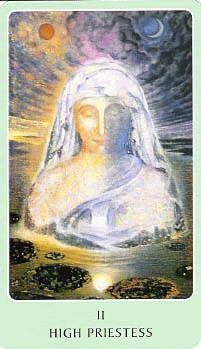
There are many variant Rider-Waites, each with its own Priestess, but this is my favourite...

I love the One World Priestess. She's the main reason I still have the deck. That's the Priestess under your skin, dividing your energies into details and coming up with more than you originally had.
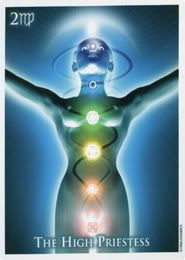
What I wrote about the Priestess in 2005
[NB: Since I wrote this I've been basically seeing Nemesis, veiled Nemesis, as a bridge between the Priestess and Justice. This precarious crossing is maintained by a fae personage whose name is(n't) Dras Ranatar. On this side of the bridge is Nemesis-As-Your-Special-Antiparticle-Who-Will-Destroy-You.
NB2, 08/2009: Whoever it is who keeps Googling after Dras Ranetar, don't bother - he's just one of the little spirits I know, and is not likely to get a mention anywhere on the internet except on this blog. He's one of those people you find at the crossroads of your soul, walking with you on the strange road on the other side of the veil, and if he's tired of slaying monsters with you it's because he wants to obsolete the entire problem and himself along with it. It's fucked up, but he's something of a father figure to me - the only one I have, really.]
The thing that struck me first about Amano's High Priestess is that, if I understand how this works at all, she's being symbolised by the sun. That's the other way round from what AE Waite has made us come to expect; the Priestess as moon and the Magician as sun, male and female strands of power coming from above and bringing us to, whatever Waite wanted to bring us to. This ain't that. This one's dancing in the daylight. It's a sweet reminder of the subjectivity and ethnocentricism, of such rigid approaches; the sun is red, not yellow, all Japanese children know that, and the sun is female rather than male. This is no moon-lady, but a Priestess as Amaterasu-o-mi-kami. Her veil is called Ama-no-Iwato and was made of solid stone, and there is no peaceful sea beyond it, but the mirror of Uzume, the dance of the dawn.
Years ago I used the Mythic deck, where the High Priestess was represented as Persephone. There is a quite clear parallel; Amaterasu is sunset rather than autumn, but her coming out of the cave she hid in, the return of the sun that it is, is celebrated on the winter solstice. (There's even a bit about eating the food of the dead, though that happened to her 'father's' spouse [also: his sister] in an earlier bit of the story. [which I wrote up here under Death]). The Priestess elements are there in both; division from the world, a barrier, a distorted reflection on the other side of it. Something else, something opposite.
The Fool will tell you that all is nothing, and the Magician will say that all is the same, but the Priestess will tell you that all has an opposite. For everything there is there is something else that cannot touch it, something that is separated from it by a veil.
And now let's do the tarot thing and turn it upside down and see the other lady in the other veil. She ain't pretty. I always used to assume that Nemesis was a function of Justice-reversed, but these days I definitely feel she's actually the other side of the Priestess. An inescapable part of life, yes, but born from divisions rather than from the wide swell of the tide; made from the subjective habits of individuals rather than the law of the flow. There's a beautiful moment near the end of the second half of Kill Bill where Bill speaks of what he did so many years ago as starting something inevitable - personal but inevitable, not revenge but the certainty of retribution. It does happen, on the whole, one way or another in the weave of the world; it isn't Justice, it's rarely 'fair', but there is a lady in a veil out there.
I had this Nemesis-Priestess thought a while ago, but reading Ronin (a 12th-century Zen myth, transcribed to novella in the 1960s by a western Zen nerd; it is the antidote to The Alchemist, if you've read that dear saccharine tome) just made it worse. It was when the Ronin said, to the vengeful young hero whose parents who he had so ruinously ruined, "Your father was a fool and your mother was a slut long before they met me" that I really got firmly attached to the idea. It's a wholly personal, wholly momentary matter. The world is made of Priestesses, after all, little lines between little patches of grey, and what can she do but act from one grey patch onto another?
Pollack associates the Priestess with camels for perfectly rational and theologically detailed reasons. This makes me giggle and throw rigidity to the five winds.
a later addition - here is a (slightly edited) clipping from an email I sent to Agla about Final Fantasy X, which riffed off the crap I wrote here. She wasn't so sure about Auron being the Priestess:
Oh, is he ever! There's the veil, over his mouth and his eyes. About the only time you can see his mouth when he talks is when he's calling out [...The Moon]. There's the positioning between life and death, between Spira and Zanarkand, between past and future, between sorrow and hope - and between Yuna's father and Tidus's father. There's his silences and secrets; he's in on everyone's world, trusted as everyone's guardian and advisor, but he will generally keep silence between people, and not pass secrets from one life to the next. And he's not intervening so much - like he said, whatever secrets he'd told them they'd've all ploughed on to Zanarkand anyway, and they were headed there long before he showed up. What he's doing is guiding them on their way, and THEN playing his hand. They're intervening for him more than vice versa - it's he who asks them to fight for sorrow, not the other way around.
The Chariot
blank eyes,
sunblind
all my strength, power and this,
to be stood at the axle,
these beasts that tug towards the shadows
stop-starting,
stutter
while I am stone
I am angry
I am the sun, the star of morning
I am the slowly-turning centre
And there is nought to do but wait and learn to be.
If only everything were as straightforward as the Chariot. I mean, you could draw it in 30 seconds in MS Paint. In fact, I think I will:
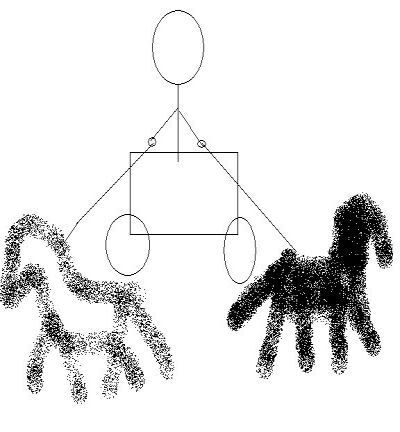
Guy in box on wheels, being pulled by two similar but different horses. That's it. Never varies. You can go home now.
...
Wait, this is a blog. Got to write about something.
So, guy in box. (More rarely, girl in box). That's generally you. The box on wheels is generally an ever-moving life that never stops, and which you can only control indirectly, with the reins which may or may not be in your hands, and if they're not they bloody should be. The Chariot is the deck's big green go button; either it takes you for a ride, or you're all dressed up with no place to go.
Would be easy if it weren't for the bloody horses. (Usually horses. Sphinxes, sometimes. I'd dearly love to see a Chariot drawn by two swans).
Since the RWS, there's always been a white one and a black one. Often they seem to be pulling in different directions, or maybe one of them isn't pulling at all, but if you could only get them both facing the right way and interested in moving forward then... Some just read the two differing horses as representing life's conflicting urges and responsibilities, but I go more specific; I think the white horse is all your conscious feelings, your settled plans, the things you understand and know about and want to have in your life. The black horse is everything else about you. The secrets you keep, the things you don't want to want, the truths you'll never see until years later, the dreams and forgotten things, and the things you don't yet know about yourself and your life. Nemesis lurks there, between the cracks. The gods guide the black horse along paths the white horse cannot see; sometimes it may reach the destination first, other times not at all.
To make them work together - now, that's something.
Images of the Chariot
A beautiful card from the Intuitive Tarot, one that pushes the horses to the border and focuses on the drive and power of the charioteer. He wears a solar mask, and holds not just the reins, but a morningstar; it's the white horse he seems to wish to castigate, and all...
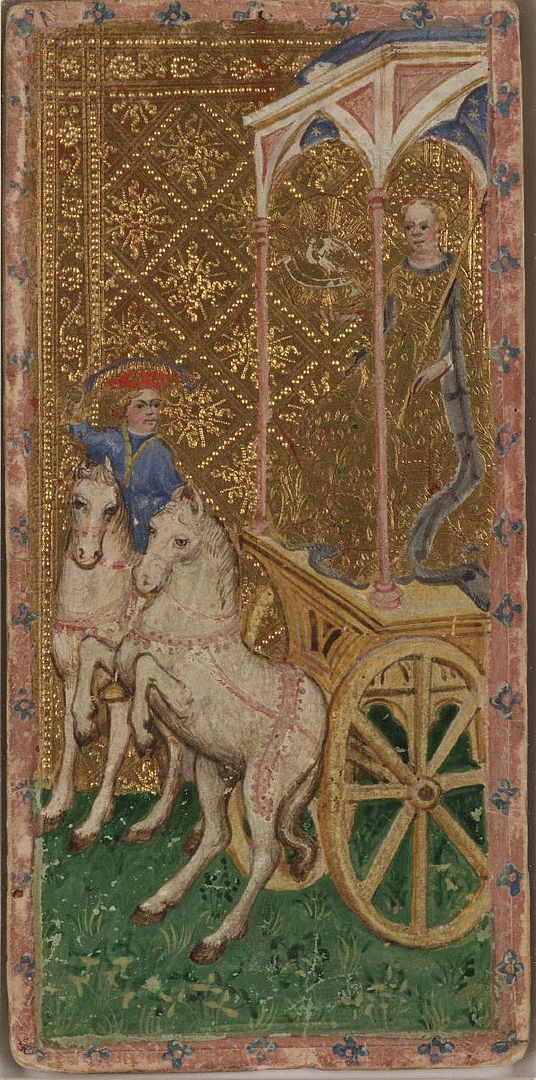
The Visconti-Sforza Chariot is drawn by one rearing horse, as a man comes by on another, more sedate horse, seemingly to greet the lady charioteer. Here the card's little psychodrama is out to socialise; the lady's horse is startled by the newcomer, but this unpredictable other seems to mean no harm.
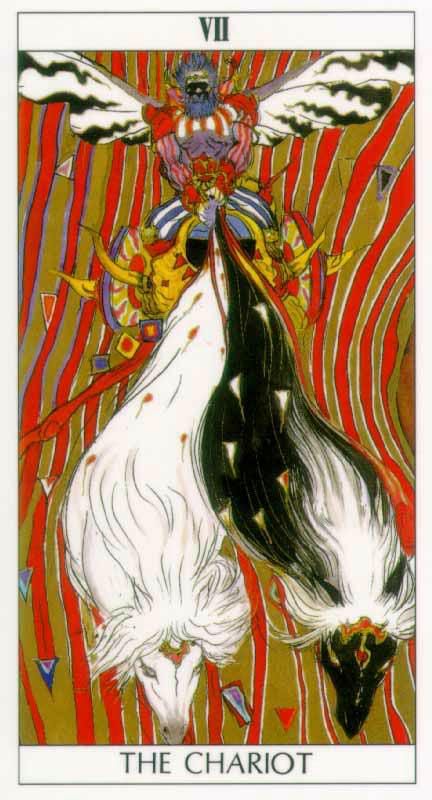
Amano's Chariot is fantastically energetic and flowing; the unnamable beasts that draw it are emanating from the charioteer's hands, but the black beast is already drawing away...
The Osho Zen Chariot is called Awareness, and is a lone breakaway from the guy-in-box-w/animals theme, instead showing a calm face, and a frightened shadow. This is progress, in Zen; to be aware in the moment, not a flailing shadow.
Now, a c/ped note from Agla, something she sent me back when I was playing Final Fantasy X:
What I wrote about the Chariot in 2005
Oh, the Chariot. Its first puzzle is quite a simple one; you look at it and you see the horses and you see the charioteer and you talk about who they are and what they do but the card is called the Chariot. Those other things, wills and words maybe, but what it's about is that chariot. It's often suggested that that means the outer person, but I don't think so, I think it means life. Something like that, like the steady thing inside that races over the face of time... I do know that last time I drew this card, reading for myself, I was very sure that the two horses were, to me then, myself and M.
So here you are standing within your own life. I suppose this is the seat of 'this one', then; the inescapable fact and responsibility of your life. You're in the Chariot; you can't get out of it and if you don't take the reins, no one will. If you don't try to move, or you don't try to control those horses, you're still the charioteer and you can't escape that role. No one is ever anyone other than themselves, and no one ever has control over any life but their own. So take the reins, because if you don't, no one else will.
This doesn't mean that there's only one direction, though - there is choice here, control here, we're past the Lovers now. See, the other thing about the Chariot is that there's two horses. This is one of those Chariot things that only clicked for me earlier this year - that those horses are, in the most literal sense I am capable of understanding it, a matter of yin and of yang. They are the two opposing currents of life, the bright and heady steel and lightning, and the soft and quiet night and water. The Chariot has its own silence, full of purpose and reality, its own stillness, stillness because it is time to be still; indeed, patience, true purposeful nothing, is a virtue of the Chariot more than anything else in the deck. And yes, Moondance K'Treva spoke for the Chariot. To say that a choice to do nothing is still a choice is a line straight from the black horse's mouth.
I've always been amused by the fact that Taoism maintains that black is more virtuous than white - but that's the Hierophant's business, not the Chariot's. The Chariot doesn't care. The Chariot has no moral compass; either horse or neither will do. They're just there, the two horses, the chariot, the charioteer, and what you do with them is up to you. But if you ignore any of them, it's at your peril.
And it's still called the Chariot. I think that's because of what Hagbard Celine said about only the trip being real. It's not solipsism, the tripper isn't even important - it's about the trip.
Also:
Close to the end of The Manual by the KLF (professional Discordians; shame about the terrible music and the racist music videos) comes this description of the Chariot:
sunblind
all my strength, power and this,
to be stood at the axle,
these beasts that tug towards the shadows
stop-starting,
stutter
while I am stone
I am angry
I am the sun, the star of morning
I am the slowly-turning centre
And there is nought to do but wait and learn to be.
If only everything were as straightforward as the Chariot. I mean, you could draw it in 30 seconds in MS Paint. In fact, I think I will:
Guy in box on wheels, being pulled by two similar but different horses. That's it. Never varies. You can go home now.
...
Wait, this is a blog. Got to write about something.
So, guy in box. (More rarely, girl in box). That's generally you. The box on wheels is generally an ever-moving life that never stops, and which you can only control indirectly, with the reins which may or may not be in your hands, and if they're not they bloody should be. The Chariot is the deck's big green go button; either it takes you for a ride, or you're all dressed up with no place to go.
Would be easy if it weren't for the bloody horses. (Usually horses. Sphinxes, sometimes. I'd dearly love to see a Chariot drawn by two swans).
Since the RWS, there's always been a white one and a black one. Often they seem to be pulling in different directions, or maybe one of them isn't pulling at all, but if you could only get them both facing the right way and interested in moving forward then... Some just read the two differing horses as representing life's conflicting urges and responsibilities, but I go more specific; I think the white horse is all your conscious feelings, your settled plans, the things you understand and know about and want to have in your life. The black horse is everything else about you. The secrets you keep, the things you don't want to want, the truths you'll never see until years later, the dreams and forgotten things, and the things you don't yet know about yourself and your life. Nemesis lurks there, between the cracks. The gods guide the black horse along paths the white horse cannot see; sometimes it may reach the destination first, other times not at all.
To make them work together - now, that's something.
Images of the Chariot
A beautiful card from the Intuitive Tarot, one that pushes the horses to the border and focuses on the drive and power of the charioteer. He wears a solar mask, and holds not just the reins, but a morningstar; it's the white horse he seems to wish to castigate, and all...
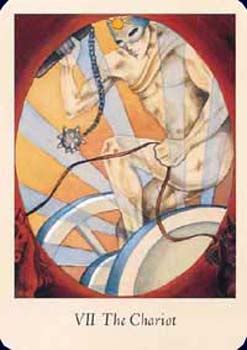
The Visconti-Sforza Chariot is drawn by one rearing horse, as a man comes by on another, more sedate horse, seemingly to greet the lady charioteer. Here the card's little psychodrama is out to socialise; the lady's horse is startled by the newcomer, but this unpredictable other seems to mean no harm.
Amano's Chariot is fantastically energetic and flowing; the unnamable beasts that draw it are emanating from the charioteer's hands, but the black beast is already drawing away...
The Osho Zen Chariot is called Awareness, and is a lone breakaway from the guy-in-box-w/animals theme, instead showing a calm face, and a frightened shadow. This is progress, in Zen; to be aware in the moment, not a flailing shadow.

Now, a c/ped note from Agla, something she sent me back when I was playing Final Fantasy X:
D'you see yet what I meant that time about Yuna being the Chariot? It's *her* pilgrimage-she's the reason for it, the centre. Ultimately, it's up to her when they stop and when they go. She's the only one that can make a Guardian of friend or stranger, and she's the only one who could chuck someone out of the party. It's because of Yuna's choice-a free choice no matter what her father did, nobody *made* her say 'I'll do what my dad did'-to be a summoner that they are on pilgrimage at all-however, she is very definitely not doing things just because of what she wants. She's being buffeted by the winds on the edge, tugged at by Duty and Desire. The Chariot is a bit of a paradox, I think-remember that in the Waite the charioteer does not hold the reins. Once it gets going you are not really in control of the situation, you're picking up speed, heading for you don't know what...Choices are being thrown at you, and you don't have much time to deliberate. You make a choice and follow it and find out what it means-often it means nothing like you thought it did. When one horse is dragging you to darkness and the other wrenching toward the light, making the chariot go where you will can be pretty darn impossible. Often it's all you can do not to crash.
What I wrote about the Chariot in 2005
Oh, the Chariot. Its first puzzle is quite a simple one; you look at it and you see the horses and you see the charioteer and you talk about who they are and what they do but the card is called the Chariot. Those other things, wills and words maybe, but what it's about is that chariot. It's often suggested that that means the outer person, but I don't think so, I think it means life. Something like that, like the steady thing inside that races over the face of time... I do know that last time I drew this card, reading for myself, I was very sure that the two horses were, to me then, myself and M.
So here you are standing within your own life. I suppose this is the seat of 'this one', then; the inescapable fact and responsibility of your life. You're in the Chariot; you can't get out of it and if you don't take the reins, no one will. If you don't try to move, or you don't try to control those horses, you're still the charioteer and you can't escape that role. No one is ever anyone other than themselves, and no one ever has control over any life but their own. So take the reins, because if you don't, no one else will.
This doesn't mean that there's only one direction, though - there is choice here, control here, we're past the Lovers now. See, the other thing about the Chariot is that there's two horses. This is one of those Chariot things that only clicked for me earlier this year - that those horses are, in the most literal sense I am capable of understanding it, a matter of yin and of yang. They are the two opposing currents of life, the bright and heady steel and lightning, and the soft and quiet night and water. The Chariot has its own silence, full of purpose and reality, its own stillness, stillness because it is time to be still; indeed, patience, true purposeful nothing, is a virtue of the Chariot more than anything else in the deck. And yes, Moondance K'Treva spoke for the Chariot. To say that a choice to do nothing is still a choice is a line straight from the black horse's mouth.
I've always been amused by the fact that Taoism maintains that black is more virtuous than white - but that's the Hierophant's business, not the Chariot's. The Chariot doesn't care. The Chariot has no moral compass; either horse or neither will do. They're just there, the two horses, the chariot, the charioteer, and what you do with them is up to you. But if you ignore any of them, it's at your peril.
And it's still called the Chariot. I think that's because of what Hagbard Celine said about only the trip being real. It's not solipsism, the tripper isn't even important - it's about the trip.
Also:
Close to the end of The Manual by the KLF (professional Discordians; shame about the terrible music and the racist music videos) comes this description of the Chariot:
Confusion.
What has all this got to do with you and our supposed concise instructions on how to make that last leap to pole position?
Everything.
Because it’s only through mastering the art of having complete control when you are at the same time totally out of control. You must hold the reigns tighter than you have ever held them before but let the chariot head over the cliff top. The abyss is calling.
Strength: A Guest Post
It's not you
It's not me
It is what I do
With my hands
And my heart
It's what I do to you.
[Strength trades under several names - Fortitude, Force, Lust - but remains the same. It also stumped me, and I kept derailing myself over it; head caught in images like that bit at the end of Wintersmith ("You are asking me to tell you how to put your hand in the lion's mouth"), or my idea of Metal Gear and its lion of military technology. So I whined to Agla about it, and she delivered. Over to her!]
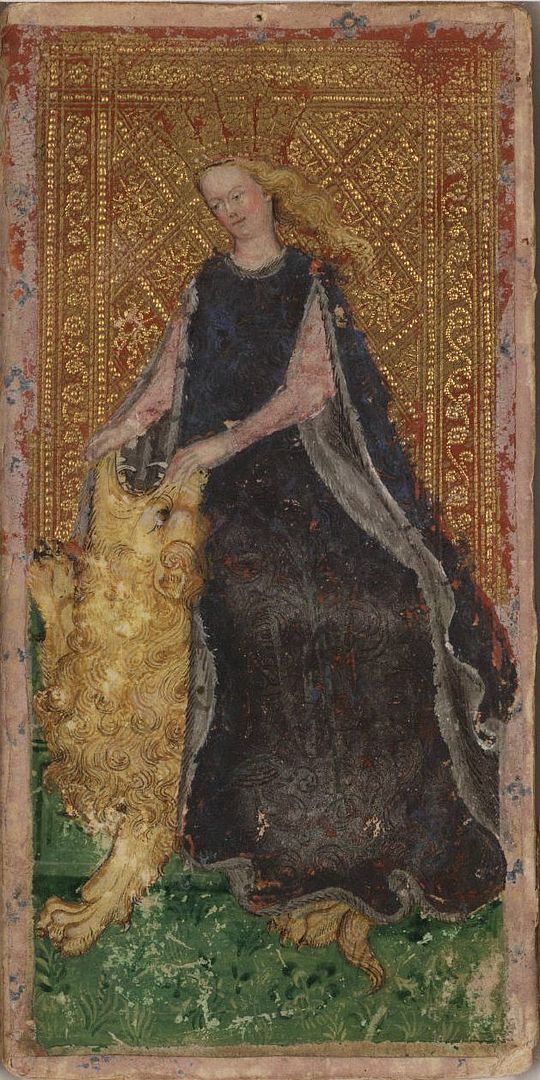
The first versions of the Strength card had muscular 'heroes' killing lions on. Pollack mentions this, and shows a pic of an old Strength that has Hercules and the Nemean Lion on. But then this one deck-the Visconti-Sforza-changed that. It showed a lion being held steady, tamed; not by a strongman, but by a woman. Demurely dressed, solemn faced, cool as cucumber. And that image somehow became the standard. It sparked everyone's imaginations.
The Hercules card was about brute strength and dominating force. The woman with her lion is about inner strength, strength through gentleness, softness, warmth. Those things all sound harmless, but they aren't. You told me a story once, about how a tyrant was brought down by a dancing girl? [Yes. Diaochan]. She flirted with him and his second-in-command, and they quarrelled over her, and ended up killing each other. They'd withstood any number of battles, but they couldn't stand up to the girl.
The lion's always quite clearly the submissive one. He's got the claws and the teeth, but the girl's bossing him about, and he seems just fine with this situation! Old Jack now, he said some stuff about how the passions benefit from being mastered by the will. Let them have free reign and they just tend to burn themselves out. I've told you this before, but I think one of the most perfect expressions of Strength I've yet seen was in Spirited Away. Haku in his dragon form has gone wild because of a spell put on him. He's thrashing about-Miyazaki used the realworld sight of a trapped eel for animation reference for this-bashing into things, snarling, causing all kinds of ruckus. He's crazy with pain and anger and seriously dangerous to anyone in his vicinity. And then along comes Chihiro, with the medicine the river spirit gave her. She approaches him-she's scared, nervous. But she calms herself, and she speaks to him soft but firm, and she puts her arm into his mouth to give him the medicine and she makes him swallow it. The girl mastered the dragon to save him. If she hadn't given him the medicine, he'd have gone on to destroy everything he could get to, willy-nilly, before dying in pain.
The girl is the boss but I've never seen her hurting the lion. Her body language is always 'firm but kind', never dominating. That first Visconti-Sforza card had a modest gentlewoman on it. Modern decks tend toward wilder looking girls. A lot of the time they're in exotic, revealing costumes, or plain naked. The girl who tames lions has been punked up since she first appeared. But I have never seen her armed. She never carries a weapon; she doesn't need one.
Besides, a weapon wouldn't be any use to her anyway. What good does a knife in the hand of a girl do, against a full-grown lion? If she started a fight, she would lose. The lion is all passions, all power. It's basic psychology that repressing things never really works. Whatever it is is still lurking in your subconcious, and at every opportunity it gets it'll come back and bite you. You have to accept stuff, and that's harder than it sounds. You have to walk into the lion's den naked and unarmed. You have to tame the beast with kindness. Bring it into the light.
At this point it's worth mentioning the Crowley-version of this card-Lust. I first met her via Promethea. In that card, the girl has lost control; the lion's the one directing her. It's sort of like a reversed version of Strength, I suppose. Lust has a cup of wine in her hand, she's drunk as a lord. Another indicator that her will is no longer ruling her passions. I don't know what Crowley thought about this-never studied his magics enough to-but to me it looks like an unsustainable situation. Sooner or later, she's gonna get savaged.
The Strength you showed me was looking up towards the corner of the picture, and the lion was looking with her-looking up at a bright light. She was astride it if I recall correctly, and they seemed totally in harmony. Maybe this version of the card, and Crowley's Lust, are both continuations of what's happening in the ordinary Strength. You can go one of two ways. You can lose the control, fall off the lion, let your passions rule you again. Or you can persist, and move forward into...what? I don't know. Some bright light...
Images of Strength:
[me again]
Here's the Visconti-Sforza. She's not changed much since then - she doesn't have to. The RWS put a leminscate above her head and everything. Few decks seem to break the basic pattern; girl, lion, clear indication if which of the two is on top. (The Mythic Tarot is the only one I've seen that has a male strength, a Hercules. I'd be interested to see Strength as Samson or Daniel, but I've not done so yet).
Most often the girl has her hands in the lion's mouth; Crowley put the girl on the lion's back, and renamed the card 'Lust'. The Intuitive card keeps that posture.
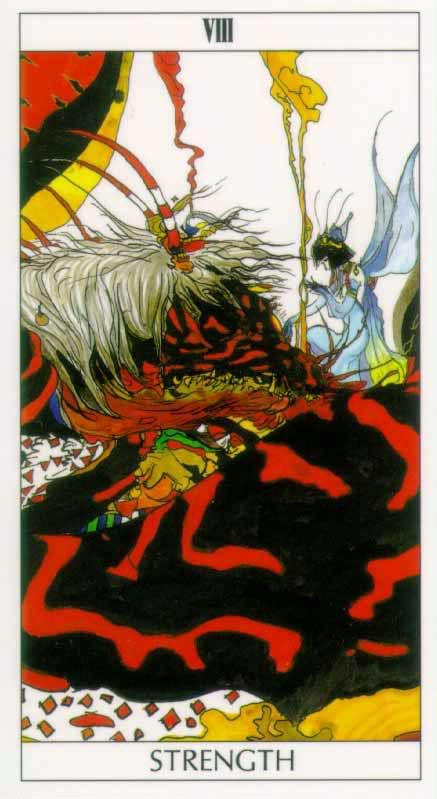
Amano puts his own spin on it; a fairy talking to a dragon. Most woman-lion pictures, from the Visconti on down, gloss over the difference in size and raw power between the two figures - we're expected to understand the lion symbolically, even if the image doesn't draw out his size and his savagery. Amano's fairy is no larger than the horns on the dragon's head, and his jaws could easily snap her up whole, and yet she strokes his head as he sleeps.
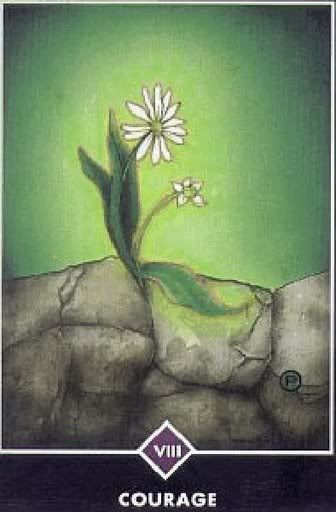
The Osho-Zen deck calls the card Courage. Very much an image of gentle life-force overcoming hard defences.
It's not me
It is what I do
With my hands
And my heart
It's what I do to you.
[Strength trades under several names - Fortitude, Force, Lust - but remains the same. It also stumped me, and I kept derailing myself over it; head caught in images like that bit at the end of Wintersmith ("You are asking me to tell you how to put your hand in the lion's mouth"), or my idea of Metal Gear and its lion of military technology. So I whined to Agla about it, and she delivered. Over to her!]
The first versions of the Strength card had muscular 'heroes' killing lions on. Pollack mentions this, and shows a pic of an old Strength that has Hercules and the Nemean Lion on. But then this one deck-the Visconti-Sforza-changed that. It showed a lion being held steady, tamed; not by a strongman, but by a woman. Demurely dressed, solemn faced, cool as cucumber. And that image somehow became the standard. It sparked everyone's imaginations.
The Hercules card was about brute strength and dominating force. The woman with her lion is about inner strength, strength through gentleness, softness, warmth. Those things all sound harmless, but they aren't. You told me a story once, about how a tyrant was brought down by a dancing girl? [Yes. Diaochan]. She flirted with him and his second-in-command, and they quarrelled over her, and ended up killing each other. They'd withstood any number of battles, but they couldn't stand up to the girl.
The lion's always quite clearly the submissive one. He's got the claws and the teeth, but the girl's bossing him about, and he seems just fine with this situation! Old Jack now, he said some stuff about how the passions benefit from being mastered by the will. Let them have free reign and they just tend to burn themselves out. I've told you this before, but I think one of the most perfect expressions of Strength I've yet seen was in Spirited Away. Haku in his dragon form has gone wild because of a spell put on him. He's thrashing about-Miyazaki used the realworld sight of a trapped eel for animation reference for this-bashing into things, snarling, causing all kinds of ruckus. He's crazy with pain and anger and seriously dangerous to anyone in his vicinity. And then along comes Chihiro, with the medicine the river spirit gave her. She approaches him-she's scared, nervous. But she calms herself, and she speaks to him soft but firm, and she puts her arm into his mouth to give him the medicine and she makes him swallow it. The girl mastered the dragon to save him. If she hadn't given him the medicine, he'd have gone on to destroy everything he could get to, willy-nilly, before dying in pain.
The girl is the boss but I've never seen her hurting the lion. Her body language is always 'firm but kind', never dominating. That first Visconti-Sforza card had a modest gentlewoman on it. Modern decks tend toward wilder looking girls. A lot of the time they're in exotic, revealing costumes, or plain naked. The girl who tames lions has been punked up since she first appeared. But I have never seen her armed. She never carries a weapon; she doesn't need one.
Besides, a weapon wouldn't be any use to her anyway. What good does a knife in the hand of a girl do, against a full-grown lion? If she started a fight, she would lose. The lion is all passions, all power. It's basic psychology that repressing things never really works. Whatever it is is still lurking in your subconcious, and at every opportunity it gets it'll come back and bite you. You have to accept stuff, and that's harder than it sounds. You have to walk into the lion's den naked and unarmed. You have to tame the beast with kindness. Bring it into the light.
At this point it's worth mentioning the Crowley-version of this card-Lust. I first met her via Promethea. In that card, the girl has lost control; the lion's the one directing her. It's sort of like a reversed version of Strength, I suppose. Lust has a cup of wine in her hand, she's drunk as a lord. Another indicator that her will is no longer ruling her passions. I don't know what Crowley thought about this-never studied his magics enough to-but to me it looks like an unsustainable situation. Sooner or later, she's gonna get savaged.
The Strength you showed me was looking up towards the corner of the picture, and the lion was looking with her-looking up at a bright light. She was astride it if I recall correctly, and they seemed totally in harmony. Maybe this version of the card, and Crowley's Lust, are both continuations of what's happening in the ordinary Strength. You can go one of two ways. You can lose the control, fall off the lion, let your passions rule you again. Or you can persist, and move forward into...what? I don't know. Some bright light...
Images of Strength:
[me again]
Here's the Visconti-Sforza. She's not changed much since then - she doesn't have to. The RWS put a leminscate above her head and everything. Few decks seem to break the basic pattern; girl, lion, clear indication if which of the two is on top. (The Mythic Tarot is the only one I've seen that has a male strength, a Hercules. I'd be interested to see Strength as Samson or Daniel, but I've not done so yet).
Most often the girl has her hands in the lion's mouth; Crowley put the girl on the lion's back, and renamed the card 'Lust'. The Intuitive card keeps that posture.

Amano puts his own spin on it; a fairy talking to a dragon. Most woman-lion pictures, from the Visconti on down, gloss over the difference in size and raw power between the two figures - we're expected to understand the lion symbolically, even if the image doesn't draw out his size and his savagery. Amano's fairy is no larger than the horns on the dragon's head, and his jaws could easily snap her up whole, and yet she strokes his head as he sleeps.
The Osho-Zen deck calls the card Courage. Very much an image of gentle life-force overcoming hard defences.
Subscribe to:
Posts (Atom)