
So, I'm working on this site again, thanks to Agla's prodding - I've done a couple more card entries up in the last few days, and I hope to do another later tonight. But. I draw cards for these musings in threes, and these threes tell interlinked stories. I had the Empress, the Eight of Wands and the Six of Pentacles two days ago, and the Four of Cups, the Knight of Cups and the Six of Pentacles yesterday.
Yep, recurrence, and you know why? Christmas.
I can rarely do much for Christmas, but this year I can't do anything. I'm in a strange place, my immigration paperwork has been delayed due to an RFI, I have no money, little basic liberty, and feel like I have contributed almost nothing to the story of the world in the last year. This sucks because I like giving people things, and as soon as I have any cash I'll likely throw all of it into sending parcels to my siblings and my friends - but that ain't now, and the calendar is running faster than I could keep up with. The Six of Pentacles is the good you get from giving. Not just the warm, fuzzy feeling, but the contribution you've made to someone else's story.
I look around me and see the other people in my life; a wooden snake Agla gave me, the running shoes my sister got me last Christmas, letters from the blue one and the sparkly one, a book that the green one gave to me. Pieces of others, but nurtured by the use I put them to; a book is just a bit of dead treeflesh until you open it and learn its secrets, find how to use them. The shoes are worn to my feet, and I run in them daily; they're my life, and I love them.
Somehow the frustration and the need to be with these people again has stopped me replying to the letters - something that would be very possible becomes hard, because of the distortion of the Six of Pentacles. And what is there here for me? The Four of Cups, sighing into his hand, and that knight, who seems to urge patience and reassessment. Of the previous lot, the Empress is the earth and her hateful expanse of distance, and the Eight of Wands is what I am, what I do, where I've been.
I am not happy, but I might be if I can find ways to give back.

Index
All cards / Latest Cards / All other posts / Notes from Agla
Major Arcana / Minor Arcana / Court Cards
Wands / Pentacles / Cups / Swords
(For a list of all card articles, open March 2008 on the sidebar).
Showing posts with label cups. Show all posts
Showing posts with label cups. Show all posts
Sunday, 30 November 2008

Thursday, 6 March 2008
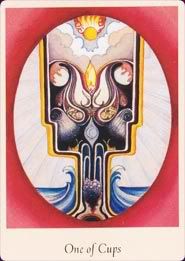
Ace Of Cups
inside this vessel, everything
the close-packed chaos that I am
the flames, the flowers
the sun and moon
the stones and snails
the clouds and things unborn within
my world inside an open cup
that floats upon the sea
which is just water.
everything within, but outside:
water.
Another draw, another Ace. And this is unlike any I've seen before; it's going to take more time than this, and I guess a dig around Conway's writings, to understand what she was getting at, but it does chime with something I learned a long time ago:
Water is everywhere.
You, every tree, every other living thing, is mostly water. And water cycles - the water that composes such a large proportion of your body mass was elsewhere not long ago - you breathe in water that other people have breathed out, you drink water that was once rain, or came from a river with its source in the glaciers, and as you bathe in the sea, the water stings your eyes and runs over your skin. The sun will bring that water out, take it from your skin, turn it into thunder. Water is the primary way your body interacts with the rest of the world. If you give any credence to the idea of beingness, just to say that everything is what it is, then this interaction can be called a form of communication.
(I was shown this by a tree I sat beneath, a tree that took ground water through its roots far below me).
That is physical water; element water runs below matter and below meaning, finding form in both. If you believe that; if that's the language you speak to the world in. The language of water is best recorded in the Tao Te Ching, where it is said that it is good to be like water, because water can wear down the hardest wall. (And that comes from China's five-element system of water, earth, wood, metal and fire).
Conway's Ace of Cups stands on a still sea, but its sides are lapped by water; it is when we build barriers that the water seems hard, and cannot flow. Would that life inside the glass be so tumultuous if it were exposed to the gentle currents? Or would the storm within expand to cover the whole sea?
When the Ace of Cups comes, best to go with the flow - the flow of language and feelings. Best to let what is inside flow out, and let what is outside flow in.
Images of the Ace of Cups:
The Intuitive thingy which I was just looking at.
The Osho Zen thing which says what I just said.
Scapini's fountain of life.
The Roots of Asia: it is not and cannot be what Water looks like, but it is close to how I choose to envision it - coming from below, supporting the night and the world with itself.
the close-packed chaos that I am
the flames, the flowers
the sun and moon
the stones and snails
the clouds and things unborn within
my world inside an open cup
that floats upon the sea
which is just water.
everything within, but outside:
water.
Another draw, another Ace. And this is unlike any I've seen before; it's going to take more time than this, and I guess a dig around Conway's writings, to understand what she was getting at, but it does chime with something I learned a long time ago:
Water is everywhere.
You, every tree, every other living thing, is mostly water. And water cycles - the water that composes such a large proportion of your body mass was elsewhere not long ago - you breathe in water that other people have breathed out, you drink water that was once rain, or came from a river with its source in the glaciers, and as you bathe in the sea, the water stings your eyes and runs over your skin. The sun will bring that water out, take it from your skin, turn it into thunder. Water is the primary way your body interacts with the rest of the world. If you give any credence to the idea of beingness, just to say that everything is what it is, then this interaction can be called a form of communication.
(I was shown this by a tree I sat beneath, a tree that took ground water through its roots far below me).
That is physical water; element water runs below matter and below meaning, finding form in both. If you believe that; if that's the language you speak to the world in. The language of water is best recorded in the Tao Te Ching, where it is said that it is good to be like water, because water can wear down the hardest wall. (And that comes from China's five-element system of water, earth, wood, metal and fire).
Conway's Ace of Cups stands on a still sea, but its sides are lapped by water; it is when we build barriers that the water seems hard, and cannot flow. Would that life inside the glass be so tumultuous if it were exposed to the gentle currents? Or would the storm within expand to cover the whole sea?
When the Ace of Cups comes, best to go with the flow - the flow of language and feelings. Best to let what is inside flow out, and let what is outside flow in.
Images of the Ace of Cups:
The Intuitive thingy which I was just looking at.
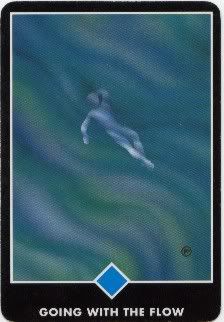
The Osho Zen thing which says what I just said.
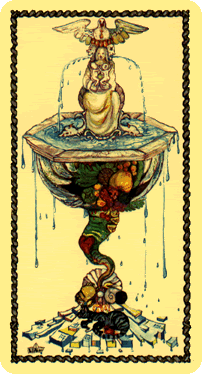
Scapini's fountain of life.
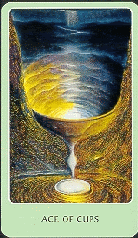
The Roots of Asia: it is not and cannot be what Water looks like, but it is close to how I choose to envision it - coming from below, supporting the night and the world with itself.
Two Of Cups
When one cup overflows into another
the river runs into the sea
it cannot return to its home in the mountain
purge its heart of salt,
for one and one make two
not indivisible, but altered
and to take the cup and draw out one grape, one vine
to have the oceans and take away one teardrop?
(Everything has happened before
and it will all happen again).
Some people get panicky, fatalistic and/or irritated when they see Death, the Devil or the Tower in a reading. I don't, but I have been known to react that way to the Two of Cups. This is partly because of the relentless heteronormativity, something it shares with the Ten of Cups. But I guess it's mostly because of the irrevocable nature of a meeting between two open hearts. What to do, where water meets water and everything changes? (Build a Thermocline Transducer? Bite me.)
So this is an encounter; this is a strange new current. I'm reminded of a line from Les Miserables (part 4, book 8, ch V): It seemed as if they so mingled their souls, that if they had desired to take them back again, it would have been impossible to identify them. 'This one is mine.' 'No, it is mine.' 'I assure you that you are mistaken. It is really I.' 'What you take for you, is I.' Somehow the vines in the picture made me think of that process of entwining and trying to draw out what there was in the beginning, but with the river that flows into the sea, it's even harder than that. The trick is to not fucking try to unravel it, but to enjoy it, mm?
Images of the Two of Cups
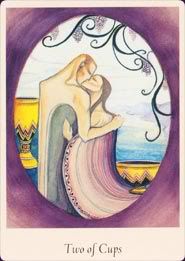
Conway's pictured a couple kissing on a beach; the beach was also the setting for the Page of Cups, while the King was deep under sea. There's the sense of this element drawing you deeper and deeper in.
The Scapini deck has the kissing couple, yes, and it also has a caduceus and a lion. It's the lion that sets me off, with the irreversibility; I can't help but think of Atalanta the Huntress, transformed into a lion for loving the right person in the wrong place, but that's another element entirely.
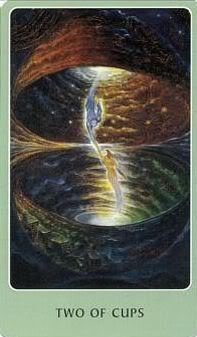
The Two of Cups from the Roots of Asia, flowing and fragile, is possibly the most beautiful card in any deck ever.
the river runs into the sea
it cannot return to its home in the mountain
purge its heart of salt,
for one and one make two
not indivisible, but altered
and to take the cup and draw out one grape, one vine
to have the oceans and take away one teardrop?
(Everything has happened before
and it will all happen again).
Some people get panicky, fatalistic and/or irritated when they see Death, the Devil or the Tower in a reading. I don't, but I have been known to react that way to the Two of Cups. This is partly because of the relentless heteronormativity, something it shares with the Ten of Cups. But I guess it's mostly because of the irrevocable nature of a meeting between two open hearts. What to do, where water meets water and everything changes? (Build a Thermocline Transducer? Bite me.)
So this is an encounter; this is a strange new current. I'm reminded of a line from Les Miserables (part 4, book 8, ch V): It seemed as if they so mingled their souls, that if they had desired to take them back again, it would have been impossible to identify them. 'This one is mine.' 'No, it is mine.' 'I assure you that you are mistaken. It is really I.' 'What you take for you, is I.' Somehow the vines in the picture made me think of that process of entwining and trying to draw out what there was in the beginning, but with the river that flows into the sea, it's even harder than that. The trick is to not fucking try to unravel it, but to enjoy it, mm?
Images of the Two of Cups
Conway's pictured a couple kissing on a beach; the beach was also the setting for the Page of Cups, while the King was deep under sea. There's the sense of this element drawing you deeper and deeper in.
The Scapini deck has the kissing couple, yes, and it also has a caduceus and a lion. It's the lion that sets me off, with the irreversibility; I can't help but think of Atalanta the Huntress, transformed into a lion for loving the right person in the wrong place, but that's another element entirely.

The Two of Cups from the Roots of Asia, flowing and fragile, is possibly the most beautiful card in any deck ever.
Three Of Cups
and we all come from the same place
the same rope, unravelled, reknotting
caught in the same stream
running to the same sea
and twisting together
and dancing,
with arms stretched to the same sky
hoping to catch the same water
we are not one
but we are three.
I've never thought of it like this before, but as I wrote that I distinctly thought of the Unholy Triumvirate. For those who do not know us; we are three, give or take, and we have a place and a togetherness, and most of all, we have stories. Some are about summertimes; some are about tramping around in the mud in Epping Forest; some are about warm afternoons in town, or weekends flomped at home with videogames and endless cups of tea; some are about coping with disasters, or arguing with each other; many only exist in the space between us - making birthday cakes for imaginary friends, sharing writing, and riffing off years of built-up injokes. We come and go with each other - but I just moved across an ocean, and that's a difficult spot to work back from.
And this picture - three abstract figures, weaving about each other, in the sky, before the waters.
It's traditionally a card of celebration, often formal celebration - right now I'm feeling the force of that threeness, with its containedness, its shape. The Three of Cups has intent - they're never figures thrown together at random, or in conflict, as in many other cards; they have decided to dance together as one, and raise their chalices together. The figures are usually all female, and the card often hints at the purpose of the gathering, but neither of these things are fixed in stone; they flow in water, and may take any route to reach the sea.
This card is a reminder that it is party time if someone says it is party time. That's all it takes.
Images of the Three of Cups:
The RWS ladies (image from the Universal Waite). They're arranged in a formal-looking dance; judging from the fruits on the ground, they dance for the harvest. Each has a different hair colour - knowing the RWS, that probably hints that the people who come together to make the Three of Cups the happy place that it is are and have to be of a great variety of elements. If they were all the same, it'd be more of a circle jerk than a dance.
Celebration from the Osho Zen. It's raining, and there is cherry blossom falling, and they are happy and dancing; it's a deliberate talkback to the RWS image, saying that there doesn't have to be a fixed celebration, a collection of balanced ingredients, a laid-out set of steps or even a sunny day; celebration is wherever you make it, in any weather, with whoever is there.
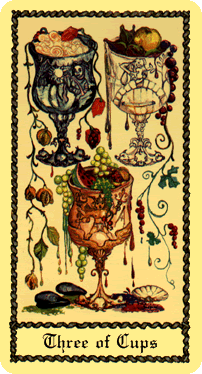
A pip card from the Scapinis - bountiful, varied and overflowing.
the same rope, unravelled, reknotting
caught in the same stream
running to the same sea
and twisting together
and dancing,
with arms stretched to the same sky
hoping to catch the same water
we are not one
but we are three.
I've never thought of it like this before, but as I wrote that I distinctly thought of the Unholy Triumvirate. For those who do not know us; we are three, give or take, and we have a place and a togetherness, and most of all, we have stories. Some are about summertimes; some are about tramping around in the mud in Epping Forest; some are about warm afternoons in town, or weekends flomped at home with videogames and endless cups of tea; some are about coping with disasters, or arguing with each other; many only exist in the space between us - making birthday cakes for imaginary friends, sharing writing, and riffing off years of built-up injokes. We come and go with each other - but I just moved across an ocean, and that's a difficult spot to work back from.
And this picture - three abstract figures, weaving about each other, in the sky, before the waters.
It's traditionally a card of celebration, often formal celebration - right now I'm feeling the force of that threeness, with its containedness, its shape. The Three of Cups has intent - they're never figures thrown together at random, or in conflict, as in many other cards; they have decided to dance together as one, and raise their chalices together. The figures are usually all female, and the card often hints at the purpose of the gathering, but neither of these things are fixed in stone; they flow in water, and may take any route to reach the sea.
This card is a reminder that it is party time if someone says it is party time. That's all it takes.
Images of the Three of Cups:
The RWS ladies (image from the Universal Waite). They're arranged in a formal-looking dance; judging from the fruits on the ground, they dance for the harvest. Each has a different hair colour - knowing the RWS, that probably hints that the people who come together to make the Three of Cups the happy place that it is are and have to be of a great variety of elements. If they were all the same, it'd be more of a circle jerk than a dance.
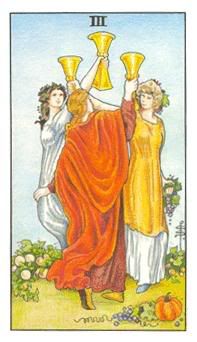
Celebration from the Osho Zen. It's raining, and there is cherry blossom falling, and they are happy and dancing; it's a deliberate talkback to the RWS image, saying that there doesn't have to be a fixed celebration, a collection of balanced ingredients, a laid-out set of steps or even a sunny day; celebration is wherever you make it, in any weather, with whoever is there.

A pip card from the Scapinis - bountiful, varied and overflowing.
Four Of Cups
Never mind the sunrise
Never mind the river-song, the empty sky, the flock.
Never mind how full life is, how bright the day, how full the flow.
I look upon an empty place
I am where blood spills on the earth
I have lost; what is your world to me?
A drop, once spilt, will not return if I look up or I look to the dawn.
The Four of Cups is never satisfied. Like fours everywhere, it has discovered form, and water has no shape other than that of the vessel it is poured into; and water moves in cycles, and cannot be kept in one place forever.
Fours of Cups differ, but tend to have three full vessels and one empty one - sometimes poured away, sometimes thirsting to be filled. No form can hold the entirety of your feelings and language. Write a poem, and you have a vessel, but you can only hope that this vessel can hold your feelings - perhaps by tomorrow, or by the time you show the poem to your friend, it will be empty again.
This card is discontent, clearly because it does not appreciate its full glasses, or the boundless flow which has filled them and will fill them again. There was a time when I was 'well, duh' about this card's situation, thinking it should just turn to the river, but...loss is loss. This card is mourning - for some feeling put into a form which has now shattered. Or perhaps for a glass crafted with such care, never to be filled.
There are layers of lessons here, but there is a time to disregard all of them. Yes, be grateful for what you have. Yes, trust the world to give you more and more to feel, to say, to express, to love. Yes, you shouldn't obsess over what you don't have, or no longer have. But damnit, there's a time for this. It's not the whole deck, is it? It's just the bit between the Three of Cups and the Five of Cups. It is a moment when, because your words and feelings have taken form, you find there's not enough, or that what may be brought by the rushing river is nothing compared to what you have lost. Yeah, I'm sure you can be a super-aware thing and see what is in each glass as non-individual, as simply water rather than this water in this cup, but the world is not like that; we have, we hold, and we lose, because cups break and water flows away.
Water is tears.
Images of the Four of Cups:
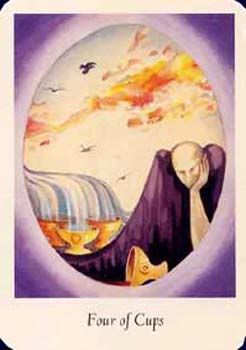
From the Intuitive Tarot.
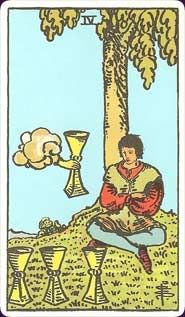
The RWS shows a thoughtful chappie who has, but who lets a dreamlike hand tempt him with more.
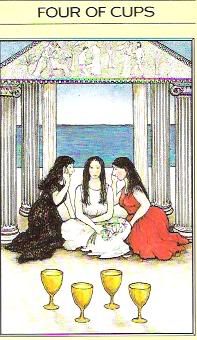
In the Mythic Tarot, the Cups tell the story of Psyche's love for the god Eros. Here her sisters persuade her that she must do what her new husband has forbidden her to do - look upon him. On the one hand, this was a really bad idea which they pushed on her to deliberately sabotage the marriage. On the other hand, it was a damn stupid rule which was crying out to be broken. Such is discontentment; it's a perfectly valid feeling, but giving into it can lead to bad things.
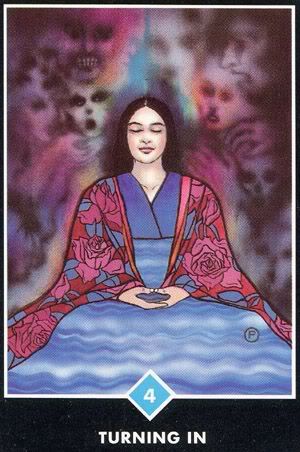
'Turning In' from the Osho Zen is an antidote to other Fours of Cups. It asks you to be aware of yourself rather than being frustrated by the world and its empty vessels and emptier promises.
Never mind the river-song, the empty sky, the flock.
Never mind how full life is, how bright the day, how full the flow.
I look upon an empty place
I am where blood spills on the earth
I have lost; what is your world to me?
A drop, once spilt, will not return if I look up or I look to the dawn.
The Four of Cups is never satisfied. Like fours everywhere, it has discovered form, and water has no shape other than that of the vessel it is poured into; and water moves in cycles, and cannot be kept in one place forever.
Fours of Cups differ, but tend to have three full vessels and one empty one - sometimes poured away, sometimes thirsting to be filled. No form can hold the entirety of your feelings and language. Write a poem, and you have a vessel, but you can only hope that this vessel can hold your feelings - perhaps by tomorrow, or by the time you show the poem to your friend, it will be empty again.
This card is discontent, clearly because it does not appreciate its full glasses, or the boundless flow which has filled them and will fill them again. There was a time when I was 'well, duh' about this card's situation, thinking it should just turn to the river, but...loss is loss. This card is mourning - for some feeling put into a form which has now shattered. Or perhaps for a glass crafted with such care, never to be filled.
There are layers of lessons here, but there is a time to disregard all of them. Yes, be grateful for what you have. Yes, trust the world to give you more and more to feel, to say, to express, to love. Yes, you shouldn't obsess over what you don't have, or no longer have. But damnit, there's a time for this. It's not the whole deck, is it? It's just the bit between the Three of Cups and the Five of Cups. It is a moment when, because your words and feelings have taken form, you find there's not enough, or that what may be brought by the rushing river is nothing compared to what you have lost. Yeah, I'm sure you can be a super-aware thing and see what is in each glass as non-individual, as simply water rather than this water in this cup, but the world is not like that; we have, we hold, and we lose, because cups break and water flows away.
Water is tears.
Images of the Four of Cups:
From the Intuitive Tarot.
The RWS shows a thoughtful chappie who has, but who lets a dreamlike hand tempt him with more.
In the Mythic Tarot, the Cups tell the story of Psyche's love for the god Eros. Here her sisters persuade her that she must do what her new husband has forbidden her to do - look upon him. On the one hand, this was a really bad idea which they pushed on her to deliberately sabotage the marriage. On the other hand, it was a damn stupid rule which was crying out to be broken. Such is discontentment; it's a perfectly valid feeling, but giving into it can lead to bad things.
'Turning In' from the Osho Zen is an antidote to other Fours of Cups. It asks you to be aware of yourself rather than being frustrated by the world and its empty vessels and emptier promises.
Five Of Cups
Out brief candle.
Out, and dripping waxen, heavy,
molten,
losing shape
swirling into something else.
It is behind me now.
I don't know how it changes
emptying,
waxing waning
colours run away in the storm.
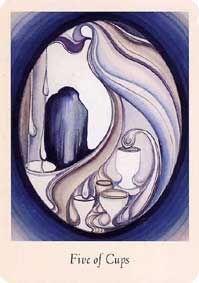
I confess, it occurred to me when I was writing about the Four of Cups that Conway's image shared a few features with many Fives of Cups; the dark-robed character, the disappointed look while he dwells on what has spilt. I think the difference here, in this washed-out, melting landscape, is time. It always is, with the Fives. He's turned away; some cups are still filling with droplets of...nothing, and some are barely there, between the curves of the image. This guy is sore about the past, but he's not paying much attention to the future either. The Four of Cups wanted something it had lost, or never had; the Five of Cups just wants to be left alone.
How did this happen? I think the Five tends to blame the Four for getting it into this. But again; time. Time as water, washing away the things that used to matter, leaving you feeling like this card looks - grey, confused and not sure where to go. I felt the Five of Cups most keenly in the days after I finished university; I had a stack of projects and pleasures I'd kept putting off til I'd finished - books to read, games to play, things to do - and suddenly time had moved on and given me endless empty hours to do those things in...and I didn't want to; none of it seemed worth a damn any more, because the past had gone and I didn't know what I was going to do with the future.
(Hint: I still don't.)
Images of the Five of Cups:
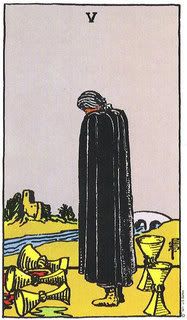
The RWS. Funny, it's really only because of this card that you can tell the black shape in the Intuitive card is even human.
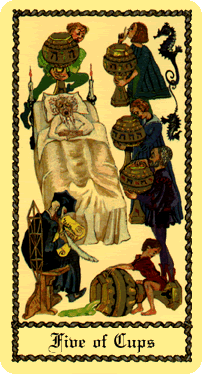
A weird scene from Scapini: my reading of it is that the central character is dying and the other five are busy carrying away her wealth while she yet breathes; one has spilt their cup already. One is crying into hers, piously - maybe she's really sad, but she could just be weeping to justify the gain she's making from the sadness. In other words, I think Scapini's Five of Cup is a card of emotional looting; of wanking over drama; of emotional greed, and disrespect for what is felt in the moment, good or bad. It is vultures come to take a drink.
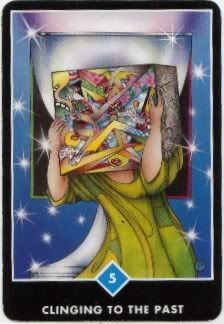
The Osho Zen is pretty upfront: Clinging To The Past. The same theme's brought out in the RWS, where the sad figure keeps looking to the left, and so never sees that though three cups are split, to his right there are two which are yet full to the brim.
Out, and dripping waxen, heavy,
molten,
losing shape
swirling into something else.
It is behind me now.
I don't know how it changes
emptying,
waxing waning
colours run away in the storm.
I confess, it occurred to me when I was writing about the Four of Cups that Conway's image shared a few features with many Fives of Cups; the dark-robed character, the disappointed look while he dwells on what has spilt. I think the difference here, in this washed-out, melting landscape, is time. It always is, with the Fives. He's turned away; some cups are still filling with droplets of...nothing, and some are barely there, between the curves of the image. This guy is sore about the past, but he's not paying much attention to the future either. The Four of Cups wanted something it had lost, or never had; the Five of Cups just wants to be left alone.
How did this happen? I think the Five tends to blame the Four for getting it into this. But again; time. Time as water, washing away the things that used to matter, leaving you feeling like this card looks - grey, confused and not sure where to go. I felt the Five of Cups most keenly in the days after I finished university; I had a stack of projects and pleasures I'd kept putting off til I'd finished - books to read, games to play, things to do - and suddenly time had moved on and given me endless empty hours to do those things in...and I didn't want to; none of it seemed worth a damn any more, because the past had gone and I didn't know what I was going to do with the future.
(Hint: I still don't.)
Images of the Five of Cups:
The RWS. Funny, it's really only because of this card that you can tell the black shape in the Intuitive card is even human.
A weird scene from Scapini: my reading of it is that the central character is dying and the other five are busy carrying away her wealth while she yet breathes; one has spilt their cup already. One is crying into hers, piously - maybe she's really sad, but she could just be weeping to justify the gain she's making from the sadness. In other words, I think Scapini's Five of Cup is a card of emotional looting; of wanking over drama; of emotional greed, and disrespect for what is felt in the moment, good or bad. It is vultures come to take a drink.
The Osho Zen is pretty upfront: Clinging To The Past. The same theme's brought out in the RWS, where the sad figure keeps looking to the left, and so never sees that though three cups are split, to his right there are two which are yet full to the brim.
Six Of Cups
looking back, it's all rosy
such a long winding way
All looks so close together -
trees and treasures,
great adventures -
clusters on the horizon, but not gone out of sight
looking back, walking onward
oh the last rays of sun
The bounty of my memory -
loves and towers,
paths of flowers -
so much more than I have, but not held in my hand.
The Six of Cups is a pretty easy card to deal with in a reading, but it's got a lot of depth. It's about nostalgia, about looking back to sweet idylls, about rosy lenses, about memories. (I'm also wont to associate the Moon with memory and forgetfulness, but I'll take that card when it comes).
If fives inject time into an element, sixes add consideration, and in terms of water this means taking a look at your wake. There's an implication that the memories the Six of Cups brings are inaccurate, over-saccharine (though I think we all know that drowning in bad memories can be just as false as smothering oneself in good ones. Reality is a mixed bag).
Let me go a little further: You've got this world, this sweet remembered world inside a card, where - in the Intuitive tarot - there's a clear path behind you that leads back to a bountiful world, full of flowers and sunshine. In the RWS we don't see a person looking back, but instead we see two children; a small boy giving a cup of flowers to a girl who stands below him, and she accepts this innocent, sexless affection with gentle grace.
It's the cute view of childhood, one many of us never really had.
It's also the Garden of Eden, right down to the gender essentialism and the supposed abiogenesis. Eden is just a story about childhood, about the idea that life is somehow worse now you're an adult and you have work to do and pain to face and both your sexuality and your environment require cultivation in the face of hostile elements.
Also, that was one rich, spoilt fucker who made up the idea that children don't have work to do or pain to face, srsly. The Six of Cups could be not just the lies we might tell ourselves about the past, but also the collective lies sold to you by people whose voices count for more than yours.
Images of the Six of Cups
From the RWS - two happy children, in a bygone age that never happened, peacefully acting out their assigned social roles, while another child plays on the edge of the scene.
In the Scapini deck, the Six of Cups seems to be peopled with crones and wizards. Rather than the idyllic memories of lush landscapes and playing children, here we see those who look back. Memory is a creative act, more reconstructed than recorded; these people are performing alchemy with their lives and their feelings, making the lead of experience into gold.
(The character in the Intuitive Tarot is white-haired and lacking in colour, but seems more not-really-there than old).
This from the Roots Of Asia is basically a pip card but I love it anyway. I think there's something in the falling water that speaks to where we've been.
such a long winding way
All looks so close together -
trees and treasures,
great adventures -
clusters on the horizon, but not gone out of sight
looking back, walking onward
oh the last rays of sun
The bounty of my memory -
loves and towers,
paths of flowers -
so much more than I have, but not held in my hand.
The Six of Cups is a pretty easy card to deal with in a reading, but it's got a lot of depth. It's about nostalgia, about looking back to sweet idylls, about rosy lenses, about memories. (I'm also wont to associate the Moon with memory and forgetfulness, but I'll take that card when it comes).
If fives inject time into an element, sixes add consideration, and in terms of water this means taking a look at your wake. There's an implication that the memories the Six of Cups brings are inaccurate, over-saccharine (though I think we all know that drowning in bad memories can be just as false as smothering oneself in good ones. Reality is a mixed bag).
Let me go a little further: You've got this world, this sweet remembered world inside a card, where - in the Intuitive tarot - there's a clear path behind you that leads back to a bountiful world, full of flowers and sunshine. In the RWS we don't see a person looking back, but instead we see two children; a small boy giving a cup of flowers to a girl who stands below him, and she accepts this innocent, sexless affection with gentle grace.
It's the cute view of childhood, one many of us never really had.
It's also the Garden of Eden, right down to the gender essentialism and the supposed abiogenesis. Eden is just a story about childhood, about the idea that life is somehow worse now you're an adult and you have work to do and pain to face and both your sexuality and your environment require cultivation in the face of hostile elements.
Also, that was one rich, spoilt fucker who made up the idea that children don't have work to do or pain to face, srsly. The Six of Cups could be not just the lies we might tell ourselves about the past, but also the collective lies sold to you by people whose voices count for more than yours.
Images of the Six of Cups
From the RWS - two happy children, in a bygone age that never happened, peacefully acting out their assigned social roles, while another child plays on the edge of the scene.

In the Scapini deck, the Six of Cups seems to be peopled with crones and wizards. Rather than the idyllic memories of lush landscapes and playing children, here we see those who look back. Memory is a creative act, more reconstructed than recorded; these people are performing alchemy with their lives and their feelings, making the lead of experience into gold.

(The character in the Intuitive Tarot is white-haired and lacking in colour, but seems more not-really-there than old).
This from the Roots Of Asia is basically a pip card but I love it anyway. I think there's something in the falling water that speaks to where we've been.

Seven Of Cups
so day breaks
the curtain opens
and what do you see here?
is it raining, is there sunlight?
what's for breakfast?
who is there?
(Is this a stage?)
Where does the light shine?
(Or is it yet still dark?)
Is that the limelight in your chalice,
and is it mine?
Where do I walk to find the sun?
(And how does the leading lady like her morning tea?)
Can I take a sip of everything?
Make a rainbow?
(Where's the chorus?)
Or shall I close the curtain,
and return to bed?
The Seven of Cups is usually framed as being about choosing; each chalice as a possible option, some pleasant, some poisoned. The sheer obviousness of the poison implies that the chooser doesn't know what they're getting, but can only be guided by instinct and dreams. Be careful what you wish for is always a watchword here.
Sevens, in general, are odd. It seems to be the number where It All Goes Wrong - whatever project the element is part of suddenly comes into question, often with a cry of 'why?' So why water? What's it for - what's inside it? To where does it flow, and do we even want to get there?
I've been slow at writing this one because I'm not sure what's going on with this particular image. A cup of sunshine in the air, sure enough, but the other six are just stacked at the bottom, and the streams that run from top to bottom here look less like water than like...cloth. So I'm seeing a curtain opening - it could be morning, or it could be Act I, Scene I. Are you really in for this whole water stuff, or is it just a role you're playing? What do you do when the curtain falls? Do you get that cup of sunshine, or is it way offstage, outside of all the roles and scenery?
Do you ever get to choose, or are you following the script?
Much confusion ;_;
[Edit: six months later, and I finally realise that this image is a simple, straightforward vulva. Fuck, I'm slow.]
Images of the Seven of Cups:
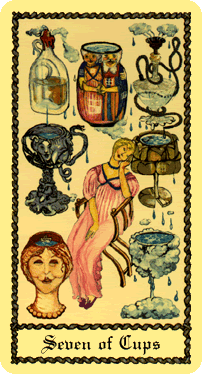
The Scapini card takes after the RWS; seven cups full of choices, and a central figure who seems to be dreaming.
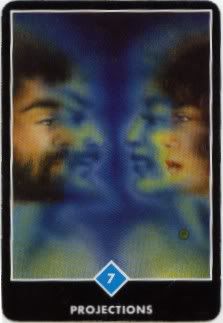
In the Osho Zen we've got Projections - two people facing each other, but far from communicating naturally, each is putting out a projected image, and it is the two projections that seem to touch, not the real people. I admit I just looked that up right now, but maybe I had it in my head when I saw the swirls of cloth in the Intuitive card, and wondered if we were on the stage.
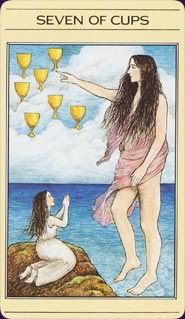
Psyche asks Aphrodite for help here in the Mythic deck. This is a fiddly moment on account of it being Psyche who screwed up, and the two of them not being best of friends in the first place, but Aphrodite says she can have her husband back...but it won't be easy. I think this is about not just choices but access to choice itself; Psyche's trying to find the way, and rather than being able to simply take a sip of whatever she likes, she's having to look for help in unlikely places to overcome the hurdles between herself and what she needs.
the curtain opens
and what do you see here?
is it raining, is there sunlight?
what's for breakfast?
who is there?
(Is this a stage?)
Where does the light shine?
(Or is it yet still dark?)
Is that the limelight in your chalice,
and is it mine?
Where do I walk to find the sun?
(And how does the leading lady like her morning tea?)
Can I take a sip of everything?
Make a rainbow?
(Where's the chorus?)
Or shall I close the curtain,
and return to bed?
The Seven of Cups is usually framed as being about choosing; each chalice as a possible option, some pleasant, some poisoned. The sheer obviousness of the poison implies that the chooser doesn't know what they're getting, but can only be guided by instinct and dreams. Be careful what you wish for is always a watchword here.
Sevens, in general, are odd. It seems to be the number where It All Goes Wrong - whatever project the element is part of suddenly comes into question, often with a cry of 'why?' So why water? What's it for - what's inside it? To where does it flow, and do we even want to get there?
I've been slow at writing this one because I'm not sure what's going on with this particular image. A cup of sunshine in the air, sure enough, but the other six are just stacked at the bottom, and the streams that run from top to bottom here look less like water than like...cloth. So I'm seeing a curtain opening - it could be morning, or it could be Act I, Scene I. Are you really in for this whole water stuff, or is it just a role you're playing? What do you do when the curtain falls? Do you get that cup of sunshine, or is it way offstage, outside of all the roles and scenery?
Do you ever get to choose, or are you following the script?
Much confusion ;_;
[Edit: six months later, and I finally realise that this image is a simple, straightforward vulva. Fuck, I'm slow.]
Images of the Seven of Cups:
The Scapini card takes after the RWS; seven cups full of choices, and a central figure who seems to be dreaming.
In the Osho Zen we've got Projections - two people facing each other, but far from communicating naturally, each is putting out a projected image, and it is the two projections that seem to touch, not the real people. I admit I just looked that up right now, but maybe I had it in my head when I saw the swirls of cloth in the Intuitive card, and wondered if we were on the stage.
Psyche asks Aphrodite for help here in the Mythic deck. This is a fiddly moment on account of it being Psyche who screwed up, and the two of them not being best of friends in the first place, but Aphrodite says she can have her husband back...but it won't be easy. I think this is about not just choices but access to choice itself; Psyche's trying to find the way, and rather than being able to simply take a sip of whatever she likes, she's having to look for help in unlikely places to overcome the hurdles between herself and what she needs.
Eight Of Cups
trace the white circle that narrows round me
wet feet heavy, caught in place
look beyond the chalice of old treasures
stand beside the roots that lead me down
sea and shore collapsing in each other
calm waves breaching all hard lines
with head bowed and a star to mark the morning
I walk on water, and I do not drown.
This is not a happy place. It's another of those Water cards that have gone to the shore, and it's not looking at the path home; that path is blocked, or eroded. It's usually not looking at us at all - it's a face turned away. It's headed downwards. It's abandoning the map and heading into deep water, alone, and as we can't see its face, we don't know how it might be feeling about that. It could be unhappy, or it could be relieved. That all depends on what it's leaving behind, and why.
One of my favourite Eights of Cups is the one in the Mythic Tarot; it shows Psyche headed to the Underworld because if she wants to rectify her mistakes and be happy, that's where she has to go. She has to give up on the idea of herself as a simple, mortal woman with a simple, mortal marriage, and go into the dark.
This one is lit by a huge moon, and shows a figure standing by a confusion of sea and shore, roots and sand, like a landspit in the ocean of feeling, a lonely place, but an illuminated one.
Virtually all Eights of Cups show a moon, and, this being tarot, that probably implies a lot of uncertainty and a need to drown the rational in the sea and rely instead on the intuitive - which may or may not be an accurate guide.
Images of the Eight of Cups
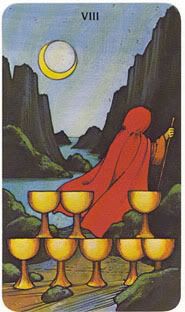
The Eight of Cups in the Morgan-Greer Tarot is based on the RWS, but is prettier; a person walks away from a path almost blocked by emotion, and heads down to the sea. That the Eight of Cups tilts downwards is fairly established; that it's for the best, or sometimes all you can do, similarly so.
Scapini hints at a different kind of descent; a passionate scandal. It's often passion that pulls us off-track, but there's this very courtly notion here that it's the expression of love, rather than the failure of love, that's bringing you low.

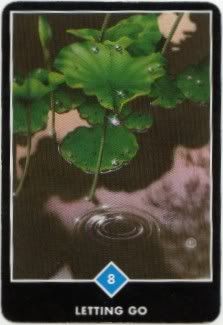
The Osho Zen Tarot doesn't describe the problem, but instead gives us the solution: Letting Go.
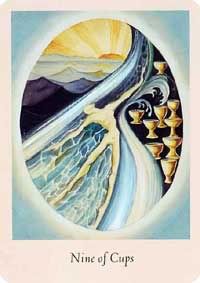
Nine Of Cups
the wave I am
four limbs tossed by its whims
i am the spray
i am swimming
i am overflowing.
i am myself
i am the sea at daybreak
i am the peak
of the next wave
First Cup out of the deck, and I think I'm in love with it. Maybe it is sea, and I'm only mistaking it for human; maybe it's sunset, and I'm just that much in love with daybreak. But if the Nine of Pentacles is the harvest, the Nine of Cups is the spring tide.
I think I'm finally getting smitten with this card. It's a great bundle of stuff, but most Nines of Cups are offputting; the smug RWS chap and his many many clones. But nine is a beautiful number - it's the furthest you can come alone, and it's the number of Yesod, which is the trapdoor in the ceiling of the material world. Nine is our exit, and everything else's entrance. And water? Water is what we're made of, what we have in common, what we have in common with trees and skies and oceans - water is how we communicate, how we experience.
A Nine of Cups is a full glass; complete in itself; lone, but not alone.
Ever read Casino Royale? Most of the good bits got put in the film. The Nine of Hearts was one bit that didn't, because in the book the hero and the villain played baccarat. James Bond called the card 'a whisper of love, a whisper of hate'. The wave is that finely balanced. Others call it 'the wish card': joy derived from having what you wanted. Satisfaction.
Reversed, you might be being superficial; and you might be letting your satisfaction drain away, consuming rather than revelling.
Images of the Nine of Cups:
This gorgeous specimen from the Intuitive. It's a far cry from the overly smug Rider-Waite-Smith Nine.
And here's a pip card from the Marseilles.
four limbs tossed by its whims
i am the spray
i am swimming
i am overflowing.
i am myself
i am the sea at daybreak
i am the peak
of the next wave
First Cup out of the deck, and I think I'm in love with it. Maybe it is sea, and I'm only mistaking it for human; maybe it's sunset, and I'm just that much in love with daybreak. But if the Nine of Pentacles is the harvest, the Nine of Cups is the spring tide.
I think I'm finally getting smitten with this card. It's a great bundle of stuff, but most Nines of Cups are offputting; the smug RWS chap and his many many clones. But nine is a beautiful number - it's the furthest you can come alone, and it's the number of Yesod, which is the trapdoor in the ceiling of the material world. Nine is our exit, and everything else's entrance. And water? Water is what we're made of, what we have in common, what we have in common with trees and skies and oceans - water is how we communicate, how we experience.
A Nine of Cups is a full glass; complete in itself; lone, but not alone.
Ever read Casino Royale? Most of the good bits got put in the film. The Nine of Hearts was one bit that didn't, because in the book the hero and the villain played baccarat. James Bond called the card 'a whisper of love, a whisper of hate'. The wave is that finely balanced. Others call it 'the wish card': joy derived from having what you wanted. Satisfaction.
Reversed, you might be being superficial; and you might be letting your satisfaction drain away, consuming rather than revelling.
Images of the Nine of Cups:
This gorgeous specimen from the Intuitive. It's a far cry from the overly smug Rider-Waite-Smith Nine.
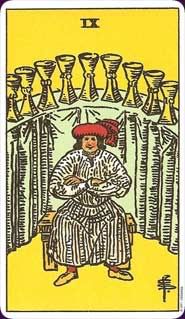
And here's a pip card from the Marseilles.

Ten Of Cups
you could be my reflection
in the waters of life
you could be part of the same weather
share my rainbow
share my body
we can be the things we make together
with no separate goals,
no clambering over each other to avoid
looking into eyes
share our burdens
I could stand by the sea
With you beside me.
I could see family in you, trust
caring and care
love overflowing.
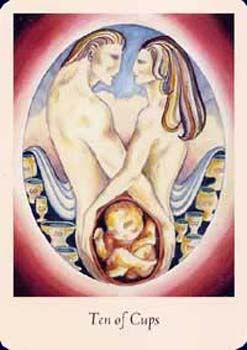
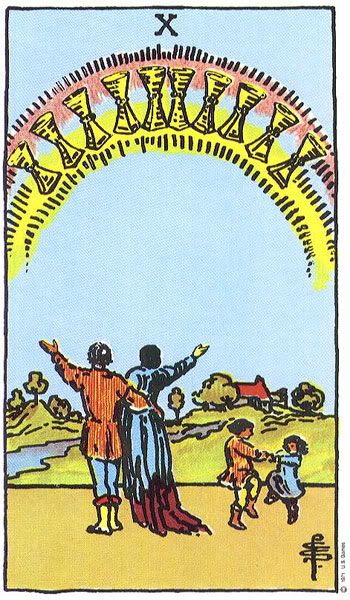
Happy card. Ten full glasses, and more often than not, a rainbow. One could almost forgive it for being the most heteronormative thing ever. Tens of Cups tend to show idealised pictures of family life, as if to say love and be loved; care and be cared for. It works for most people; the rest are left to extrapolate the message to other forms of shared responsibility.
I don't think the Ten of Cups is something you can do alone; that would be the Nine at work. The Ten flows, from one person to another; it has work to do, in spaces between people. Sadly, it can be seen as an end in itself, which it isn't (andkids grow up, and when they do, it usually annoys someone Hit me again). Especially if you're relying on an external situation to create your joys, they won't last forever. Carrying your responsibilities on the inside, the way this young couple in the Intuitive deck does, may make it last.
Images of the Ten of Cups:
The Intuitive pic, which I find just slightly creepy on the one hand, and pleasantly egalitarian on the other. It's part of the same chain of events as the RWS Ten Of Cups, but the message of shared responsibility is just that little bit blunter. Not only that, but because the drawing can't possibly be literal, it's easier to look past its literal meaning.
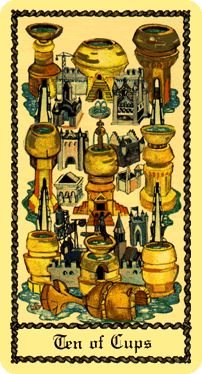
Scapini has no rainbow, but has made this card into a fortress.
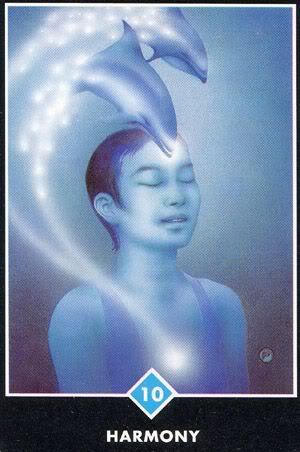
The Osho Zen is all about Harmony. It is about listening to your heart, and about the end of the difficult struggle to attain simplicity. It's rare in that few Tens of Cups contain only one character, but I guess that's the Zen worldview for you.
in the waters of life
you could be part of the same weather
share my rainbow
share my body
we can be the things we make together
with no separate goals,
no clambering over each other to avoid
looking into eyes
share our burdens
I could stand by the sea
With you beside me.
I could see family in you, trust
caring and care
love overflowing.
Happy card. Ten full glasses, and more often than not, a rainbow. One could almost forgive it for being the most heteronormative thing ever. Tens of Cups tend to show idealised pictures of family life, as if to say love and be loved; care and be cared for. It works for most people; the rest are left to extrapolate the message to other forms of shared responsibility.
I don't think the Ten of Cups is something you can do alone; that would be the Nine at work. The Ten flows, from one person to another; it has work to do, in spaces between people. Sadly, it can be seen as an end in itself, which it isn't (and
Images of the Ten of Cups:
The Intuitive pic, which I find just slightly creepy on the one hand, and pleasantly egalitarian on the other. It's part of the same chain of events as the RWS Ten Of Cups, but the message of shared responsibility is just that little bit blunter. Not only that, but because the drawing can't possibly be literal, it's easier to look past its literal meaning.
Scapini has no rainbow, but has made this card into a fortress.
The Osho Zen is all about Harmony. It is about listening to your heart, and about the end of the difficult struggle to attain simplicity. It's rare in that few Tens of Cups contain only one character, but I guess that's the Zen worldview for you.
Page Of Cups
drip, drip, drip
the softest of impacts
the most fleeting of kisses
the smallest of waves
the slightest of sips
from the cup of the river
from the bloodstream of life
from the veins of my body
drip, drip
and turn
the gentlest of slopes
(stretching down to the sea)
the smoothest of sands
(in my toes, by the sea)
the shallowest of waters
(laps my legs, in the sea)
the palest of suns
(warms my flesh, under sea)
(This is my borderland).
I am seeing this beautiful card through amethyst, as if for the first time, on a night near the far edge of the year, and I think she may drown me in her teacup, or in her deep blue eyes. She is the edge of the water. I doubt I've got a screenie of it, but in the Mythic Tarot this is Narcissus sat on the bank of the pool, in love with his own reflection. This Page is head, shoulders and half an arm, by the water of an inlet, seemingly naked - but severed at the border, so we'll never know.
I get it now. She's the edge of the universal river, the point before you learn whether you'll sink or swim, the point where you're just deciding how deep in you're going to go. She's the first sip from the first chalice; maybe a voice of warning, maybe a glimmer of light that beckons you further on - or maybe, as Narcissus never realised, your own reflection, simultaneously trapping you and preventing you from going deeper. She's the first drop; the first tear. Not an advisor, a gatekeeper or a guardian, just a girl on a beach with a question, and eyes so blue that you're lost.
Images of the Page of Cups
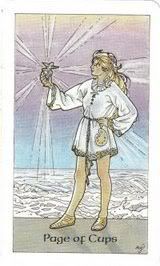
The RWS was the source of the beach setting you see in many Pages of Cups; here's one from the Robin Wood tarot, all leggy and ambiguously gendered.
This bizzare construction from Amano also makes used of a winding borderline, and a boy who's between sleeping and waking.
The Osho Zen deck is going with Awakening, and the door of the canary cage swinging open to admit the sky.
the softest of impacts
the most fleeting of kisses
the smallest of waves
the slightest of sips
from the cup of the river
from the bloodstream of life
from the veins of my body
drip, drip
and turn
the gentlest of slopes
(stretching down to the sea)
the smoothest of sands
(in my toes, by the sea)
the shallowest of waters
(laps my legs, in the sea)
the palest of suns
(warms my flesh, under sea)
(This is my borderland).
I am seeing this beautiful card through amethyst, as if for the first time, on a night near the far edge of the year, and I think she may drown me in her teacup, or in her deep blue eyes. She is the edge of the water. I doubt I've got a screenie of it, but in the Mythic Tarot this is Narcissus sat on the bank of the pool, in love with his own reflection. This Page is head, shoulders and half an arm, by the water of an inlet, seemingly naked - but severed at the border, so we'll never know.
I get it now. She's the edge of the universal river, the point before you learn whether you'll sink or swim, the point where you're just deciding how deep in you're going to go. She's the first sip from the first chalice; maybe a voice of warning, maybe a glimmer of light that beckons you further on - or maybe, as Narcissus never realised, your own reflection, simultaneously trapping you and preventing you from going deeper. She's the first drop; the first tear. Not an advisor, a gatekeeper or a guardian, just a girl on a beach with a question, and eyes so blue that you're lost.
Images of the Page of Cups
The RWS was the source of the beach setting you see in many Pages of Cups; here's one from the Robin Wood tarot, all leggy and ambiguously gendered.
This bizzare construction from Amano also makes used of a winding borderline, and a boy who's between sleeping and waking.

The Osho Zen deck is going with Awakening, and the door of the canary cage swinging open to admit the sky.
Knight Of Cups
so I saw you by the riverside
dipped my feet into dark waters
where everything was half-moon bright
and you
my heart spun in your current
river deep, and knight so cold
and I spoke with words ne'er to be told
and you
you replied to my pleas to the moon on the water
you took my hand and said it was alright
you had me make a wish, and made no promises
you led me into your reflection
and were gone, like a fish in the river
like a raindrop on the pavement
like you never were more than a whisper in my mind.
...and that is how I met the Knight of Cups and what I did to him when I found him, or vice versa, told in retrospect because it's the only way to be. Verse has jack-all to do with Conway's lovely picture - a knight armoured in shell and scale, shown in profile as he looks into his cup of dark water, which is fountaining enthusiastically all over the middle of the card. I like that it's a profile, because I for one can never see this guy straight on - I might notice him in hindsight, or get obsessed with his reflection, but in all my life he's never looked me in the eye.
Who is this guy?
He's a bit of a paradox - the torchbearer of Water, a light shining under the sea. He follows his heart, but only he can see where it leads; you're lucky if you can work it out by inference. His waters are as much for drowning as for drinking.
Unlike the Knight of Wands or Knight of Swords, he's never at full charge; his movements are calm, steady, or even hesitant. If the horse represents the knight's ego, his is well in hand - or he may be a little unsure of himself, in spite of the path he's on. I'm finding it hard to say anything concrete about this card...
Images of the Knight of Cups
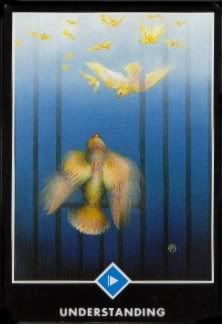
The RWS (from the Universal Waite recolour), also in profile, staring at who knows what.
Amano seems to be showing the Knight of Cups in the role of a lover; his posture is taut, and I think the cup in his hands may be a gift for another. All we see of his horse is its head, with a rose held in its mouth - perhaps this knight has pushed his ego aside entirely, but on the other hand only one of Amano's knights is pictured on horseback.
Osho's knight has a different means of transport. Its title is 'trust'...something I failed to touch on above. Trusting the Knight is the only way to get anywhere with him, mentally - you can never see what he sees, so you need to put faith in what he tells and shows you. Faith I often lack.
From the Robin Wood tarot, here's a knight astride a merbeast, a seashell on his head. It's gorgeous but where's the viewer standing, eh?, that's what I want to know.
And Scapini has drawn someone suitably hideous, riding a horse that looks like it's about to die. This shows a potential for folly and delusion in the soggy path of the Knight of Cups.
dipped my feet into dark waters
where everything was half-moon bright
and you
my heart spun in your current
river deep, and knight so cold
and I spoke with words ne'er to be told
and you
you replied to my pleas to the moon on the water
you took my hand and said it was alright
you had me make a wish, and made no promises
you led me into your reflection
and were gone, like a fish in the river
like a raindrop on the pavement
like you never were more than a whisper in my mind.
...and that is how I met the Knight of Cups and what I did to him when I found him, or vice versa, told in retrospect because it's the only way to be. Verse has jack-all to do with Conway's lovely picture - a knight armoured in shell and scale, shown in profile as he looks into his cup of dark water, which is fountaining enthusiastically all over the middle of the card. I like that it's a profile, because I for one can never see this guy straight on - I might notice him in hindsight, or get obsessed with his reflection, but in all my life he's never looked me in the eye.
Who is this guy?
He's a bit of a paradox - the torchbearer of Water, a light shining under the sea. He follows his heart, but only he can see where it leads; you're lucky if you can work it out by inference. His waters are as much for drowning as for drinking.
Unlike the Knight of Wands or Knight of Swords, he's never at full charge; his movements are calm, steady, or even hesitant. If the horse represents the knight's ego, his is well in hand - or he may be a little unsure of himself, in spite of the path he's on. I'm finding it hard to say anything concrete about this card...
Images of the Knight of Cups
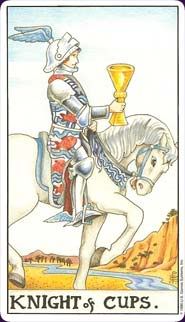
The RWS (from the Universal Waite recolour), also in profile, staring at who knows what.
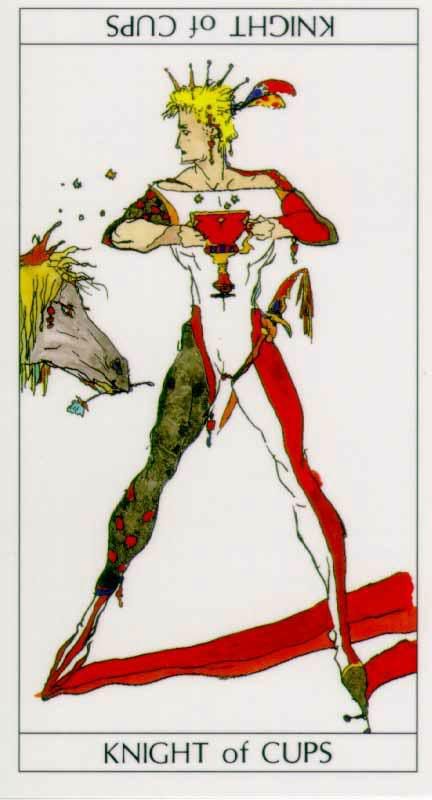
Amano seems to be showing the Knight of Cups in the role of a lover; his posture is taut, and I think the cup in his hands may be a gift for another. All we see of his horse is its head, with a rose held in its mouth - perhaps this knight has pushed his ego aside entirely, but on the other hand only one of Amano's knights is pictured on horseback.
Osho's knight has a different means of transport. Its title is 'trust'...something I failed to touch on above. Trusting the Knight is the only way to get anywhere with him, mentally - you can never see what he sees, so you need to put faith in what he tells and shows you. Faith I often lack.

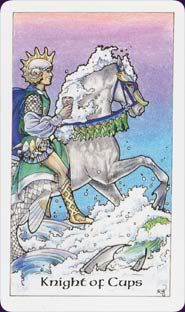
From the Robin Wood tarot, here's a knight astride a merbeast, a seashell on his head. It's gorgeous but where's the viewer standing, eh?, that's what I want to know.
And Scapini has drawn someone suitably hideous, riding a horse that looks like it's about to die. This shows a potential for folly and delusion in the soggy path of the Knight of Cups.

Queen Of Cups
open
the circle
your eyes
waters
come to my seat by the sea.
flow
from the crown
over skin
to the cup
drink of the love of the sea.
Another topless queen - looking a bit more regal than the last. This is the fourth Queen out of the gates, and she's come up behind the Magician. I think that the way Queens serve, balance and apply their element is connected to the Magician, but he is less prone to becoming trapped within his spells.
This lady of the waters is looking me in the eye; hers are purple, as is the jewel in her crown, and her flowing cloak (she's not wearing anything else; yep, another bare-boobed queendom), and even the card's border. I'll take the leap of thinking that Conway was trying to show us this Queen's insightful nature. And no other Queen has her straight-backed, forward-looking posture; there is strength in her spine, and it provides a structure for the waves that flow to her cup. She's a queen of kundalini, of the snake that winds up the spine from root to crown.
Out in the world of other people, she's the port in the storms of your emotional journeys - you sail to her for validation, and to get your bearings and move on. She keeps many hearts afloat in her chalice. Like all Queens, she could be trapped in this role, but she enjoys her place by the lapping waters. She has a calm to share with others, and she accepts their storms in return.
Images of the Queen of Cups:
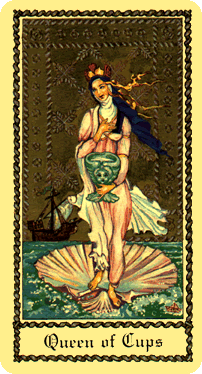
The Queen of Cups often looks pretty. Scapini has dressed her up as Venus.
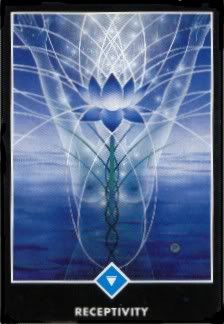
The Osho Zen gives us Receptivity. Now, I've written before about having strong views wrt pictures of naked, headless female torsos; here the big idea is meant to be receiving without the mental filter, without an 'aggressive mind' to riposte with responses. The Osho Zen has stranger images, but...if you wanted to show the removal of an 'aggressive mind', why not use a headless male torso? Yeah, you could see the nod to female mental aggression as a positive, but I feel there's a reluctance to trash male bodily integrity in this way. hm.
There's no way in hell it really is, but Amano's Queen of Cups makes me think of Diaochan. Diaochan is a Three Kingdoms character; a nice girl who could sing and dance, and who had a fairly important father. Two tyrants united to rule the land together; the strong but not so bright Lü Bu, and the smart but not so tough Dong Zhuo. Together they were too strong for any other men to overcome...so Diaochan sneaked her way into their company, and started flirting with both of them. They turned on each other soon afterwards.
She is Verse 43 of the Tao Te Ching: gentle water, wearing down the impenetrable stone. The softest thing can easily overcome the hardest. She doesn't need strength, substance, action; it's the very lack of these things that made her so powerful.
Unlike most other Three Kingdoms folk, Diaochan probably never really existed. There are varying stories about what became of the character, but all seem to revolve around Guan Yu; sometimes he sends her to become a nun; sometimes he is given her as a spoil of war, in the same way as he acquired Lü Bu's famous horse, but he beheads her out of distrust; sometimes Guan and his two brothers, Liu Bei and Zhang Fei, all fall for her and Guan kills her to protect their oath. Yunchang, what's your problem? Why is she so dangerous to you?
I haven't a scan of it, but the Mythic deck places Helen of Troy in this position. She, Diaochan and Venus are all bringers of temptation; some say Helen is now the will-o'wisp who shines false lights to sailors and leads them to the rocks. The Queen of Cups has that power. Don't mess with her, do not follow her out of lust - she's not yours, she is Queen to everyone who seeks her - and do not trust her blindly unless the waters of your heart are pure.
the circle
your eyes
waters
come to my seat by the sea.
flow
from the crown
over skin
to the cup
drink of the love of the sea.
Another topless queen - looking a bit more regal than the last. This is the fourth Queen out of the gates, and she's come up behind the Magician. I think that the way Queens serve, balance and apply their element is connected to the Magician, but he is less prone to becoming trapped within his spells.
This lady of the waters is looking me in the eye; hers are purple, as is the jewel in her crown, and her flowing cloak (she's not wearing anything else; yep, another bare-boobed queendom), and even the card's border. I'll take the leap of thinking that Conway was trying to show us this Queen's insightful nature. And no other Queen has her straight-backed, forward-looking posture; there is strength in her spine, and it provides a structure for the waves that flow to her cup. She's a queen of kundalini, of the snake that winds up the spine from root to crown.
Out in the world of other people, she's the port in the storms of your emotional journeys - you sail to her for validation, and to get your bearings and move on. She keeps many hearts afloat in her chalice. Like all Queens, she could be trapped in this role, but she enjoys her place by the lapping waters. She has a calm to share with others, and she accepts their storms in return.
Images of the Queen of Cups:
The Queen of Cups often looks pretty. Scapini has dressed her up as Venus.
The Osho Zen gives us Receptivity. Now, I've written before about having strong views wrt pictures of naked, headless female torsos; here the big idea is meant to be receiving without the mental filter, without an 'aggressive mind' to riposte with responses. The Osho Zen has stranger images, but...if you wanted to show the removal of an 'aggressive mind', why not use a headless male torso? Yeah, you could see the nod to female mental aggression as a positive, but I feel there's a reluctance to trash male bodily integrity in this way. hm.
There's no way in hell it really is, but Amano's Queen of Cups makes me think of Diaochan. Diaochan is a Three Kingdoms character; a nice girl who could sing and dance, and who had a fairly important father. Two tyrants united to rule the land together; the strong but not so bright Lü Bu, and the smart but not so tough Dong Zhuo. Together they were too strong for any other men to overcome...so Diaochan sneaked her way into their company, and started flirting with both of them. They turned on each other soon afterwards.
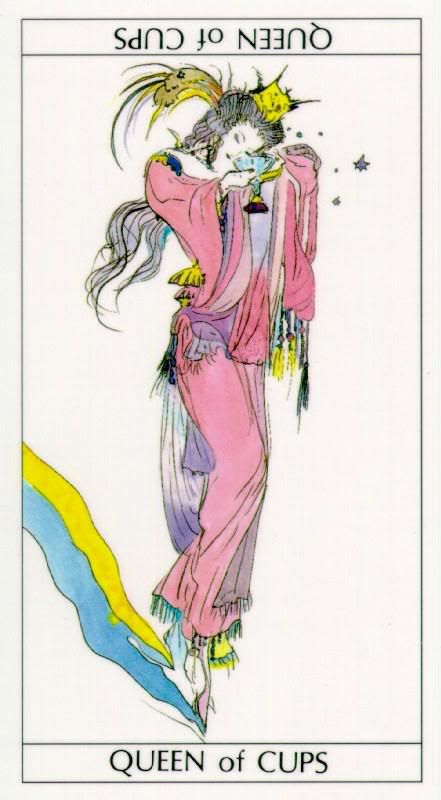
She is Verse 43 of the Tao Te Ching: gentle water, wearing down the impenetrable stone. The softest thing can easily overcome the hardest. She doesn't need strength, substance, action; it's the very lack of these things that made her so powerful.
Unlike most other Three Kingdoms folk, Diaochan probably never really existed. There are varying stories about what became of the character, but all seem to revolve around Guan Yu; sometimes he sends her to become a nun; sometimes he is given her as a spoil of war, in the same way as he acquired Lü Bu's famous horse, but he beheads her out of distrust; sometimes Guan and his two brothers, Liu Bei and Zhang Fei, all fall for her and Guan kills her to protect their oath. Yunchang, what's your problem? Why is she so dangerous to you?
I haven't a scan of it, but the Mythic deck places Helen of Troy in this position. She, Diaochan and Venus are all bringers of temptation; some say Helen is now the will-o'wisp who shines false lights to sailors and leads them to the rocks. The Queen of Cups has that power. Don't mess with her, do not follow her out of lust - she's not yours, she is Queen to everyone who seeks her - and do not trust her blindly unless the waters of your heart are pure.
King Of Cups
Drink deeply
and think.
I've come far underwater,
come past shoal and spire
To the base of all things
To the spring of creation
(it's where you came from, you know)
To sit at the head
of creation's table.
To wear its light on my brow.
(and if there is poison in the water, I will know).
Poison. It's because there is clearly a gilt spider on Conway's cup. This should be a small worry when there's a GIANT SHARK lurking in the card's watery background. I didn't see much at first glance here - just the gentle face, the pleasant tone of blue - but there's so much information, much wonder and more darkness if you keep on looking.
As with the image, so with the person.
Kings of Cups are emotionally authoritative, gentle in the ways of the heart and they are usually trying their best to do good. They play the role of protector or guardian. But if they rule from the waters, then they rule over everything that that means, including the GIANT SHARKS. (They may try to pretend this is not the case, that they're not part of the same ecosystem as the bad shit, but they so are).
Following on from here and god knows where else - there's one of those sublime people waiting here for me. His name is Kasimir, and the thought of him is of water and music, and deep amber eyes.
Images of the King of Cups
Here's Orpheus from the Mythic Tarot. You know the story; his wife dies of a snakebite, he goes to the Underworld to sing sad songs about how much he wants her back, and Hades & Persephone make him an offer in order to get rid of him; she can follow you home, sure, but only if you don't look behind you until you get back to the real world. He almost, almost makes it but then turns, because he doesn't believe the gods are keeping their promise - and there he sees her, and there he loses her forever. Doubt, distrust and jealousy are as much a part of this king's realm as love and care are.
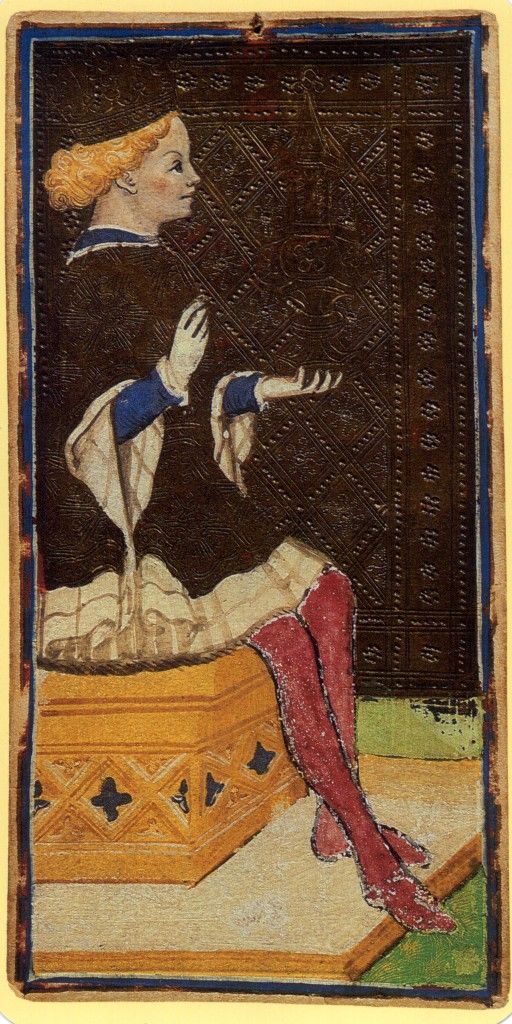
This King from the Visconti-Sforza is studying his chalice with sweet, brown eyes.
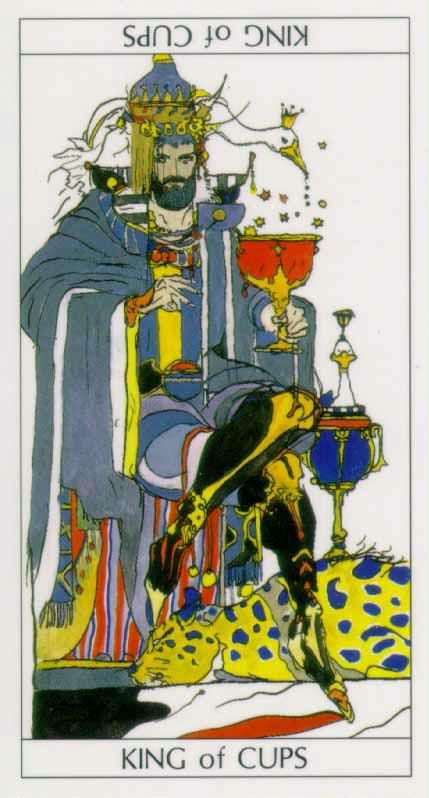
So Amano has this guy with a duck on his head and an overgrown cat by his spindly feet. The duck looks rather like the swan in Amano's gorgeous Star. On the other hand, the cup on top of the cat - what? - has a definite duck on it. I don't get it, but I think it's grinning at me.
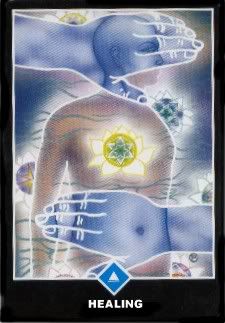
The King of Cups in the Osho Zen tarot is Healing: a lotus blooming at his heart, but huge hands covering his belly and much of his face.
and think.
I've come far underwater,
come past shoal and spire
To the base of all things
To the spring of creation
(it's where you came from, you know)
To sit at the head
of creation's table.
To wear its light on my brow.
(and if there is poison in the water, I will know).
Poison. It's because there is clearly a gilt spider on Conway's cup. This should be a small worry when there's a GIANT SHARK lurking in the card's watery background. I didn't see much at first glance here - just the gentle face, the pleasant tone of blue - but there's so much information, much wonder and more darkness if you keep on looking.
As with the image, so with the person.
Kings of Cups are emotionally authoritative, gentle in the ways of the heart and they are usually trying their best to do good. They play the role of protector or guardian. But if they rule from the waters, then they rule over everything that that means, including the GIANT SHARKS. (They may try to pretend this is not the case, that they're not part of the same ecosystem as the bad shit, but they so are).
Following on from here and god knows where else - there's one of those sublime people waiting here for me. His name is Kasimir, and the thought of him is of water and music, and deep amber eyes.
Images of the King of Cups
Here's Orpheus from the Mythic Tarot. You know the story; his wife dies of a snakebite, he goes to the Underworld to sing sad songs about how much he wants her back, and Hades & Persephone make him an offer in order to get rid of him; she can follow you home, sure, but only if you don't look behind you until you get back to the real world. He almost, almost makes it but then turns, because he doesn't believe the gods are keeping their promise - and there he sees her, and there he loses her forever. Doubt, distrust and jealousy are as much a part of this king's realm as love and care are.
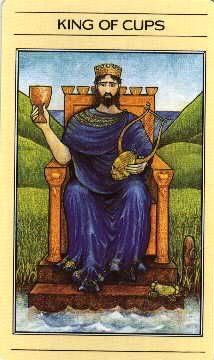
This King from the Visconti-Sforza is studying his chalice with sweet, brown eyes.
So Amano has this guy with a duck on his head and an overgrown cat by his spindly feet. The duck looks rather like the swan in Amano's gorgeous Star. On the other hand, the cup on top of the cat - what? - has a definite duck on it. I don't get it, but I think it's grinning at me.
The King of Cups in the Osho Zen tarot is Healing: a lotus blooming at his heart, but huge hands covering his belly and much of his face.
Subscribe to:
Posts (Atom)