
So, I'm working on this site again, thanks to Agla's prodding - I've done a couple more card entries up in the last few days, and I hope to do another later tonight. But. I draw cards for these musings in threes, and these threes tell interlinked stories. I had the Empress, the Eight of Wands and the Six of Pentacles two days ago, and the Four of Cups, the Knight of Cups and the Six of Pentacles yesterday.
Yep, recurrence, and you know why? Christmas.
I can rarely do much for Christmas, but this year I can't do anything. I'm in a strange place, my immigration paperwork has been delayed due to an RFI, I have no money, little basic liberty, and feel like I have contributed almost nothing to the story of the world in the last year. This sucks because I like giving people things, and as soon as I have any cash I'll likely throw all of it into sending parcels to my siblings and my friends - but that ain't now, and the calendar is running faster than I could keep up with. The Six of Pentacles is the good you get from giving. Not just the warm, fuzzy feeling, but the contribution you've made to someone else's story.
I look around me and see the other people in my life; a wooden snake Agla gave me, the running shoes my sister got me last Christmas, letters from the blue one and the sparkly one, a book that the green one gave to me. Pieces of others, but nurtured by the use I put them to; a book is just a bit of dead treeflesh until you open it and learn its secrets, find how to use them. The shoes are worn to my feet, and I run in them daily; they're my life, and I love them.
Somehow the frustration and the need to be with these people again has stopped me replying to the letters - something that would be very possible becomes hard, because of the distortion of the Six of Pentacles. And what is there here for me? The Four of Cups, sighing into his hand, and that knight, who seems to urge patience and reassessment. Of the previous lot, the Empress is the earth and her hateful expanse of distance, and the Eight of Wands is what I am, what I do, where I've been.
I am not happy, but I might be if I can find ways to give back.

Index
All cards / Latest Cards / All other posts / Notes from Agla
Major Arcana / Minor Arcana / Court Cards
Wands / Pentacles / Cups / Swords
(For a list of all card articles, open March 2008 on the sidebar).
Showing posts with label minor arcana. Show all posts
Showing posts with label minor arcana. Show all posts
Sunday, 30 November 2008

Thursday, 6 March 2008
Two Of Wands
you would open your wings
and draw a line across the sun
you would pull back the curtain
and take all that is yours in your hand
and you'd throw it over the fields
and you'd not know where it was going
but you'd have the faith to see it done
As previously mentioned, I'm doing these in the order the deck wants them done. This is the seventh. The last two were the High Priestess and the Queen of Pentacles - ladies about robes and veils.
Fuck me if this isn't a wide-open curtain.
An Ace is energy at its source; a Two, therefore, is a vector - a moving thing (of fire, this time), but where does it go? It's cheesy, but I see the Two of Wands as being in a state of superposition; sure of its momentum, but what it is is no longer material.
There is something pretty damn phallic about all this. I could more easily draw you a diagram than put it into words; the Two of Wands is a Two of Chokhma, for starters, a first jag of lightning from the source, looking for a shape to hold it. Many decks have it that the Two then faces a forked path, which from that part on the Tree is true enough; down it must go, but it may or may not take the path of least resistance.
Images of the Two of Wands:
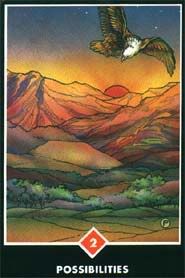
Need to scan the Intuitive one. Til then, here's the Osho Zen - flying away from the setting sun.
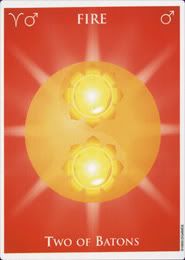
See also the One World Two: a pip card, but note the corner symbols - Aries (as in zodiac), Mars (as in planet), and another Mars for good measure. This is what tipped me off about the penis thing.
and draw a line across the sun
you would pull back the curtain
and take all that is yours in your hand
and you'd throw it over the fields
and you'd not know where it was going
but you'd have the faith to see it done
As previously mentioned, I'm doing these in the order the deck wants them done. This is the seventh. The last two were the High Priestess and the Queen of Pentacles - ladies about robes and veils.
Fuck me if this isn't a wide-open curtain.
An Ace is energy at its source; a Two, therefore, is a vector - a moving thing (of fire, this time), but where does it go? It's cheesy, but I see the Two of Wands as being in a state of superposition; sure of its momentum, but what it is is no longer material.
There is something pretty damn phallic about all this. I could more easily draw you a diagram than put it into words; the Two of Wands is a Two of Chokhma, for starters, a first jag of lightning from the source, looking for a shape to hold it. Many decks have it that the Two then faces a forked path, which from that part on the Tree is true enough; down it must go, but it may or may not take the path of least resistance.
Images of the Two of Wands:
Need to scan the Intuitive one. Til then, here's the Osho Zen - flying away from the setting sun.
See also the One World Two: a pip card, but note the corner symbols - Aries (as in zodiac), Mars (as in planet), and another Mars for good measure. This is what tipped me off about the penis thing.
Three Of Wands
I bowed my head and reached into
the light inside and out I pulled
a ribbon and another
(spiral up in to the trees)
ravelling out and out and then
in my hands
the world.
white smoke-threads in my branches
and in my hands
the world.
So whatever's in that Ace spills out, revs up the Two, and then becomes a form. The fire inside becomes the blueprint for a whole new world - and most Threes of Wands have this 'but now what?' expression; a mixture of pride, awe and confusion. This one has taken his creation straight from the fire, and seems to touch it gingerly, as if it burns. The ribbons are trails of smoke. If he had a name, it might be Fëanor. What has he done now?
One suggested solution to this card is that thing Fëanor didn't do; humility. Another is simply to let the awe roll over you and keep your hands in the furnace. Three is Binah's number; a two is wisdom (a tool), and a three is understanding (the scope of a tool, the work it's done. We speak of Fire here; if we spoke of Water, then I'd say a Three is the glass that catches the flow of Two). It's natural to pause in the hope of gaining understanding, but truly understanding the way your dreams are coming to life in your hands requires that you keep sodding working.
Images of the Three of Wands:
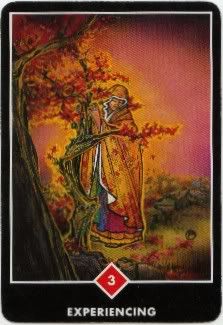
'Experiencing' from the Osho Zen. The point here is that world around you is, if you just choose to commune with it, divine. Awe is a perfectly natural response to that. The Osho Zen in general puts a great emphasis on doing, which is the natural realm of the Wands in any case; you trip up over the Three of Wands because its potential has suddenly become real, and when that happens, it's hard to just keep doing it.
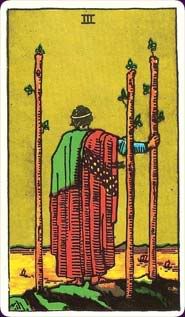
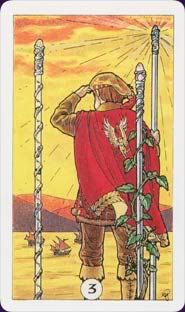
The RWS, an image that some refer to as 'Alexander' - okay, so here's India, but wtf have I done? The Robin Wood image is similar, but the figure seems to send a different message.
the light inside and out I pulled
a ribbon and another
(spiral up in to the trees)
ravelling out and out and then
in my hands
the world.
white smoke-threads in my branches
and in my hands
the world.
So whatever's in that Ace spills out, revs up the Two, and then becomes a form. The fire inside becomes the blueprint for a whole new world - and most Threes of Wands have this 'but now what?' expression; a mixture of pride, awe and confusion. This one has taken his creation straight from the fire, and seems to touch it gingerly, as if it burns. The ribbons are trails of smoke. If he had a name, it might be Fëanor. What has he done now?
One suggested solution to this card is that thing Fëanor didn't do; humility. Another is simply to let the awe roll over you and keep your hands in the furnace. Three is Binah's number; a two is wisdom (a tool), and a three is understanding (the scope of a tool, the work it's done. We speak of Fire here; if we spoke of Water, then I'd say a Three is the glass that catches the flow of Two). It's natural to pause in the hope of gaining understanding, but truly understanding the way your dreams are coming to life in your hands requires that you keep sodding working.
Images of the Three of Wands:
'Experiencing' from the Osho Zen. The point here is that world around you is, if you just choose to commune with it, divine. Awe is a perfectly natural response to that. The Osho Zen in general puts a great emphasis on doing, which is the natural realm of the Wands in any case; you trip up over the Three of Wands because its potential has suddenly become real, and when that happens, it's hard to just keep doing it.
The RWS, an image that some refer to as 'Alexander' - okay, so here's India, but wtf have I done? The Robin Wood image is similar, but the figure seems to send a different message.
Six Of Wands
one
the first step of a thousand miles
two
the open roads before me
three
I am rising
four
I am stooping under the sun
five
the climb is steep, and I am tired
six
and I am here.
The Six of Wands is suspiciously benign. It is victory, and it is celebration of victory; it is a triumph parade after a long, deliberate effort. The Six of Wands never comes from nowhere, and is rarely a surprise. The Six of Wands says you earned this. On the other hand, it says and now you have to live up to it, which is perhaps why the Wands get so complicated from here on up.
Conway's image has, as far as I know, only one commonality with most Sixes of Wands; it's daylight. Her figure (seemingly naked, possibly male) has climbed his steep curve, and now raises merry arms to the sun. But I am a dawnwatcher, and I think the sun in the image looks like a setting sun.
The Six of Wands tells you to raise your hands and celebrate the ways that your dreams and ideas have come about, but it advises against resting on your laurels; a reversed card may be doing just that, though I'd be more inclined to read a reversal as meaning a failure to celebrate what you have done. Celebration is a moment in every soul, and it is not wrong to bring it to the surface. That said, go read verse 31 of the Tao Te Ching; its message, that war ends with a funeral, not with triumph, was recently echoed by Our Crucial Pamphlet from Penny Arcade.
Images of the Six of Wands:
The Dragon Tarot has the first Six of Wands I fell for; a black letter V, and a diamond beneath it. In my head this card will always be linked to - owned by, part of - Gaiety, the Knight of Wands.
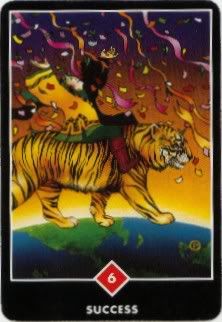
In the Osho Zen, Success is a man astride a tiger, walking over the world.
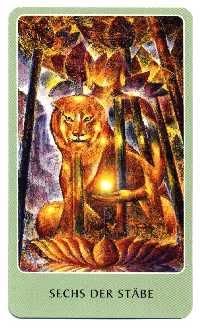
The Roots of Asia also has a great cat, resting in the shade - this card suggests a Six in territorial victory.
the first step of a thousand miles
two
the open roads before me
three
I am rising
four
I am stooping under the sun
five
the climb is steep, and I am tired
six
and I am here.
The Six of Wands is suspiciously benign. It is victory, and it is celebration of victory; it is a triumph parade after a long, deliberate effort. The Six of Wands never comes from nowhere, and is rarely a surprise. The Six of Wands says you earned this. On the other hand, it says and now you have to live up to it, which is perhaps why the Wands get so complicated from here on up.
Conway's image has, as far as I know, only one commonality with most Sixes of Wands; it's daylight. Her figure (seemingly naked, possibly male) has climbed his steep curve, and now raises merry arms to the sun. But I am a dawnwatcher, and I think the sun in the image looks like a setting sun.
The Six of Wands tells you to raise your hands and celebrate the ways that your dreams and ideas have come about, but it advises against resting on your laurels; a reversed card may be doing just that, though I'd be more inclined to read a reversal as meaning a failure to celebrate what you have done. Celebration is a moment in every soul, and it is not wrong to bring it to the surface. That said, go read verse 31 of the Tao Te Ching; its message, that war ends with a funeral, not with triumph, was recently echoed by Our Crucial Pamphlet from Penny Arcade.
Images of the Six of Wands:
The Dragon Tarot has the first Six of Wands I fell for; a black letter V, and a diamond beneath it. In my head this card will always be linked to - owned by, part of - Gaiety, the Knight of Wands.

In the Osho Zen, Success is a man astride a tiger, walking over the world.
The Roots of Asia also has a great cat, resting in the shade - this card suggests a Six in territorial victory.
Eight Of Wands
ready, set, now or never
horizon close and sky too low
take a straight line in any direction
stretch out hand, foot, eye -
- go
go past the dark and see no walls
go cut the wind, be storm, be light
go find your new destination
go be the journey, be the -
- flight
I haven't done this in a while, so my verse sucks worse than usual, but the picture here - eight abstract figures, lining up to a vanishing point, as if preparing for a race - is evoking the base laws of nature. The figures are identical in form, only shrinking in size towards the vanishing point, and they make me think of photons, and the world's only real speed limit: c.
Eight is the last, hardest turn; between those crazy sevens and the bloodyminded nines; the Eight of Wands is fire in motion, with it all finally figured out and on the go. Traditional readers might say it symbolises travel; perhaps so, but as much of the soul as of the body. If you just changed your mind and are throwing your life into something new and exciting, you might find yourself here. Mind you keep a foot on the ground, though.
(The Intuitive card came out of the deck firmly attached to the Empress, btw. What's with that?)
Images of the Eight of Wands
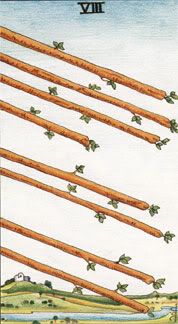
The Eight of Wands is one of very few RWS cards that includes no human figure (offhand the only others I can think of are the four Aces and the Moon). That implies a lack of humanity - and a lack of human frailty - in the energies symbolised here. Smith's design speaks of flight, and perhaps of the sky and the eight directions of the wind - prior to the RWS, Wands were associated with air and Swords with fire, and there's a dose of the former element here.
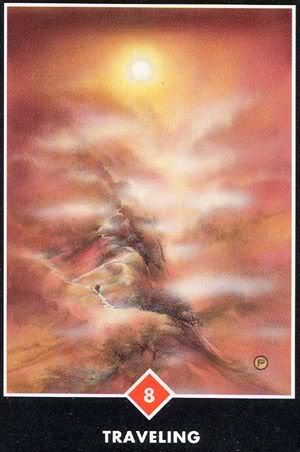
The Osho Zen card is Travelling, one of the more simple in the deck; the mountains imply a difficult road, and it seems to be close to nightfall, but I for one see a lot to look forward to in that picture.
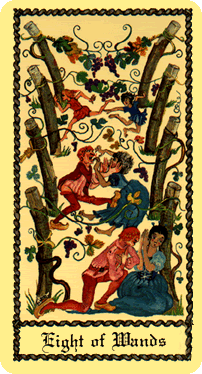
In the Medieval Scapini, a comic-like story is told; for some reason I read it bottom-to-top, and see two lovers speaking coyly, then dancing, then moving apart. It can equally be read top-to-bottom, with the two meeting in a wild dance and then settling down to canoodle. That's the trouble with the Eight of Wands - you never know if you're running from or running to.
horizon close and sky too low
take a straight line in any direction
stretch out hand, foot, eye -
- go
go past the dark and see no walls
go cut the wind, be storm, be light
go find your new destination
go be the journey, be the -
- flight
I haven't done this in a while, so my verse sucks worse than usual, but the picture here - eight abstract figures, lining up to a vanishing point, as if preparing for a race - is evoking the base laws of nature. The figures are identical in form, only shrinking in size towards the vanishing point, and they make me think of photons, and the world's only real speed limit: c.
Eight is the last, hardest turn; between those crazy sevens and the bloodyminded nines; the Eight of Wands is fire in motion, with it all finally figured out and on the go. Traditional readers might say it symbolises travel; perhaps so, but as much of the soul as of the body. If you just changed your mind and are throwing your life into something new and exciting, you might find yourself here. Mind you keep a foot on the ground, though.
(The Intuitive card came out of the deck firmly attached to the Empress, btw. What's with that?)
Images of the Eight of Wands
The Eight of Wands is one of very few RWS cards that includes no human figure (offhand the only others I can think of are the four Aces and the Moon). That implies a lack of humanity - and a lack of human frailty - in the energies symbolised here. Smith's design speaks of flight, and perhaps of the sky and the eight directions of the wind - prior to the RWS, Wands were associated with air and Swords with fire, and there's a dose of the former element here.
The Osho Zen card is Travelling, one of the more simple in the deck; the mountains imply a difficult road, and it seems to be close to nightfall, but I for one see a lot to look forward to in that picture.
In the Medieval Scapini, a comic-like story is told; for some reason I read it bottom-to-top, and see two lovers speaking coyly, then dancing, then moving apart. It can equally be read top-to-bottom, with the two meeting in a wild dance and then settling down to canoodle. That's the trouble with the Eight of Wands - you never know if you're running from or running to.
Nine Of Wands
So look what lies behind me
the night
the forest
embers
this is my fortress
look upon my body
the scars
the strength
the journey
this is my engine of war.
look what lies before me:
nothing?
We shall see.
When I first started learning, in 1999 (or possibly 1998), this was my favourite card in the deck. It chimed with my whole attitude to life at the time; bloodied, unbowed, determined as ever, putting on a tired show of force (or a show of tired force, one of those), not in the least inclined to give in. It's the only stance you can take when you're backed into a corner and can't get out and can't be driven further back either. I've toyed with other cards to represent insomnia - the Knight of Swords or the Tower - but I think it could belong here, at home.
You don't need to reverse this card; it reverses itself perfectly fucking well.
This is, incidentally, the butchest card image I've ever seen in my life, even among Nines of Wands. Big, male, naked, with wands formed into spearpoints, something I haven't noticed on any other Wand thus far. The figure's genitals are fully displayed and his arms are spread wide - not invitingly, not entreatingly, just to show you what he's made of. The whole show is just a ridiculous representation - there is no card like this for masculine posturing, or for base territoriality, or for pride bruised to a pulp but still intact and unyielding. Fuck every other word I've said; this card is your survival.
Like other nines, the spot is secure and lonely and rewarding; we've seen the card of harvest, and the card of the spring tide, and the whirlwind is yet to come; here we have old embers, charcoal, fires burned twice.
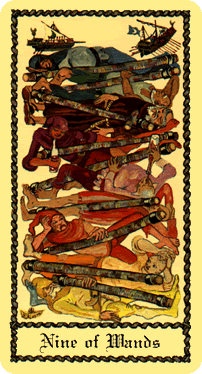
Images of the Nine of Wands:
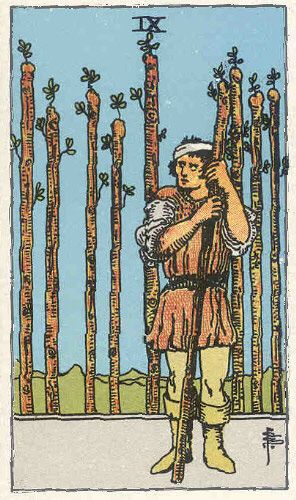
RWS. Love.
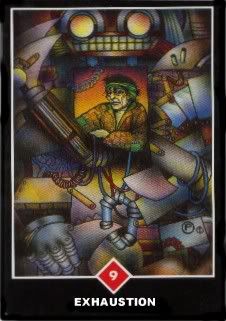
Exhaustion - the Osho Zen Nine, trapped in the machine.
Medieval Scapini Nine of Wands. Crushed and at sea - notably less posturing than most Nines and yet sending the exact same message.
the night
the forest
embers
this is my fortress
look upon my body
the scars
the strength
the journey
this is my engine of war.
look what lies before me:
nothing?
We shall see.
When I first started learning, in 1999 (or possibly 1998), this was my favourite card in the deck. It chimed with my whole attitude to life at the time; bloodied, unbowed, determined as ever, putting on a tired show of force (or a show of tired force, one of those), not in the least inclined to give in. It's the only stance you can take when you're backed into a corner and can't get out and can't be driven further back either. I've toyed with other cards to represent insomnia - the Knight of Swords or the Tower - but I think it could belong here, at home.
You don't need to reverse this card; it reverses itself perfectly fucking well.
This is, incidentally, the butchest card image I've ever seen in my life, even among Nines of Wands. Big, male, naked, with wands formed into spearpoints, something I haven't noticed on any other Wand thus far. The figure's genitals are fully displayed and his arms are spread wide - not invitingly, not entreatingly, just to show you what he's made of. The whole show is just a ridiculous representation - there is no card like this for masculine posturing, or for base territoriality, or for pride bruised to a pulp but still intact and unyielding. Fuck every other word I've said; this card is your survival.
Like other nines, the spot is secure and lonely and rewarding; we've seen the card of harvest, and the card of the spring tide, and the whirlwind is yet to come; here we have old embers, charcoal, fires burned twice.
Images of the Nine of Wands:
RWS. Love.
Exhaustion - the Osho Zen Nine, trapped in the machine.
Medieval Scapini Nine of Wands. Crushed and at sea - notably less posturing than most Nines and yet sending the exact same message.
Ten Of Wands
and it started with a skeleton
a structure made of code
an architecture, a paper destination
and the dark clouds are gathering
and the city is so far.
no one else lifts for you
and you're tired but you're still lifting
still not there
you never will be
there is no time to stop and stare
because it's out there, it's real, and all you do
is try to pad the words around it
try to put flesh on the skeleton
seventy-eight bones
and the words are never perfect
can't be exhausted
you're never right
you'll never say it all
you'll never reach the end
and your words will rot
will be forgotten
your lifting lost, yet those bones will last
and centuries hence, a girl will take her deck
her seventy-eight shards of information
will shuffle, will draw the ten of wands
and she'll nod her head
and feel tired of words,
and you and she
will have the same old bones.
This is a great card for being irritatingly close to finished with your tarot project, for srs. I have, idk, maybe 18 more to go after this one and at the pace I started off at I'd've been done in under a week but now I'm out of focus and only adding one every so often and I planned to be done before this time last year and and oh come on we've all felt like this and that's why there's a goddamn card for it. Hello. I am Thene, and this is the Ten of Wands. It's heavy, but that's the point - some things are, especially things that are very close to payoff. Drawing it is like a promise. Just think of what you can do, how free you'll be, if you can just lug it around the next corner.
I really like the Intuitive Tarot version of it, too - it's a person building the frame of a house, far from the city, and so the burden is also going to give them lasting shelter - but it's a huge and lonely burden, and the clouds are coming. It's still seemingly less pointless than the RWS et al. It's more than just firewood. Some things we labour over can last longer than our lifetimes - our words are still there even if they have no more readers, our homes will last on even if they stand abandoned and empty - and I've posted scans here of the Visconti tarot, drawn hundreds of years ago. Whatever time you put into anything becomes part of the landscape of the world - doesn't matter how little or how much it means, because its presence is enough for the Wands. You dreamed and you did and you're tired and they're done with numbers, they're happy.
And you put down your deck, and tarot goes on.
Images of the Ten of Wands
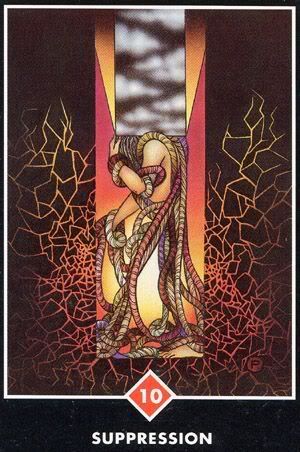
The Osho Zen deck is going with a Freudian word, 'Suppression', and its character is roped-up and weighed down by a box full of cloudy nothing. It's showing the illusory nature of the Ten of Wands; you really can just up sticks and leave at any time. Nothing's stopping you from freeing yourself from the burden. But sometimes, you want to keep holding them up until you're through.
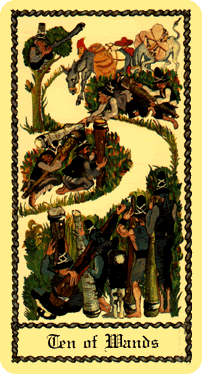
Scapini's is a long road with many people on it. I'm not up enough on the whole Catholic thing to really know, but I think it might be reflecting one of the Stations of the Cross. Not that Wands are into hyperbole or anything like that.
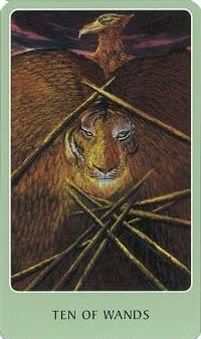
The Roots of Asia is a sky blotted out by wings, and the feeling I have about what's going on there is that they've built their own trap and fallen into it.
a structure made of code
an architecture, a paper destination
and the dark clouds are gathering
and the city is so far.
no one else lifts for you
and you're tired but you're still lifting
still not there
you never will be
there is no time to stop and stare
because it's out there, it's real, and all you do
is try to pad the words around it
try to put flesh on the skeleton
seventy-eight bones
and the words are never perfect
can't be exhausted
you're never right
you'll never say it all
you'll never reach the end
and your words will rot
will be forgotten
your lifting lost, yet those bones will last
and centuries hence, a girl will take her deck
her seventy-eight shards of information
will shuffle, will draw the ten of wands
and she'll nod her head
and feel tired of words,
and you and she
will have the same old bones.
This is a great card for being irritatingly close to finished with your tarot project, for srs. I have, idk, maybe 18 more to go after this one and at the pace I started off at I'd've been done in under a week but now I'm out of focus and only adding one every so often and I planned to be done before this time last year and and oh come on we've all felt like this and that's why there's a goddamn card for it. Hello. I am Thene, and this is the Ten of Wands. It's heavy, but that's the point - some things are, especially things that are very close to payoff. Drawing it is like a promise. Just think of what you can do, how free you'll be, if you can just lug it around the next corner.
I really like the Intuitive Tarot version of it, too - it's a person building the frame of a house, far from the city, and so the burden is also going to give them lasting shelter - but it's a huge and lonely burden, and the clouds are coming. It's still seemingly less pointless than the RWS et al. It's more than just firewood. Some things we labour over can last longer than our lifetimes - our words are still there even if they have no more readers, our homes will last on even if they stand abandoned and empty - and I've posted scans here of the Visconti tarot, drawn hundreds of years ago. Whatever time you put into anything becomes part of the landscape of the world - doesn't matter how little or how much it means, because its presence is enough for the Wands. You dreamed and you did and you're tired and they're done with numbers, they're happy.
And you put down your deck, and tarot goes on.
Images of the Ten of Wands
The Osho Zen deck is going with a Freudian word, 'Suppression', and its character is roped-up and weighed down by a box full of cloudy nothing. It's showing the illusory nature of the Ten of Wands; you really can just up sticks and leave at any time. Nothing's stopping you from freeing yourself from the burden. But sometimes, you want to keep holding them up until you're through.
Scapini's is a long road with many people on it. I'm not up enough on the whole Catholic thing to really know, but I think it might be reflecting one of the Stations of the Cross. Not that Wands are into hyperbole or anything like that.
The Roots of Asia is a sky blotted out by wings, and the feeling I have about what's going on there is that they've built their own trap and fallen into it.
Page Of Wands
I've walked across the forest
through brush and rivers, in its hands
and I walk on-
I've walked across the sky
four winds, five rainstorms, in its clouds
and I walk on-
and now into the desert.
I feel no heat; I have shade.
I feel no thirst; the rains are with me.
The forest is inside me.
The sky rest on my brow.
I like this Page of Wands; it seems a wiser young adventurer than many. The card always reminds me of a someone who I never really knew, someone I hope I'll know better one day - her name is Dominique, and I think the reason why she is adventurous is because everywhere around her she sees the rewards of adventurousness. The Page Of Wands, you might say, knows only the survivors.
A Wand could never tumble into the pitfalls of the Page Of Swords; Wands, even a Wand who doesn't have it herself, value lived experience, value realities - they just value dreams equally so. That's not perverse, just nature - you can't love anything without being drawn to its opposite, and the Wands are up-down channels between one world and the next. Their flames need fuel. She's only just setting out, but the Page of Wands is carrying her journey upon her sturdy back. She only knows the survivors. Her eyes are wide, but alert. She has yet to see disaster.
Images of the Page of Wands:
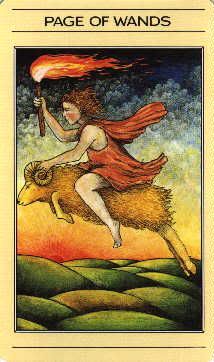
Phrixus, the Mythic Page - the image shows him fleeing from his evil stepmother, on the back of what later became the Golden Fleece. His twin sister took a nosedive into the sea shortly before this image was sketched.
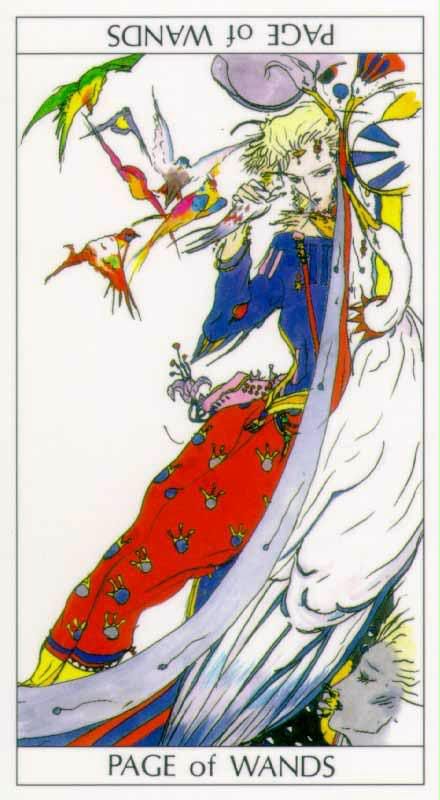
Amano brings out a possible reverse meaning of his Page of Wands; he's dreaming. I think all of Amano's pages have two faces; this shows one daylit face, playing with a flock of birds - and in the corner of the card, blocked from the other figure by a swan, is a shadowed face, eyes closed, surrounded by darkness and stars. This Page seems to be yet to leave his bedroom; the birds are, perhaps, his colourful dreams. (And damn, now I wish I knew what the swan means in Japanese myth).
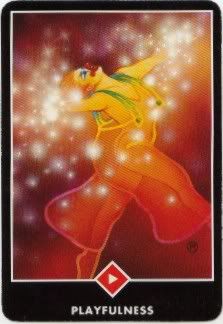
The Osho Zen Page says life is a jape, and she and all the rest of us are clowns.
through brush and rivers, in its hands
and I walk on-
I've walked across the sky
four winds, five rainstorms, in its clouds
and I walk on-
and now into the desert.
I feel no heat; I have shade.
I feel no thirst; the rains are with me.
The forest is inside me.
The sky rest on my brow.
I like this Page of Wands; it seems a wiser young adventurer than many. The card always reminds me of a someone who I never really knew, someone I hope I'll know better one day - her name is Dominique, and I think the reason why she is adventurous is because everywhere around her she sees the rewards of adventurousness. The Page Of Wands, you might say, knows only the survivors.
A Wand could never tumble into the pitfalls of the Page Of Swords; Wands, even a Wand who doesn't have it herself, value lived experience, value realities - they just value dreams equally so. That's not perverse, just nature - you can't love anything without being drawn to its opposite, and the Wands are up-down channels between one world and the next. Their flames need fuel. She's only just setting out, but the Page of Wands is carrying her journey upon her sturdy back. She only knows the survivors. Her eyes are wide, but alert. She has yet to see disaster.
Images of the Page of Wands:
Phrixus, the Mythic Page - the image shows him fleeing from his evil stepmother, on the back of what later became the Golden Fleece. His twin sister took a nosedive into the sea shortly before this image was sketched.
Amano brings out a possible reverse meaning of his Page of Wands; he's dreaming. I think all of Amano's pages have two faces; this shows one daylit face, playing with a flock of birds - and in the corner of the card, blocked from the other figure by a swan, is a shadowed face, eyes closed, surrounded by darkness and stars. This Page seems to be yet to leave his bedroom; the birds are, perhaps, his colourful dreams. (And damn, now I wish I knew what the swan means in Japanese myth).
The Osho Zen Page says life is a jape, and she and all the rest of us are clowns.
Knight Of Wands
fire can look like anything
like an eye
a cloud
an open flower
like the shape of a man
like his eyes
his smile
like anything
I know you
know your footsteps on the path outside
know the calm blue inside you, just before-
doesn't seem so, all looks so still now,
but all will burn.
This is such a cool-looking Knight of Wands, the coolest I am ever likely to see; he's barely even smiling. But we know. We know it's easier to ask for forgiveness than for permission. We know that if something can be done, then something must be done. We know that it will never be enough.
There is a girl dancing in my head.
When I wrote the King of Swords, I said I'd tell you about these guys, these sublime people. But I never know where to begin. Her name is Gaiety. And she doesn't care what you think. Her purposes will become clear once the smoke blows over. Possibly, anyway. You don't even know, for certain, that it was her who did it, but it always is.
It just looks like she's not holding the reins.
Wands are about seeing-dreaming-doing-changing, and Knights are a suit's champions, the ones who go too far on purpose. This is fire-of-fire. And when they burn out, they burn out bad. Also, reversed Wand-Knights tend to be nihilists; a profoundly irritating bunch.
Images of the Knight of Wands:
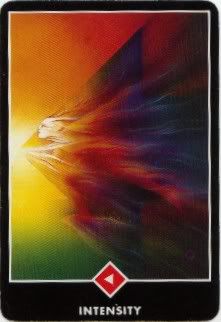
Intensity: the Osho Zen Knight, not waiting around.
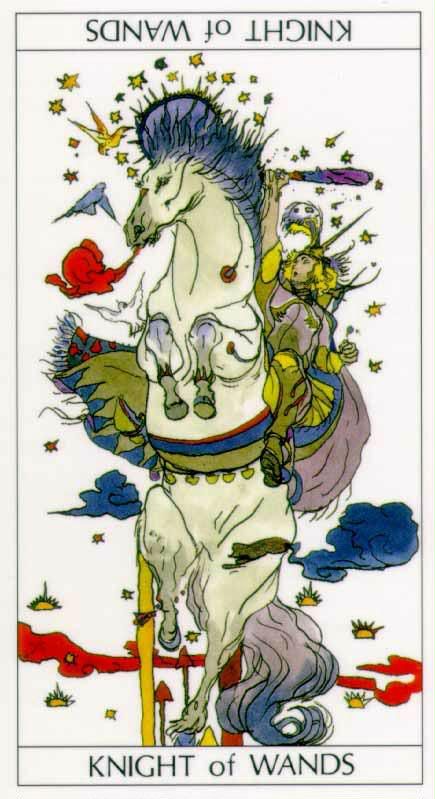
Amano's Knight, barely visible behind the things he's set in motion. If a Knight of Wands is shown mounted, it's traditional for the horse to be bucking on its back feet; ready to move and looking damn swish.
like an eye
a cloud
an open flower
like the shape of a man
like his eyes
his smile
like anything
I know you
know your footsteps on the path outside
know the calm blue inside you, just before-
doesn't seem so, all looks so still now,
but all will burn.
This is such a cool-looking Knight of Wands, the coolest I am ever likely to see; he's barely even smiling. But we know. We know it's easier to ask for forgiveness than for permission. We know that if something can be done, then something must be done. We know that it will never be enough.
There is a girl dancing in my head.
When I wrote the King of Swords, I said I'd tell you about these guys, these sublime people. But I never know where to begin. Her name is Gaiety. And she doesn't care what you think. Her purposes will become clear once the smoke blows over. Possibly, anyway. You don't even know, for certain, that it was her who did it, but it always is.
It just looks like she's not holding the reins.
Wands are about seeing-dreaming-doing-changing, and Knights are a suit's champions, the ones who go too far on purpose. This is fire-of-fire. And when they burn out, they burn out bad. Also, reversed Wand-Knights tend to be nihilists; a profoundly irritating bunch.
Images of the Knight of Wands:
Intensity: the Osho Zen Knight, not waiting around.
Amano's Knight, barely visible behind the things he's set in motion. If a Knight of Wands is shown mounted, it's traditional for the horse to be bucking on its back feet; ready to move and looking damn swish.
Queen Of Wands
my wand;
raises bubbles of fire from the earth to the sky
charms snakes,
snakes of fortunes,
tails wrapped around gold
my wand;
lifts my head high, crowns it with riches and rainbows
charms others,
with my body,
makes all things golden.
makes flesh be fire.
(I feel particularly uninspired tonight. Damn).
As with other Queens we have discussed, this lady is in control, not in command. That's fitting for a snake-charmer; using her arts and skills to turn risk into good fortune. In China, snakes stand for prosperity - I wonder if Conway was instead thinking of the Queen's snake as sinister, or as a bringer of forbidden knowledge, or as a sexual symbol? I read it as a good sign and as a dangerous one.
She hardly needs more sexual symbols; she's not naked, but adorned - bare breasts ringed with gold and with a beaded chain. To me the getup looks deliberately sexually submissive, but is it my eyes she has in mind? I can't know, can't know more than what I'd make of so many jewels, so much eye-makeup. She is the Queen of Wands. Her rod is budding fire. She controls the channel between dreamings and doings - she sees that creations are made real, she guides fantasy into reality.
Did Conway intend her to give the seeming of a prostitute? I hope not; I hope not because there are plenty of real prostitutes out there and they are more than just people who make other people's dreams come true; they are themselves, like everyone else. But it sure looks like Conway was doing that, and if she was, she's made it look like the ever-downside of all Queens; it's a trap. Why does this Queen display her bounties, and adorn her flesh rather than enjoy it in comfort? (The image is not of a strong woman - her arms shows no muscle tone, her collarbone is deeply recessed, her breasts are very small. Only the neck that supports her jewelled collar shows and strength).
I know I must come back here one day; I am uninspired, I can't hear in my right ear and that's fucking with my proprioception, and I can't see the upside here at all. There must be one, somewhere.
Images of the Queen of Wands:
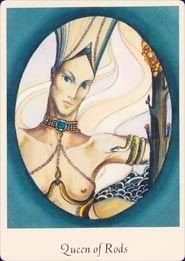
The Intuitive Queen - yes, just this once, you can see the lady I was looking at.
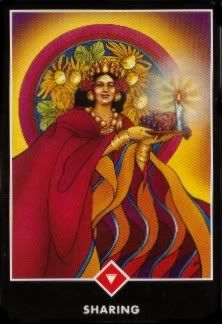
Sharing - the Osho Zen Queen. The idea here is that the Queen of Wands has so much that she can share without noticing. Maybe Conway was aiming for that too, a sharing of treasure and sensuality and experience from someone who had much to give, but she fucked up for me with that frail body and that unfortunate collar. (though, again, those who wear collars often do have power and experience to share - but you can't aim that niche, lady, you just can't, because tarot images are images, representations meant to be read).
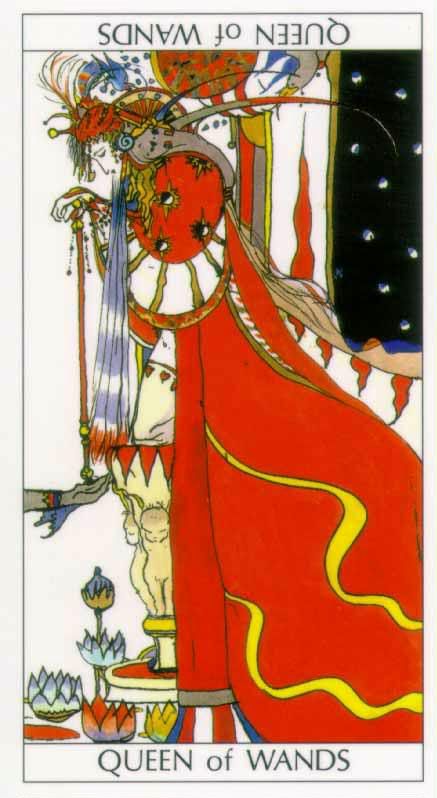
Amano's Queen of Wands - head bowed, rod resting on a hand notably darker than her own. It's very hard to see where this Queen ends - she seems half-pedestal, half-architecture.
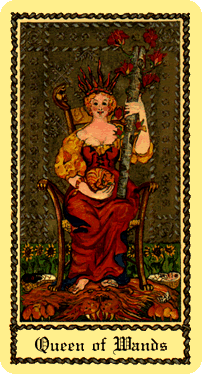
The Scapini Queen - I included this because it includes a common icon of the Queen of Wands; a cat. In the RWS, this cat is black - here it's a ginger tabby. Sometimes, it's a tigress.
raises bubbles of fire from the earth to the sky
charms snakes,
snakes of fortunes,
tails wrapped around gold
my wand;
lifts my head high, crowns it with riches and rainbows
charms others,
with my body,
makes all things golden.
makes flesh be fire.
(I feel particularly uninspired tonight. Damn).
As with other Queens we have discussed, this lady is in control, not in command. That's fitting for a snake-charmer; using her arts and skills to turn risk into good fortune. In China, snakes stand for prosperity - I wonder if Conway was instead thinking of the Queen's snake as sinister, or as a bringer of forbidden knowledge, or as a sexual symbol? I read it as a good sign and as a dangerous one.
She hardly needs more sexual symbols; she's not naked, but adorned - bare breasts ringed with gold and with a beaded chain. To me the getup looks deliberately sexually submissive, but is it my eyes she has in mind? I can't know, can't know more than what I'd make of so many jewels, so much eye-makeup. She is the Queen of Wands. Her rod is budding fire. She controls the channel between dreamings and doings - she sees that creations are made real, she guides fantasy into reality.
Did Conway intend her to give the seeming of a prostitute? I hope not; I hope not because there are plenty of real prostitutes out there and they are more than just people who make other people's dreams come true; they are themselves, like everyone else. But it sure looks like Conway was doing that, and if she was, she's made it look like the ever-downside of all Queens; it's a trap. Why does this Queen display her bounties, and adorn her flesh rather than enjoy it in comfort? (The image is not of a strong woman - her arms shows no muscle tone, her collarbone is deeply recessed, her breasts are very small. Only the neck that supports her jewelled collar shows and strength).
I know I must come back here one day; I am uninspired, I can't hear in my right ear and that's fucking with my proprioception, and I can't see the upside here at all. There must be one, somewhere.
Images of the Queen of Wands:
The Intuitive Queen - yes, just this once, you can see the lady I was looking at.
Sharing - the Osho Zen Queen. The idea here is that the Queen of Wands has so much that she can share without noticing. Maybe Conway was aiming for that too, a sharing of treasure and sensuality and experience from someone who had much to give, but she fucked up for me with that frail body and that unfortunate collar. (though, again, those who wear collars often do have power and experience to share - but you can't aim that niche, lady, you just can't, because tarot images are images, representations meant to be read).
Amano's Queen of Wands - head bowed, rod resting on a hand notably darker than her own. It's very hard to see where this Queen ends - she seems half-pedestal, half-architecture.
The Scapini Queen - I included this because it includes a common icon of the Queen of Wands; a cat. In the RWS, this cat is black - here it's a ginger tabby. Sometimes, it's a tigress.
King Of Wands
the fire in my hands
is the fire of the sky
is the fire of my crown
is the fire of the waters
is all fire; all fire kindled as one fire,
held as one fire,
wielded as one fire.
it illuminates the darkest hour
and yet
still it is dark.
This guy. Is the first card back after the break I took following the World. I've lost my thread, but that's okay; the big snake would've eaten it anyway. And this kind of writing is still easy, is still good. I think I have adopted his attitude to creation; it should be what is most natural for you to create, it should rest easily in your hands, and should allow the fire inside you to guide your hands smoothly; it should seem to connect you to what is above, and to what is in the flow of life. The King of Wands has it cracked.
He's a raving egomaniac too, but tends to be blind to it because he regards his dreams as being separate from himself when everyone else can clearly see just how much his confidence, and his very self, rest upon his fires. Yes, he's powerful (and a helpful card to draw), but not necessarily stable, or substantial. The fires in his hands and mind are also a candle that burns at both ends.
Images of the King of Wands:
From the Intuitive Tarot.
The Scapini image brings out the King's aggression; he has a big stick and he's ready to use it. This ties in to the sex/phallic aspect of Wandiness that I tend to overlook because literal anatomy has no discernible bearing on Wandiness; but the guy is showing off his body and is ready to lift that big stick - and all the while the fire burns above him, pointing upward.
The Osho Zen, by contrast, couldn't be more serene, and he's got there by turning fire upon himself. Fire is destructive in careless hands, but creative if you put care and time into knowing of it - and this person is making himself, shaping himself, in the warmth of the flames.
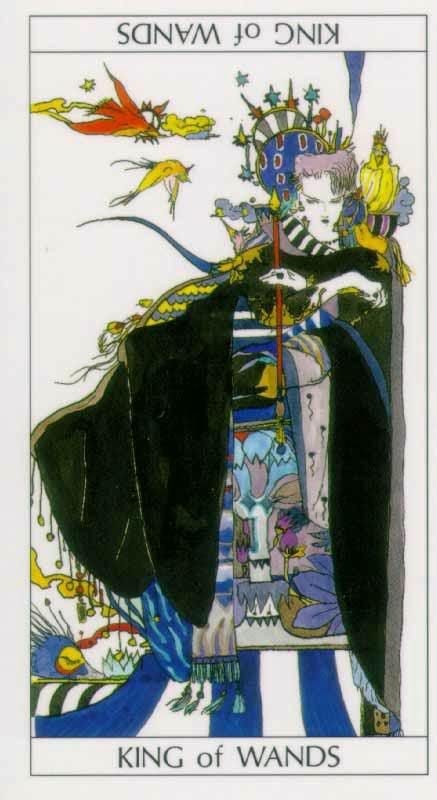
Amano's King of Wands has big rings and delicate fingers.
The Mythic King of Wands is Theseus of Athens - adventurer and hero, but leader and lover too. [For a given value of love.]
is the fire of the sky
is the fire of my crown
is the fire of the waters
is all fire; all fire kindled as one fire,
held as one fire,
wielded as one fire.
it illuminates the darkest hour
and yet
still it is dark.
This guy. Is the first card back after the break I took following the World. I've lost my thread, but that's okay; the big snake would've eaten it anyway. And this kind of writing is still easy, is still good. I think I have adopted his attitude to creation; it should be what is most natural for you to create, it should rest easily in your hands, and should allow the fire inside you to guide your hands smoothly; it should seem to connect you to what is above, and to what is in the flow of life. The King of Wands has it cracked.
He's a raving egomaniac too, but tends to be blind to it because he regards his dreams as being separate from himself when everyone else can clearly see just how much his confidence, and his very self, rest upon his fires. Yes, he's powerful (and a helpful card to draw), but not necessarily stable, or substantial. The fires in his hands and mind are also a candle that burns at both ends.
Images of the King of Wands:
From the Intuitive Tarot.
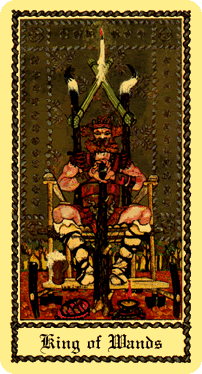
The Scapini image brings out the King's aggression; he has a big stick and he's ready to use it. This ties in to the sex/phallic aspect of Wandiness that I tend to overlook because literal anatomy has no discernible bearing on Wandiness; but the guy is showing off his body and is ready to lift that big stick - and all the while the fire burns above him, pointing upward.
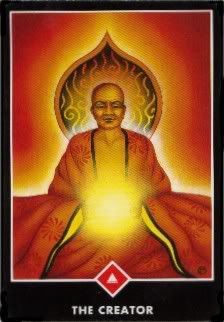
The Osho Zen, by contrast, couldn't be more serene, and he's got there by turning fire upon himself. Fire is destructive in careless hands, but creative if you put care and time into knowing of it - and this person is making himself, shaping himself, in the warmth of the flames.
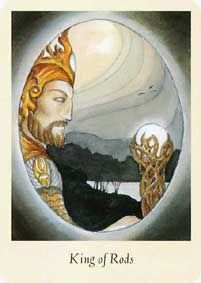
Amano's King of Wands has big rings and delicate fingers.
The Mythic King of Wands is Theseus of Athens - adventurer and hero, but leader and lover too. [For a given value of love.]

Ace Of Pentacles
Come into my parlour
then through the door
past the curtain
step inside the portal
and lift the top layer
enter the circle
put your hands upon the mandala
and open the box inside the dial
follow the money
keep digging-
Will I find the root? No.
I'll reach the stars.
An Ace is element at its starting-point. It could go anywhere. By the time you get to the Three, it probably already did.
When tarot readers and other occult folk talk of elements, they might talk of Earth as representing your physical existence, your home, your work, your security and your bodily health; I don't think that's accurate. I say earth is. Earth is real, it's one of the constituent parts of the world occultists live in; it might manifest in your life as work, home, body, but those are just the consequences of something that is more deeply present.
[What I wrote next later got snipped off into the Elements article.]
An Ace of Pentacles is Earth landing in your world - maybe like a rock on a muddy pond-bed, maybe like a meteorite. It's heralding a change of a practical nature - reversed, it may be encouraging such change - and this isn't so much about rearranging the furniture (though that itself is Earth magic at its finest - try it, you'll see how it works) as about Earth itself becoming a stronger current in your life.
(I really like this card, btw; it is layers within boxes within wheels within dials, with a star of David in the middle, and perhaps an eye in the middle of that. An Ace of Pentacles opens doors, and with Pentacles, inside every door is another door).
Images of the Ace of Pentacles:
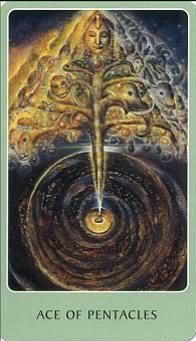
Roots of Asia - similarly layered. A seed, planted in a spiral, becomes a tree of many triangles; in spite of the geometric forms, the card feels very natural compared to the Intuitive card. Earth is both things - both the world made by people, and the world just as it is.
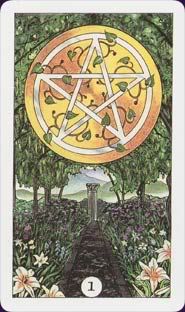
The Robin Wood Tarot sets the Ace of Pentacles in a wood, above a long path lined by flowers.
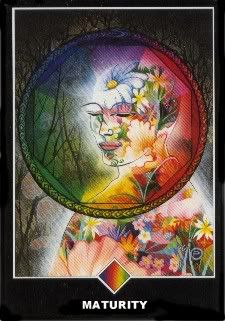
'Maturity', the Osho Zen Ace of Pentacles, shows a man whose being is within a rainbow circle, brighter than the world outside. The Zen view of people is that we are all already enlightened, and just need to be nudged into remembering it; we carry springtime within us. The Earth in your life is already there - the Ace of Pentacles is prompting you to let it bloom.
then through the door
past the curtain
step inside the portal
and lift the top layer
enter the circle
put your hands upon the mandala
and open the box inside the dial
follow the money
keep digging-
Will I find the root? No.
I'll reach the stars.
An Ace is element at its starting-point. It could go anywhere. By the time you get to the Three, it probably already did.
When tarot readers and other occult folk talk of elements, they might talk of Earth as representing your physical existence, your home, your work, your security and your bodily health; I don't think that's accurate. I say earth is. Earth is real, it's one of the constituent parts of the world occultists live in; it might manifest in your life as work, home, body, but those are just the consequences of something that is more deeply present.
[What I wrote next later got snipped off into the Elements article.]
An Ace of Pentacles is Earth landing in your world - maybe like a rock on a muddy pond-bed, maybe like a meteorite. It's heralding a change of a practical nature - reversed, it may be encouraging such change - and this isn't so much about rearranging the furniture (though that itself is Earth magic at its finest - try it, you'll see how it works) as about Earth itself becoming a stronger current in your life.
(I really like this card, btw; it is layers within boxes within wheels within dials, with a star of David in the middle, and perhaps an eye in the middle of that. An Ace of Pentacles opens doors, and with Pentacles, inside every door is another door).
Images of the Ace of Pentacles:
Roots of Asia - similarly layered. A seed, planted in a spiral, becomes a tree of many triangles; in spite of the geometric forms, the card feels very natural compared to the Intuitive card. Earth is both things - both the world made by people, and the world just as it is.
The Robin Wood Tarot sets the Ace of Pentacles in a wood, above a long path lined by flowers.
'Maturity', the Osho Zen Ace of Pentacles, shows a man whose being is within a rainbow circle, brighter than the world outside. The Zen view of people is that we are all already enlightened, and just need to be nudged into remembering it; we carry springtime within us. The Earth in your life is already there - the Ace of Pentacles is prompting you to let it bloom.
Two Of Pentacles
I stood beside a mirror
and it cut me into two
Two eyes, two hands
two strange-shaped forms
two souls, two flames, two hearts
my crown is an hourglass
an infinite space in my mind
but all outside is an infinite wash of colour
and I am inside the mirror
small, still
frozen.
The Two of Pentacles is that life that happens while you're too busy doing other things. It is when that lovely spiffy earth energy from the Ace gathers momentum and eats every minute you put into it. That sounds bad, but I honestly miss this card; filling your every moment with accomplishments feels wonderful. But it's precarious - every hour, and every penny, will be allocated to something and an unexpected nudge can make it shatter.
The Two of Pentacles often contains a lemniscate (∞); a reminder, perhaps, that the resources which feel so stretched and fragile right now are, in truth, eternal. The Intuitive card shows this just above the head of a distorted silhouette; it's huge, white, swirled and symmetrical. The RWS shows a juggler with two objects wrapped in a ∞-shaped sash. Keeping things balanced, symmetrical, is important to this card; it requires the budgeting of time (and often money and other resources). But the balance includes the rest of the deck, in its infinite extent - it tells you to not neglect the rest of your needs. (Many Major Arcana cards involve balance - notably Justice, the High Priestess and Temperance; you can look to them for guidance when dealing with any Two, this one especially).
Images of the Two of Pentacles
The Marseilles shows two coins, a broken lemniscate that sprouts flowers, and - tellingly - is the card that features the deck's maker's mark, as the Ace of Spades sometimes does in modern 52s.
Did I mention the RWS juggler is doing his thing on the beach with the tide coming in behind him? This image makes me think of Morecambe Bay, which I used to live not far from; a treacherous six-mile stretch of sand which should only be negotiated with the aid of the official guide (who is paid £6 a year by royal decree). The bay is place of myth; it is pitted with quicksand, and it is said that the tide comes in faster than a galloping horse. It was on Morecambe Bay that 23 Chinese cockle-pickers were killed in February 2004. (I will not say they drowned or simply died; they were killed by their piece-of-shit gangmaster. Pentacles know the difference between what is and what is caused to be).
The Osho Zen 'Moment To Moment' card shows a man taking stepping stones over rainbows.
This is probably the only Thoth card I am ever going to link; here we see the balance of yin and yang, within a loop formed by the ouroboros. (This is a 8 rather than a ∞; eh?) As with most Thoth images, it's a very simple blending of symbols, one that emphasises symmetry.
And the Mythic Daedalus, whose work is just begun.
and it cut me into two
Two eyes, two hands
two strange-shaped forms
two souls, two flames, two hearts
my crown is an hourglass
an infinite space in my mind
but all outside is an infinite wash of colour
and I am inside the mirror
small, still
frozen.
The Two of Pentacles is that life that happens while you're too busy doing other things. It is when that lovely spiffy earth energy from the Ace gathers momentum and eats every minute you put into it. That sounds bad, but I honestly miss this card; filling your every moment with accomplishments feels wonderful. But it's precarious - every hour, and every penny, will be allocated to something and an unexpected nudge can make it shatter.
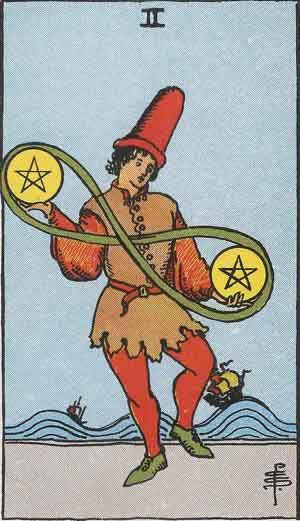
The Two of Pentacles often contains a lemniscate (∞); a reminder, perhaps, that the resources which feel so stretched and fragile right now are, in truth, eternal. The Intuitive card shows this just above the head of a distorted silhouette; it's huge, white, swirled and symmetrical. The RWS shows a juggler with two objects wrapped in a ∞-shaped sash. Keeping things balanced, symmetrical, is important to this card; it requires the budgeting of time (and often money and other resources). But the balance includes the rest of the deck, in its infinite extent - it tells you to not neglect the rest of your needs. (Many Major Arcana cards involve balance - notably Justice, the High Priestess and Temperance; you can look to them for guidance when dealing with any Two, this one especially).
Images of the Two of Pentacles
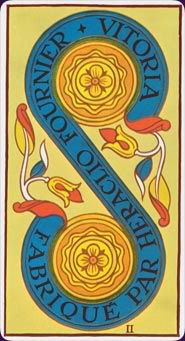
The Marseilles shows two coins, a broken lemniscate that sprouts flowers, and - tellingly - is the card that features the deck's maker's mark, as the Ace of Spades sometimes does in modern 52s.
Did I mention the RWS juggler is doing his thing on the beach with the tide coming in behind him? This image makes me think of Morecambe Bay, which I used to live not far from; a treacherous six-mile stretch of sand which should only be negotiated with the aid of the official guide (who is paid £6 a year by royal decree). The bay is place of myth; it is pitted with quicksand, and it is said that the tide comes in faster than a galloping horse. It was on Morecambe Bay that 23 Chinese cockle-pickers were killed in February 2004. (I will not say they drowned or simply died; they were killed by their piece-of-shit gangmaster. Pentacles know the difference between what is and what is caused to be).
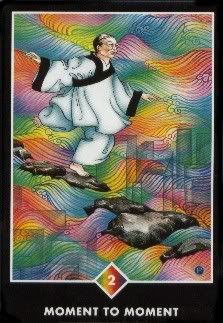
The Osho Zen 'Moment To Moment' card shows a man taking stepping stones over rainbows.
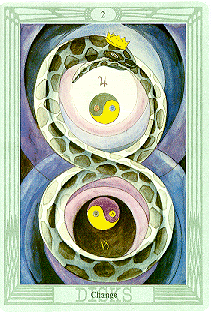
This is probably the only Thoth card I am ever going to link; here we see the balance of yin and yang, within a loop formed by the ouroboros. (This is a 8 rather than a ∞; eh?) As with most Thoth images, it's a very simple blending of symbols, one that emphasises symmetry.
And the Mythic Daedalus, whose work is just begun.
Three Of Pentacles
place a grain of sand on another grain of sand
turn the wheel
press down
make a stone, layer by layer
place a block of stone on another block of stone
turn the wheel
you can see it
turn the wheel
cut teeth into a wheel, place a wheel -
- atop another wheel, make a gear
make a handle
let the handle turn the wheel -
let it go
let there be work within your working
without you working
iteration
grains of sand
Grains of sand.
(Yeah, I love Sid Meier's Alpha Centauri).
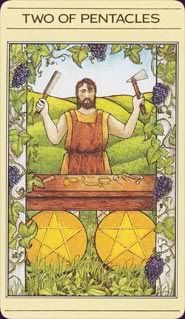
...I swore to god I'd done this bitch before. So much so that when I drew it, I went right past it looking for a new card to write about. Why did I think I'd pondered on its face before - its impossible Escherian architecture, its turning cogwheels, its tiny overseer?
This is the grind. It's never new, I guess.
I rather like structure; one reason this site feels so good to write on is that I know what I have to do each time a new card comes out of the deck - let it talk in italics, rant a while, post some pretty pictures, publish, check it's popped out in the right order, go add it to the list, rinse, x78. It's easy to go through the motions, and easy to pause and then get going again where I left off. On the other hand, it's no surprise at all that I burned out after about x50 and didn't pick it up again for another six months.
The Three of Cups is in it for the long run, and it's boring; the RWS shows the building of a cathedral, and that's a project that can run for decades or centuries. The most beautiful church in the world, Barcelona's Sagrada Familia, has been under construction since 1882 and still isn't ready yet, but it's getting there by inches and dear god will it ever be worth it when it's done.
You could say the same about human civilisation - with its impossible figures and shady construction schedule. (You don't want to ask about the budget).
I drew it alongside the Two of Pentacles ('you've always got time') and the Magician ('what you do for yourself matters for the world'). Those, yeah, I'd done already, and I thought 'right, sure, keep grinding, now move on to the next page.'
I guess this is a poke suggesting I be more meticulous in my work in future? Whatever.
Images of the Three of Pentacles
Here's Conway's picture. I think the overseer is shrugging and maybe wondering what the machine is accomplishing? But still it turns, beneath that structure that makes no sense, and still we keep building.
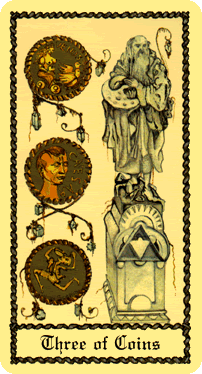
Scapini has also gone with stonework - I look at this and I see Lear and Caesar, I see a pyramid built of pyramids, and I see a whole edifice weeping at its own construction.
turn the wheel
press down
make a stone, layer by layer
place a block of stone on another block of stone
turn the wheel
you can see it
turn the wheel
cut teeth into a wheel, place a wheel -
- atop another wheel, make a gear
make a handle
let the handle turn the wheel -
let it go
let there be work within your working
without you working
iteration
grains of sand
Grains of sand.
(Yeah, I love Sid Meier's Alpha Centauri).
...I swore to god I'd done this bitch before. So much so that when I drew it, I went right past it looking for a new card to write about. Why did I think I'd pondered on its face before - its impossible Escherian architecture, its turning cogwheels, its tiny overseer?
This is the grind. It's never new, I guess.
I rather like structure; one reason this site feels so good to write on is that I know what I have to do each time a new card comes out of the deck - let it talk in italics, rant a while, post some pretty pictures, publish, check it's popped out in the right order, go add it to the list, rinse, x78. It's easy to go through the motions, and easy to pause and then get going again where I left off. On the other hand, it's no surprise at all that I burned out after about x50 and didn't pick it up again for another six months.
The Three of Cups is in it for the long run, and it's boring; the RWS shows the building of a cathedral, and that's a project that can run for decades or centuries. The most beautiful church in the world, Barcelona's Sagrada Familia, has been under construction since 1882 and still isn't ready yet, but it's getting there by inches and dear god will it ever be worth it when it's done.
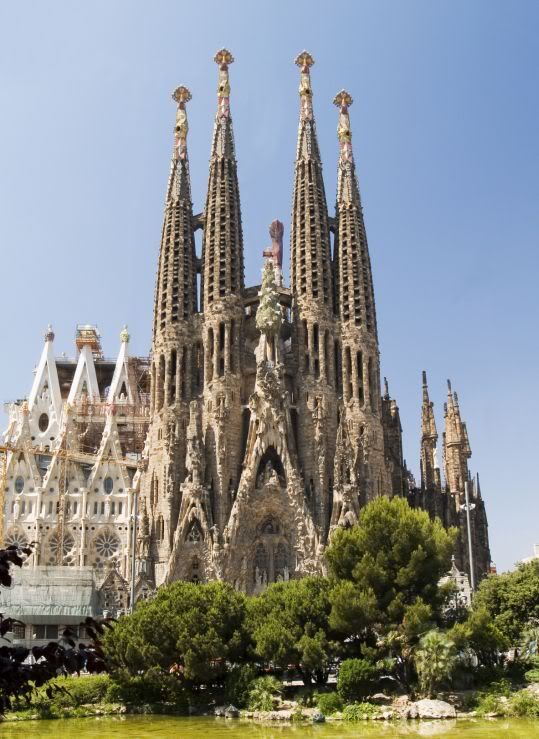
You could say the same about human civilisation - with its impossible figures and shady construction schedule. (You don't want to ask about the budget).
I drew it alongside the Two of Pentacles ('you've always got time') and the Magician ('what you do for yourself matters for the world'). Those, yeah, I'd done already, and I thought 'right, sure, keep grinding, now move on to the next page.'
I guess this is a poke suggesting I be more meticulous in my work in future? Whatever.
Images of the Three of Pentacles
Here's Conway's picture. I think the overseer is shrugging and maybe wondering what the machine is accomplishing? But still it turns, beneath that structure that makes no sense, and still we keep building.
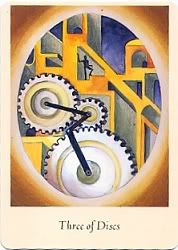
Scapini has also gone with stonework - I look at this and I see Lear and Caesar, I see a pyramid built of pyramids, and I see a whole edifice weeping at its own construction.
Four Of Pentacles
this is about protection
this is about me wrapped around them holding them under me protected solid safe
this is about them protecting me me needing them knowing them using
them using me
this is about everything is within me nothing
nothing outside
i can't see anything outside
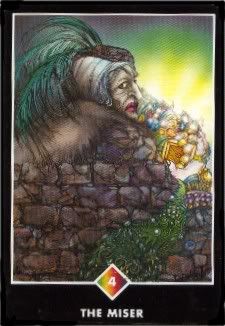
It's tough not being down about the Four of Pentacles. Earth is a shape here; come from a point, to a moving line, to a geometric form, and now become a solid thing. This card is called Miser; it is a hoard, something trapped by its human owner as it is trapping him in turn. It is clasped tight, not used; held with awe and fear, but not use.
It's so easy to be down on this. But this shape is not simply a prison; think, without it, everything would fall through your hands. A Four of Pentacles maintains, budgets, is never without shelter. Just gotta be careful of it. It can be a box of gold inside a person. It can also be a person inside a box of gold.
Images of the Four of Pentacles:
The Rider-Waite-Smith original; rather hunched - perhaps fearful, perhaps taking shelter.
The Osho Zen Four, caught out in the cold.
this is about me wrapped around them holding them under me protected solid safe
this is about them protecting me me needing them knowing them using
them using me
this is about everything is within me nothing
nothing outside
i can't see anything outside
It's tough not being down about the Four of Pentacles. Earth is a shape here; come from a point, to a moving line, to a geometric form, and now become a solid thing. This card is called Miser; it is a hoard, something trapped by its human owner as it is trapping him in turn. It is clasped tight, not used; held with awe and fear, but not use.
It's so easy to be down on this. But this shape is not simply a prison; think, without it, everything would fall through your hands. A Four of Pentacles maintains, budgets, is never without shelter. Just gotta be careful of it. It can be a box of gold inside a person. It can also be a person inside a box of gold.
Images of the Four of Pentacles:
The Rider-Waite-Smith original; rather hunched - perhaps fearful, perhaps taking shelter.

The Osho Zen Four, caught out in the cold.
Five Of Pentacles
as I walked across the desert
I met a man upon the sands
'Why do you cross the desert?' he said
'Tis hard, but must be done.
There is no shade in the city now,
just turning wheels of bronze.
If I walk, if I endure, then I can join the world again.'
He bowed his hooded head, and I asked him in turn;
'Why do you stay here in the desert?
What do you do upon the sands?'
Said he, 'The city is but turning wheels,
the sands but empty ground.
Here, the birds fly free; like them
I make my shade from freedom
I prosper in my solitude
My world is on these sands.'
Dreaded continuity; there is no desert on the Intuitive Page Of Wands, I just intuited one, and here it is, the moment I turn my next card. And it's perfect; I don't recall seeing one on a Five of Pentacles before, I recall more midnight flights than harsh sunlight here, but god, I like this.
The Five of Pentacles is that moment where the security of the Four, that treasurebox with a man inside (or vice versa), is exposed to a new dimension; time. And time is not kind to locks, for there is always a new lockpick. It doesn't matter what happened, if the scene of the Four even occurred prior to the given situation, but this is a Pentacle in the flow of time; it erodes, becomes sand, and is carried far from the safety of the city.
In spite of the card's despondency and signs of hardship, I feel it points towards a happy ending. You can learn a lot from having the supposedly secure things in life give way - you can learn what there is left after security has gone; how huge the world is, and how bountiful; how there is more to good fortune than keeping the same possessions in the same place for all time. The Five of Pentacles travels with few burdens, but with its back bowed; because of those few burdens, it can learn to raise its head to the sun again.
Images of the Five of Pentacles:
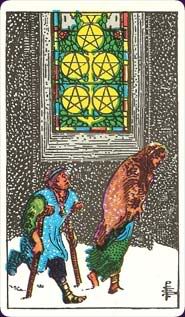
The RWS shows two figures walking past a church; one is ragged, and I think is only half shod - the other is disabled. It is snowing. The missing shoe may be the source of my optimism about the card - my shadow, Sendalin, usually appears to me barefoot, and he is known to be optimistic in even the most peculiar circumstances.
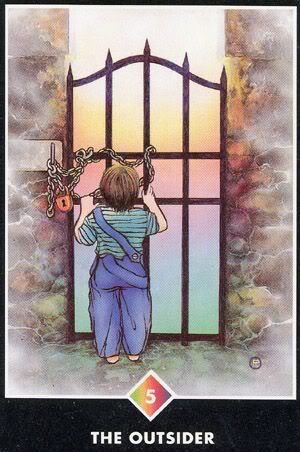
The Osho Zen 'Outsider': look closely, and you'll see that the padlock isn't actually closed, something the Outsider has seemingly neglected to notice in his hurry to perve wistfully over the place he's not inside of.
I met a man upon the sands
'Why do you cross the desert?' he said
'Tis hard, but must be done.
There is no shade in the city now,
just turning wheels of bronze.
If I walk, if I endure, then I can join the world again.'
He bowed his hooded head, and I asked him in turn;
'Why do you stay here in the desert?
What do you do upon the sands?'
Said he, 'The city is but turning wheels,
the sands but empty ground.
Here, the birds fly free; like them
I make my shade from freedom
I prosper in my solitude
My world is on these sands.'
Dreaded continuity; there is no desert on the Intuitive Page Of Wands, I just intuited one, and here it is, the moment I turn my next card. And it's perfect; I don't recall seeing one on a Five of Pentacles before, I recall more midnight flights than harsh sunlight here, but god, I like this.
The Five of Pentacles is that moment where the security of the Four, that treasurebox with a man inside (or vice versa), is exposed to a new dimension; time. And time is not kind to locks, for there is always a new lockpick. It doesn't matter what happened, if the scene of the Four even occurred prior to the given situation, but this is a Pentacle in the flow of time; it erodes, becomes sand, and is carried far from the safety of the city.
In spite of the card's despondency and signs of hardship, I feel it points towards a happy ending. You can learn a lot from having the supposedly secure things in life give way - you can learn what there is left after security has gone; how huge the world is, and how bountiful; how there is more to good fortune than keeping the same possessions in the same place for all time. The Five of Pentacles travels with few burdens, but with its back bowed; because of those few burdens, it can learn to raise its head to the sun again.
Images of the Five of Pentacles:
The RWS shows two figures walking past a church; one is ragged, and I think is only half shod - the other is disabled. It is snowing. The missing shoe may be the source of my optimism about the card - my shadow, Sendalin, usually appears to me barefoot, and he is known to be optimistic in even the most peculiar circumstances.
The Osho Zen 'Outsider': look closely, and you'll see that the padlock isn't actually closed, something the Outsider has seemingly neglected to notice in his hurry to perve wistfully over the place he's not inside of.
Six Of Pentacles
To take the things you do not need
and let them drop
and to walk away the taller,
lighter,
to keep but one thing in your hand
to be straight-backed while others stoop:
This is power,
but power,
is not an easy thing to do.
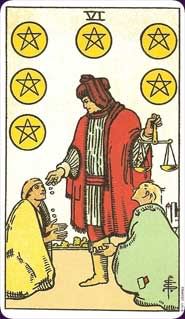
The Six of Pentacles concerns the power of giving. It looks very sweet up there in the RWS, prospering enough to attract beggars, kind enough to be letting things go (far cry from the Four - though if you see this as a continuing dynamic, given what goes down in the Five it's more likely that the character in the Four is the receiver here than the giver).
But to experience the power of giving, first you need to have enough to give away - or to have the strength to give up everything (except, perhaps, the piece you still hold in your hand). Neither could come from nowhere. 'Fact, we could even go ask the Five of Swords how you came by them. Or we could go look how the patronage economy of, say, Renaissance Italy, really worked and see who could give and who could receive, and how that reinforced the existing social hierarchy.
[I later took another look at the Six of Pentacles and the power of giving, here, one that spoke more of the lasting presence a gift can have in someone else's life.]
If sevens tend to be caught in uncertainty, sixes tend to be pleasant on the surface, but hiding all sorts of ugly secrets about power underneath. Many Sixes of Pentacles feature a set of scales, or some other indication that balance is important; this one doesn't, but the idea's still there in my head. The giving here can redress a balance, but 'balance' is equally likely to wind up just leaving things the way they currently are, rather than producing a real change. There's a cool take on this theme in the Osho Zen, so I guess it's time for the picture part.
Images of the Six of Pentacles:
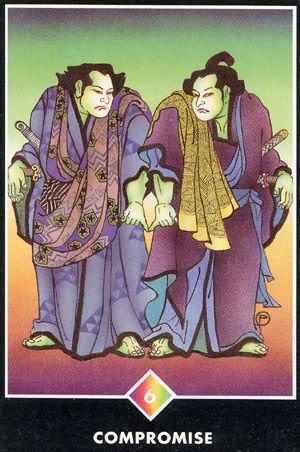
Compromise from the Osho Zen supposedly features a pair of eunuchs. In Three Kingdoms - a saga from China, rather than the land of Zen - the great moral message you're given, backed up by 2500+ pages of story, is 'Don't trust eunuchs, okay? Ever. Ever. Trusting eunuchs will make you fail'. Age-old suspicion of the gender-variant aside - this is about power and about how you negotiate with those who have it. 'Compromise' is a word that means 'giving away what you have, but trying to get more in return', which is the heart and soul of the Six of Pentacles. It's fine, it's a good trick to know, but what about the things you're not prepared to compromise? The things you won't trade away to the people who have power? If you're determined to compromise, how do you protect those things from these sinister men of power?
Here's the Intuitive card. See also the RWS, which isn't vastly different.
and let them drop
and to walk away the taller,
lighter,
to keep but one thing in your hand
to be straight-backed while others stoop:
This is power,
but power,
is not an easy thing to do.
The Six of Pentacles concerns the power of giving. It looks very sweet up there in the RWS, prospering enough to attract beggars, kind enough to be letting things go (far cry from the Four - though if you see this as a continuing dynamic, given what goes down in the Five it's more likely that the character in the Four is the receiver here than the giver).
But to experience the power of giving, first you need to have enough to give away - or to have the strength to give up everything (except, perhaps, the piece you still hold in your hand). Neither could come from nowhere. 'Fact, we could even go ask the Five of Swords how you came by them. Or we could go look how the patronage economy of, say, Renaissance Italy, really worked and see who could give and who could receive, and how that reinforced the existing social hierarchy.
[I later took another look at the Six of Pentacles and the power of giving, here, one that spoke more of the lasting presence a gift can have in someone else's life.]
If sevens tend to be caught in uncertainty, sixes tend to be pleasant on the surface, but hiding all sorts of ugly secrets about power underneath. Many Sixes of Pentacles feature a set of scales, or some other indication that balance is important; this one doesn't, but the idea's still there in my head. The giving here can redress a balance, but 'balance' is equally likely to wind up just leaving things the way they currently are, rather than producing a real change. There's a cool take on this theme in the Osho Zen, so I guess it's time for the picture part.
Images of the Six of Pentacles:
Compromise from the Osho Zen supposedly features a pair of eunuchs. In Three Kingdoms - a saga from China, rather than the land of Zen - the great moral message you're given, backed up by 2500+ pages of story, is 'Don't trust eunuchs, okay? Ever. Ever. Trusting eunuchs will make you fail'. Age-old suspicion of the gender-variant aside - this is about power and about how you negotiate with those who have it. 'Compromise' is a word that means 'giving away what you have, but trying to get more in return', which is the heart and soul of the Six of Pentacles. It's fine, it's a good trick to know, but what about the things you're not prepared to compromise? The things you won't trade away to the people who have power? If you're determined to compromise, how do you protect those things from these sinister men of power?
Here's the Intuitive card. See also the RWS, which isn't vastly different.

Seven Of Pentacles
seven suns for seven seas
they pointillise the sky, as if it were
so many grains of sand from
the beach of the all-River
as if the beach were a person
as if the person were the sea at seven sunsets
as if.
do you chance the purple waters
in your fragile, unbound form?
or do you wait for night to find you
by the crazy purple shore?
This is a pretty one. There's a confusion between person and sand here, between meadow and sky. I also have no idea how to read it - my head is cluttered with other Sevens of Pentacles, and - the pointillist metaphor turns on - I am not sure whether to read the entire clutch of cards I've seen, or this individual one here.
Now these points of data make a beautiful line -
Much like the Seven of Cups, it's a bit of a doubtful mess. But the confusion here is about physical investment - about being involved in something, having put some stake and perhaps a lot of effort into it, then having to ask; 'is this ever going to be worth it?' Will you ever put enough points of colour in the sky to make a picture? If you leave the shallows and swim, could you truly make it over the dark waters, or will you fall apart?
It's about trust in yourself, and the ability to work hard for what you've invested in. It's also about the ability to spot a bad risk, say 'no' when it's time to say no, and back out with grace before the sea washes over you. It's back-up and shelter as well as long efforts and dirty hands.
Images of the Seven of Pentacles:
The Scapini card makes the risk element prominent; here we have gamblers. Will they quit when they're ahead, play on and lose it all, or fold before they start?
The Osho Zen brings out the virtue at the heart of the Seven of Pentacles: Patience.
Over at the Mythic deck, Daedalus should've said 'no'. Really. Just because you know you can do it doesn't mean it's worth your effort. There could be risks you're not thinking of, like angry kings, or the possibility that you're just a pawn in some game being played by a jealous god. Gotta watch your step here.
they pointillise the sky, as if it were
so many grains of sand from
the beach of the all-River
as if the beach were a person
as if the person were the sea at seven sunsets
as if.
do you chance the purple waters
in your fragile, unbound form?
or do you wait for night to find you
by the crazy purple shore?
This is a pretty one. There's a confusion between person and sand here, between meadow and sky. I also have no idea how to read it - my head is cluttered with other Sevens of Pentacles, and - the pointillist metaphor turns on - I am not sure whether to read the entire clutch of cards I've seen, or this individual one here.
Much like the Seven of Cups, it's a bit of a doubtful mess. But the confusion here is about physical investment - about being involved in something, having put some stake and perhaps a lot of effort into it, then having to ask; 'is this ever going to be worth it?' Will you ever put enough points of colour in the sky to make a picture? If you leave the shallows and swim, could you truly make it over the dark waters, or will you fall apart?
It's about trust in yourself, and the ability to work hard for what you've invested in. It's also about the ability to spot a bad risk, say 'no' when it's time to say no, and back out with grace before the sea washes over you. It's back-up and shelter as well as long efforts and dirty hands.
Images of the Seven of Pentacles:
The Scapini card makes the risk element prominent; here we have gamblers. Will they quit when they're ahead, play on and lose it all, or fold before they start?
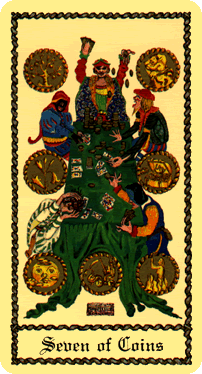
The Osho Zen brings out the virtue at the heart of the Seven of Pentacles: Patience.
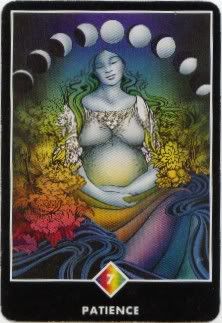
Over at the Mythic deck, Daedalus should've said 'no'. Really. Just because you know you can do it doesn't mean it's worth your effort. There could be risks you're not thinking of, like angry kings, or the possibility that you're just a pawn in some game being played by a jealous god. Gotta watch your step here.
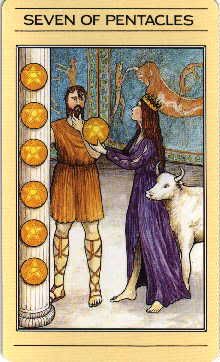
Eight Of Pentacles
a chip of the hammer
a turn of the wheel
a careful hand
a bent head
an hour's practice.
With these things,
I will succeed,
every making will be like the last,
and tomorrow will be like today.
This is the first Eight out of the deck. I haven't had a Seven yet either. Eights are resolutions - they bring you a new form of work to do on their element, work that will bring you toward completion - and the work of Earth is work.
The Eight of Pentacles is called the Apprentice. It's often shown in a workshop setting; both the Intuitive card and the RWS shows it making Pentacles - crafting the symbols of Earth. The work an Eight does is perhaps about a shift from letting an element work through you to engineering the element's experiences yourself. Earlier Pentacles - see the Two, Four, or Five - are being acted on by Earth, trying to cope with its energies. The Eight asks you to take Earth and (if I may quote a phrase I love from a man I love) shape it on the anvil of your will.
The Eight of Pentacles is probably tiring; it may be boring, but only if you don't pay attention. Its creations are inherently samey - even if they appear to show variety, the energy within them will be the same. The Eight is finicky, and needs gentleness and care. It is daunting, too, but totally worthwhile.
Images of the Eight of Pentacles:
The Osho Zen Eight of Pentacles is called Ordinariness; rather than a workshop, its character is toiling in the fields - a direct nod up to the Nine. The card seems happy.
The Scapini image shows a worker on a ladder, and beneath, a woman and a child. This is a clumsy heteronormative way to remind us of how family can be as relevant to the Pentacles as to the Cups, and how the work we do is often for, about, or affected by, family. (It's an essentially good idea, but I need to see a version of this image where the woman is subject, not object, before I can grok it).
a turn of the wheel
a careful hand
a bent head
an hour's practice.
With these things,
I will succeed,
every making will be like the last,
and tomorrow will be like today.
This is the first Eight out of the deck. I haven't had a Seven yet either. Eights are resolutions - they bring you a new form of work to do on their element, work that will bring you toward completion - and the work of Earth is work.
The Eight of Pentacles is called the Apprentice. It's often shown in a workshop setting; both the Intuitive card and the RWS shows it making Pentacles - crafting the symbols of Earth. The work an Eight does is perhaps about a shift from letting an element work through you to engineering the element's experiences yourself. Earlier Pentacles - see the Two, Four, or Five - are being acted on by Earth, trying to cope with its energies. The Eight asks you to take Earth and (if I may quote a phrase I love from a man I love) shape it on the anvil of your will.
The Eight of Pentacles is probably tiring; it may be boring, but only if you don't pay attention. Its creations are inherently samey - even if they appear to show variety, the energy within them will be the same. The Eight is finicky, and needs gentleness and care. It is daunting, too, but totally worthwhile.
Images of the Eight of Pentacles:
The Osho Zen Eight of Pentacles is called Ordinariness; rather than a workshop, its character is toiling in the fields - a direct nod up to the Nine. The card seems happy.
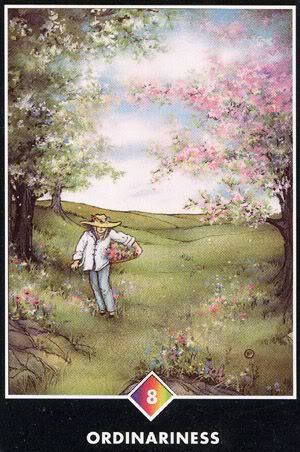
The Scapini image shows a worker on a ladder, and beneath, a woman and a child. This is a clumsy heteronormative way to remind us of how family can be as relevant to the Pentacles as to the Cups, and how the work we do is often for, about, or affected by, family. (It's an essentially good idea, but I need to see a version of this image where the woman is subject, not object, before I can grok it).

Nine Of Pentacles
my open eyes
my orchard ground
my ships
my harvest
my open hand
my body
your sky
your sea.
my open hand.
This is my tenth card article; I have nine completed ones sat on the blog front page. Three a day, every day, I hope, though tonight I am very tired; yesterday and the day before, I felt full of life when I was done, ready for a fourth, but I really don't want to burn this out. Harvesting feels nice. Writing is a harvest - a harvest of thoughts and feelings that were sown long ago, left to grow as you read, as you turned your earth over.
That this is so much easier than writing fiction maybe tells me what I ought to be doing with the words in my head. But it's good to rotate, to avoid monoculture, and to let your mind run fallow for a year at a time.
As with all things Pentacle, a good harvest does not spring out of nowhere; neither does it disappear when you put the hoes away. [...I'm sorry.] Whose orchard is it - whose harvest? There's this beautiful idea, I think in the first appendix of ILLUMINATUS!, that it's absurd for a human being to claim to own land, or a building - how can something far older than you, which will live far longer than you will, be your possession? It is better to see oneself as steward to the harvest rather than the owner of it. For a more Pentacly footnote, see how much power, privilege, and capital gains tax plays into the owning and using of land.
And that harvest needs managing, has to last through your winter; and from what I know of winter, it would be good to share around some of what you have brought forth from the earth, so that the same will come to you in time. A real Pentacle would stab me for saying that, though.
So if there's a flaw, a reversal, here, it'd be taking your fruit for granted, rather than seeing why it's yours and where it has to go next. And as I hope the above stream-of-consciousness crap hinted, I fear there's a desire, in the Intuitive image, to think it natural to own the world.
(It's not come yet - though my guess is it'll be sooner rather than later, I'll jot this down in case it slips away: The Nine of Swords is reaping the whirlwind. (And the Nine of Cups is here, and has brought the spring tide)).
Images of the Nine of Pentacles:
Ripeness - the Osho Zen Nine. Great name, because it makes it about timing and about the fruit being ready for the harvest, rather than the harvester being ready. By removing the human character, the deck makes the natural process of harvest more clear.
The traditional hawker of the RWS. Why a hawker? The Intuitive card takes quite a nod from this one, only with more sea and no hawk.
my orchard ground
my ships
my harvest
my open hand
my body
your sky
your sea.
my open hand.
This is my tenth card article; I have nine completed ones sat on the blog front page. Three a day, every day, I hope, though tonight I am very tired; yesterday and the day before, I felt full of life when I was done, ready for a fourth, but I really don't want to burn this out. Harvesting feels nice. Writing is a harvest - a harvest of thoughts and feelings that were sown long ago, left to grow as you read, as you turned your earth over.
That this is so much easier than writing fiction maybe tells me what I ought to be doing with the words in my head. But it's good to rotate, to avoid monoculture, and to let your mind run fallow for a year at a time.
As with all things Pentacle, a good harvest does not spring out of nowhere; neither does it disappear when you put the hoes away. [...I'm sorry.] Whose orchard is it - whose harvest? There's this beautiful idea, I think in the first appendix of ILLUMINATUS!, that it's absurd for a human being to claim to own land, or a building - how can something far older than you, which will live far longer than you will, be your possession? It is better to see oneself as steward to the harvest rather than the owner of it. For a more Pentacly footnote, see how much power, privilege, and capital gains tax plays into the owning and using of land.
And that harvest needs managing, has to last through your winter; and from what I know of winter, it would be good to share around some of what you have brought forth from the earth, so that the same will come to you in time. A real Pentacle would stab me for saying that, though.
So if there's a flaw, a reversal, here, it'd be taking your fruit for granted, rather than seeing why it's yours and where it has to go next. And as I hope the above stream-of-consciousness crap hinted, I fear there's a desire, in the Intuitive image, to think it natural to own the world.
(It's not come yet - though my guess is it'll be sooner rather than later, I'll jot this down in case it slips away: The Nine of Swords is reaping the whirlwind. (And the Nine of Cups is here, and has brought the spring tide)).
Images of the Nine of Pentacles:
Ripeness - the Osho Zen Nine. Great name, because it makes it about timing and about the fruit being ready for the harvest, rather than the harvester being ready. By removing the human character, the deck makes the natural process of harvest more clear.
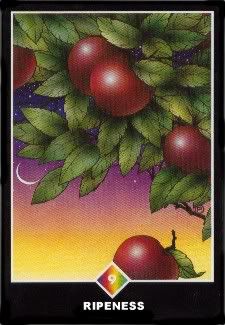
The traditional hawker of the RWS. Why a hawker? The Intuitive card takes quite a nod from this one, only with more sea and no hawk.
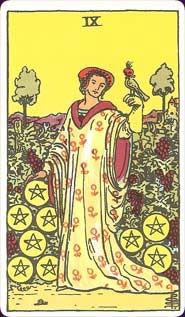
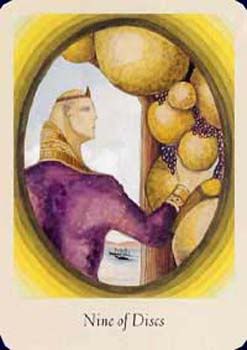
Subscribe to:
Posts (Atom)