as I walked across the desert
I met a man upon the sands
'Why do you cross the desert?' he said
'Tis hard, but must be done.
There is no shade in the city now,
just turning wheels of bronze.
If I walk, if I endure, then I can join the world again.'
He bowed his hooded head, and I asked him in turn;
'Why do you stay here in the desert?
What do you do upon the sands?'
Said he, 'The city is but turning wheels,
the sands but empty ground.
Here, the birds fly free; like them
I make my shade from freedom
I prosper in my solitude
My world is on these sands.'
Dreaded continuity; there is no desert on the Intuitive Page Of Wands, I just intuited one, and here it is, the moment I turn my next card. And it's perfect; I don't recall seeing one on a Five of Pentacles before, I recall more midnight flights than harsh sunlight here, but god, I like this.
The Five of Pentacles is that moment where the security of the Four, that treasurebox with a man inside (or vice versa), is exposed to a new dimension; time. And time is not kind to locks, for there is always a new lockpick. It doesn't matter what happened, if the scene of the Four even occurred prior to the given situation, but this is a Pentacle in the flow of time; it erodes, becomes sand, and is carried far from the safety of the city.
In spite of the card's despondency and signs of hardship, I feel it points towards a happy ending. You can learn a lot from having the supposedly secure things in life give way - you can learn what there is left after security has gone; how huge the world is, and how bountiful; how there is more to good fortune than keeping the same possessions in the same place for all time. The Five of Pentacles travels with few burdens, but with its back bowed; because of those few burdens, it can learn to raise its head to the sun again.
Images of the Five of Pentacles:
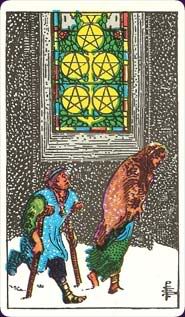
The RWS shows two figures walking past a church; one is ragged, and I think is only half shod - the other is disabled. It is snowing. The missing shoe may be the source of my optimism about the card - my shadow, Sendalin, usually appears to me barefoot, and he is known to be optimistic in even the most peculiar circumstances.
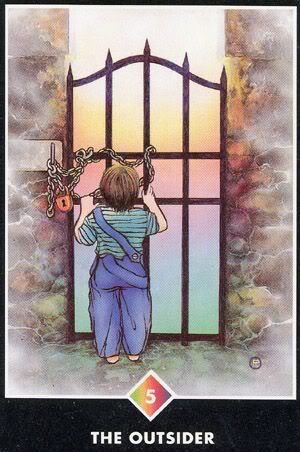
The Osho Zen 'Outsider': look closely, and you'll see that the padlock isn't actually closed, something the Outsider has seemingly neglected to notice in his hurry to perve wistfully over the place he's not inside of.

Index
All cards / Latest Cards / All other posts / Notes from Agla
Major Arcana / Minor Arcana / Court Cards
Wands / Pentacles / Cups / Swords
(For a list of all card articles, open March 2008 on the sidebar).
Showing posts with label fives. Show all posts
Showing posts with label fives. Show all posts
Thursday, 6 March 2008

Five Of Cups
Out brief candle.
Out, and dripping waxen, heavy,
molten,
losing shape
swirling into something else.
It is behind me now.
I don't know how it changes
emptying,
waxing waning
colours run away in the storm.
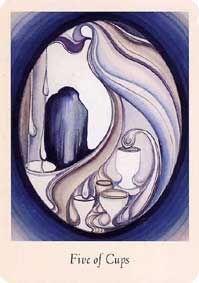
I confess, it occurred to me when I was writing about the Four of Cups that Conway's image shared a few features with many Fives of Cups; the dark-robed character, the disappointed look while he dwells on what has spilt. I think the difference here, in this washed-out, melting landscape, is time. It always is, with the Fives. He's turned away; some cups are still filling with droplets of...nothing, and some are barely there, between the curves of the image. This guy is sore about the past, but he's not paying much attention to the future either. The Four of Cups wanted something it had lost, or never had; the Five of Cups just wants to be left alone.
How did this happen? I think the Five tends to blame the Four for getting it into this. But again; time. Time as water, washing away the things that used to matter, leaving you feeling like this card looks - grey, confused and not sure where to go. I felt the Five of Cups most keenly in the days after I finished university; I had a stack of projects and pleasures I'd kept putting off til I'd finished - books to read, games to play, things to do - and suddenly time had moved on and given me endless empty hours to do those things in...and I didn't want to; none of it seemed worth a damn any more, because the past had gone and I didn't know what I was going to do with the future.
(Hint: I still don't.)
Images of the Five of Cups:
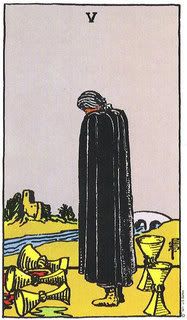
The RWS. Funny, it's really only because of this card that you can tell the black shape in the Intuitive card is even human.
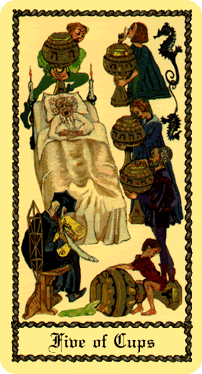
A weird scene from Scapini: my reading of it is that the central character is dying and the other five are busy carrying away her wealth while she yet breathes; one has spilt their cup already. One is crying into hers, piously - maybe she's really sad, but she could just be weeping to justify the gain she's making from the sadness. In other words, I think Scapini's Five of Cup is a card of emotional looting; of wanking over drama; of emotional greed, and disrespect for what is felt in the moment, good or bad. It is vultures come to take a drink.
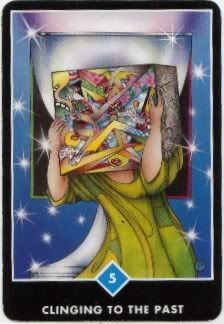
The Osho Zen is pretty upfront: Clinging To The Past. The same theme's brought out in the RWS, where the sad figure keeps looking to the left, and so never sees that though three cups are split, to his right there are two which are yet full to the brim.
Out, and dripping waxen, heavy,
molten,
losing shape
swirling into something else.
It is behind me now.
I don't know how it changes
emptying,
waxing waning
colours run away in the storm.
I confess, it occurred to me when I was writing about the Four of Cups that Conway's image shared a few features with many Fives of Cups; the dark-robed character, the disappointed look while he dwells on what has spilt. I think the difference here, in this washed-out, melting landscape, is time. It always is, with the Fives. He's turned away; some cups are still filling with droplets of...nothing, and some are barely there, between the curves of the image. This guy is sore about the past, but he's not paying much attention to the future either. The Four of Cups wanted something it had lost, or never had; the Five of Cups just wants to be left alone.
How did this happen? I think the Five tends to blame the Four for getting it into this. But again; time. Time as water, washing away the things that used to matter, leaving you feeling like this card looks - grey, confused and not sure where to go. I felt the Five of Cups most keenly in the days after I finished university; I had a stack of projects and pleasures I'd kept putting off til I'd finished - books to read, games to play, things to do - and suddenly time had moved on and given me endless empty hours to do those things in...and I didn't want to; none of it seemed worth a damn any more, because the past had gone and I didn't know what I was going to do with the future.
(Hint: I still don't.)
Images of the Five of Cups:
The RWS. Funny, it's really only because of this card that you can tell the black shape in the Intuitive card is even human.
A weird scene from Scapini: my reading of it is that the central character is dying and the other five are busy carrying away her wealth while she yet breathes; one has spilt their cup already. One is crying into hers, piously - maybe she's really sad, but she could just be weeping to justify the gain she's making from the sadness. In other words, I think Scapini's Five of Cup is a card of emotional looting; of wanking over drama; of emotional greed, and disrespect for what is felt in the moment, good or bad. It is vultures come to take a drink.
The Osho Zen is pretty upfront: Clinging To The Past. The same theme's brought out in the RWS, where the sad figure keeps looking to the left, and so never sees that though three cups are split, to his right there are two which are yet full to the brim.
Five Of Swords
one is under, one is over
one has power, one has none
one is secret, one is naked
one is stooping, one is tall.
one has all, and one has nothing
one is dark, and one is bright
one is cloud, and one is ocean
one will rise, and one will fall.
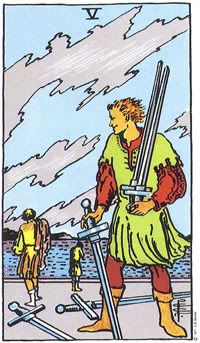
The Five of Swords - Air in the sands of time - is, maybe, the place the deck comes closest to Geburah. It's a card that brings up the bad stuff you have to do to keep the good stuff going; it's no more avoidable than the last card I pulled, the Three of Cups. The Five of Swords is a tough lover; it says yes, live, endure, but know that there are hard parts. And above all, know about power. Know how to have enough of it to scrape by.
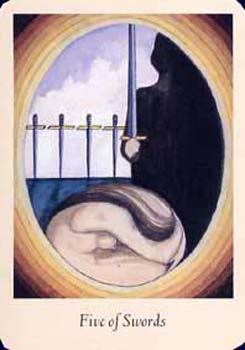
The Intuitive card makes that pretty explicit, but it does one thing that Fives of Swords usually don't; it focuses on the loser. The victor who's holding all the knives is completely cowled. (Which could be an indication that both are the same person, Jung-stylee). It's a different take on the usual situation, which shows the defeated only in the background, but I think the same undercurrent exists; they'll be back, because they are still alive. (And not even angry. Hit me.) I've never seen blood on a Five of Swords, just defeat and bruises - and this isn't the Six of Wands; if you win, no one's going to throw you a parade.
Above all, this card is a reminder that life is a zero-sum game; you will find places where a situation cannot be resolved in a way that makes everyone happy. There will be losses, yieldings, ugly wins, graceful surrenders to sorrow, and beatings that no one wants to talk about. But you can get up, and go down to the sea - and from there you can pick up the sword and go back to the fight, or you can keep walking.
Images of the Five of Swords:
Here's the Intuitive card - honestly? I'm half-tempted to call D/s here. There's no sign of harm done, only of power and implicit threats that don't seem to fit any possible real situation, only a figurative one. Clearly I just have a dirty mind. There's also the clear hint that the barely-there background character - someone completely out of focus and dehumanised - isn't real, but merely projected.
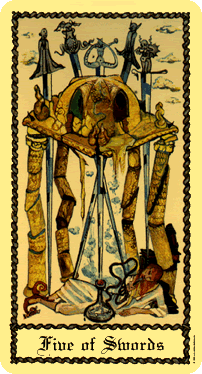
The Scapini is similarly focused on the person at the bottom, but there's no one on top of the pyramid. Envy, maybe?
The RWS pic, just so's you know.
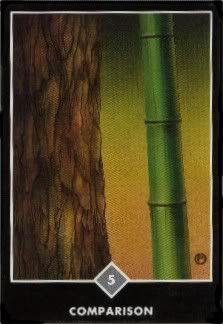
Comparison, the Osho Zen image, makes that whole power dynamic vivid; how can the bamboo compare to the old treetrunk? It can't. But they can both win; that's ecosystems for you.
one has power, one has none
one is secret, one is naked
one is stooping, one is tall.
one has all, and one has nothing
one is dark, and one is bright
one is cloud, and one is ocean
one will rise, and one will fall.
The Five of Swords - Air in the sands of time - is, maybe, the place the deck comes closest to Geburah. It's a card that brings up the bad stuff you have to do to keep the good stuff going; it's no more avoidable than the last card I pulled, the Three of Cups. The Five of Swords is a tough lover; it says yes, live, endure, but know that there are hard parts. And above all, know about power. Know how to have enough of it to scrape by.
The Intuitive card makes that pretty explicit, but it does one thing that Fives of Swords usually don't; it focuses on the loser. The victor who's holding all the knives is completely cowled. (Which could be an indication that both are the same person, Jung-stylee). It's a different take on the usual situation, which shows the defeated only in the background, but I think the same undercurrent exists; they'll be back, because they are still alive. (
Above all, this card is a reminder that life is a zero-sum game; you will find places where a situation cannot be resolved in a way that makes everyone happy. There will be losses, yieldings, ugly wins, graceful surrenders to sorrow, and beatings that no one wants to talk about. But you can get up, and go down to the sea - and from there you can pick up the sword and go back to the fight, or you can keep walking.
Images of the Five of Swords:
Here's the Intuitive card - honestly? I'm half-tempted to call D/s here. There's no sign of harm done, only of power and implicit threats that don't seem to fit any possible real situation, only a figurative one. Clearly I just have a dirty mind. There's also the clear hint that the barely-there background character - someone completely out of focus and dehumanised - isn't real, but merely projected.
The Scapini is similarly focused on the person at the bottom, but there's no one on top of the pyramid. Envy, maybe?
The RWS pic, just so's you know.
Comparison, the Osho Zen image, makes that whole power dynamic vivid; how can the bamboo compare to the old treetrunk? It can't. But they can both win; that's ecosystems for you.
Subscribe to:
Posts (Atom)