one
the first step of a thousand miles
two
the open roads before me
three
I am rising
four
I am stooping under the sun
five
the climb is steep, and I am tired
six
and I am here.
The Six of Wands is suspiciously benign. It is victory, and it is celebration of victory; it is a triumph parade after a long, deliberate effort. The Six of Wands never comes from nowhere, and is rarely a surprise. The Six of Wands says you earned this. On the other hand, it says and now you have to live up to it, which is perhaps why the Wands get so complicated from here on up.
Conway's image has, as far as I know, only one commonality with most Sixes of Wands; it's daylight. Her figure (seemingly naked, possibly male) has climbed his steep curve, and now raises merry arms to the sun. But I am a dawnwatcher, and I think the sun in the image looks like a setting sun.
The Six of Wands tells you to raise your hands and celebrate the ways that your dreams and ideas have come about, but it advises against resting on your laurels; a reversed card may be doing just that, though I'd be more inclined to read a reversal as meaning a failure to celebrate what you have done. Celebration is a moment in every soul, and it is not wrong to bring it to the surface. That said, go read verse 31 of the Tao Te Ching; its message, that war ends with a funeral, not with triumph, was recently echoed by Our Crucial Pamphlet from Penny Arcade.
Images of the Six of Wands:
The Dragon Tarot has the first Six of Wands I fell for; a black letter V, and a diamond beneath it. In my head this card will always be linked to - owned by, part of - Gaiety, the Knight of Wands.
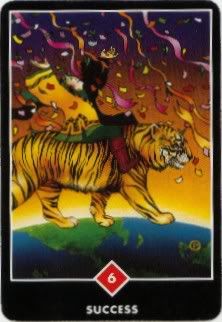
In the Osho Zen, Success is a man astride a tiger, walking over the world.
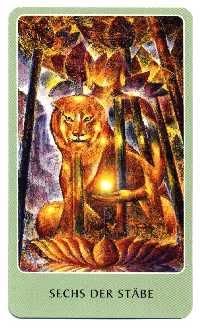
The Roots of Asia also has a great cat, resting in the shade - this card suggests a Six in territorial victory.

Index
All cards / Latest Cards / All other posts / Notes from Agla
Major Arcana / Minor Arcana / Court Cards
Wands / Pentacles / Cups / Swords
(For a list of all card articles, open March 2008 on the sidebar).
Showing posts with label sixes. Show all posts
Showing posts with label sixes. Show all posts
Thursday, 6 March 2008

Six Of Pentacles
To take the things you do not need
and let them drop
and to walk away the taller,
lighter,
to keep but one thing in your hand
to be straight-backed while others stoop:
This is power,
but power,
is not an easy thing to do.
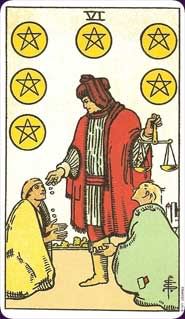
The Six of Pentacles concerns the power of giving. It looks very sweet up there in the RWS, prospering enough to attract beggars, kind enough to be letting things go (far cry from the Four - though if you see this as a continuing dynamic, given what goes down in the Five it's more likely that the character in the Four is the receiver here than the giver).
But to experience the power of giving, first you need to have enough to give away - or to have the strength to give up everything (except, perhaps, the piece you still hold in your hand). Neither could come from nowhere. 'Fact, we could even go ask the Five of Swords how you came by them. Or we could go look how the patronage economy of, say, Renaissance Italy, really worked and see who could give and who could receive, and how that reinforced the existing social hierarchy.
[I later took another look at the Six of Pentacles and the power of giving, here, one that spoke more of the lasting presence a gift can have in someone else's life.]
If sevens tend to be caught in uncertainty, sixes tend to be pleasant on the surface, but hiding all sorts of ugly secrets about power underneath. Many Sixes of Pentacles feature a set of scales, or some other indication that balance is important; this one doesn't, but the idea's still there in my head. The giving here can redress a balance, but 'balance' is equally likely to wind up just leaving things the way they currently are, rather than producing a real change. There's a cool take on this theme in the Osho Zen, so I guess it's time for the picture part.
Images of the Six of Pentacles:
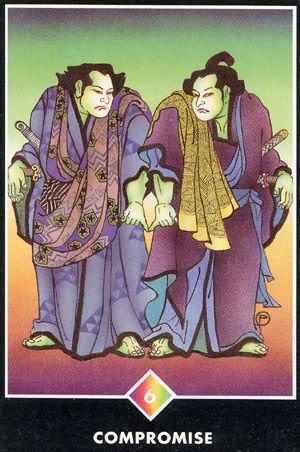
Compromise from the Osho Zen supposedly features a pair of eunuchs. In Three Kingdoms - a saga from China, rather than the land of Zen - the great moral message you're given, backed up by 2500+ pages of story, is 'Don't trust eunuchs, okay? Ever. Ever. Trusting eunuchs will make you fail'. Age-old suspicion of the gender-variant aside - this is about power and about how you negotiate with those who have it. 'Compromise' is a word that means 'giving away what you have, but trying to get more in return', which is the heart and soul of the Six of Pentacles. It's fine, it's a good trick to know, but what about the things you're not prepared to compromise? The things you won't trade away to the people who have power? If you're determined to compromise, how do you protect those things from these sinister men of power?
Here's the Intuitive card. See also the RWS, which isn't vastly different.
and let them drop
and to walk away the taller,
lighter,
to keep but one thing in your hand
to be straight-backed while others stoop:
This is power,
but power,
is not an easy thing to do.
The Six of Pentacles concerns the power of giving. It looks very sweet up there in the RWS, prospering enough to attract beggars, kind enough to be letting things go (far cry from the Four - though if you see this as a continuing dynamic, given what goes down in the Five it's more likely that the character in the Four is the receiver here than the giver).
But to experience the power of giving, first you need to have enough to give away - or to have the strength to give up everything (except, perhaps, the piece you still hold in your hand). Neither could come from nowhere. 'Fact, we could even go ask the Five of Swords how you came by them. Or we could go look how the patronage economy of, say, Renaissance Italy, really worked and see who could give and who could receive, and how that reinforced the existing social hierarchy.
[I later took another look at the Six of Pentacles and the power of giving, here, one that spoke more of the lasting presence a gift can have in someone else's life.]
If sevens tend to be caught in uncertainty, sixes tend to be pleasant on the surface, but hiding all sorts of ugly secrets about power underneath. Many Sixes of Pentacles feature a set of scales, or some other indication that balance is important; this one doesn't, but the idea's still there in my head. The giving here can redress a balance, but 'balance' is equally likely to wind up just leaving things the way they currently are, rather than producing a real change. There's a cool take on this theme in the Osho Zen, so I guess it's time for the picture part.
Images of the Six of Pentacles:
Compromise from the Osho Zen supposedly features a pair of eunuchs. In Three Kingdoms - a saga from China, rather than the land of Zen - the great moral message you're given, backed up by 2500+ pages of story, is 'Don't trust eunuchs, okay? Ever. Ever. Trusting eunuchs will make you fail'. Age-old suspicion of the gender-variant aside - this is about power and about how you negotiate with those who have it. 'Compromise' is a word that means 'giving away what you have, but trying to get more in return', which is the heart and soul of the Six of Pentacles. It's fine, it's a good trick to know, but what about the things you're not prepared to compromise? The things you won't trade away to the people who have power? If you're determined to compromise, how do you protect those things from these sinister men of power?
Here's the Intuitive card. See also the RWS, which isn't vastly different.
Six Of Cups
looking back, it's all rosy
such a long winding way
All looks so close together -
trees and treasures,
great adventures -
clusters on the horizon, but not gone out of sight
looking back, walking onward
oh the last rays of sun
The bounty of my memory -
loves and towers,
paths of flowers -
so much more than I have, but not held in my hand.
The Six of Cups is a pretty easy card to deal with in a reading, but it's got a lot of depth. It's about nostalgia, about looking back to sweet idylls, about rosy lenses, about memories. (I'm also wont to associate the Moon with memory and forgetfulness, but I'll take that card when it comes).
If fives inject time into an element, sixes add consideration, and in terms of water this means taking a look at your wake. There's an implication that the memories the Six of Cups brings are inaccurate, over-saccharine (though I think we all know that drowning in bad memories can be just as false as smothering oneself in good ones. Reality is a mixed bag).
Let me go a little further: You've got this world, this sweet remembered world inside a card, where - in the Intuitive tarot - there's a clear path behind you that leads back to a bountiful world, full of flowers and sunshine. In the RWS we don't see a person looking back, but instead we see two children; a small boy giving a cup of flowers to a girl who stands below him, and she accepts this innocent, sexless affection with gentle grace.
It's the cute view of childhood, one many of us never really had.
It's also the Garden of Eden, right down to the gender essentialism and the supposed abiogenesis. Eden is just a story about childhood, about the idea that life is somehow worse now you're an adult and you have work to do and pain to face and both your sexuality and your environment require cultivation in the face of hostile elements.
Also, that was one rich, spoilt fucker who made up the idea that children don't have work to do or pain to face, srsly. The Six of Cups could be not just the lies we might tell ourselves about the past, but also the collective lies sold to you by people whose voices count for more than yours.
Images of the Six of Cups
From the RWS - two happy children, in a bygone age that never happened, peacefully acting out their assigned social roles, while another child plays on the edge of the scene.
In the Scapini deck, the Six of Cups seems to be peopled with crones and wizards. Rather than the idyllic memories of lush landscapes and playing children, here we see those who look back. Memory is a creative act, more reconstructed than recorded; these people are performing alchemy with their lives and their feelings, making the lead of experience into gold.
(The character in the Intuitive Tarot is white-haired and lacking in colour, but seems more not-really-there than old).
This from the Roots Of Asia is basically a pip card but I love it anyway. I think there's something in the falling water that speaks to where we've been.
such a long winding way
All looks so close together -
trees and treasures,
great adventures -
clusters on the horizon, but not gone out of sight
looking back, walking onward
oh the last rays of sun
The bounty of my memory -
loves and towers,
paths of flowers -
so much more than I have, but not held in my hand.
The Six of Cups is a pretty easy card to deal with in a reading, but it's got a lot of depth. It's about nostalgia, about looking back to sweet idylls, about rosy lenses, about memories. (I'm also wont to associate the Moon with memory and forgetfulness, but I'll take that card when it comes).
If fives inject time into an element, sixes add consideration, and in terms of water this means taking a look at your wake. There's an implication that the memories the Six of Cups brings are inaccurate, over-saccharine (though I think we all know that drowning in bad memories can be just as false as smothering oneself in good ones. Reality is a mixed bag).
Let me go a little further: You've got this world, this sweet remembered world inside a card, where - in the Intuitive tarot - there's a clear path behind you that leads back to a bountiful world, full of flowers and sunshine. In the RWS we don't see a person looking back, but instead we see two children; a small boy giving a cup of flowers to a girl who stands below him, and she accepts this innocent, sexless affection with gentle grace.
It's the cute view of childhood, one many of us never really had.
It's also the Garden of Eden, right down to the gender essentialism and the supposed abiogenesis. Eden is just a story about childhood, about the idea that life is somehow worse now you're an adult and you have work to do and pain to face and both your sexuality and your environment require cultivation in the face of hostile elements.
Also, that was one rich, spoilt fucker who made up the idea that children don't have work to do or pain to face, srsly. The Six of Cups could be not just the lies we might tell ourselves about the past, but also the collective lies sold to you by people whose voices count for more than yours.
Images of the Six of Cups
From the RWS - two happy children, in a bygone age that never happened, peacefully acting out their assigned social roles, while another child plays on the edge of the scene.
In the Scapini deck, the Six of Cups seems to be peopled with crones and wizards. Rather than the idyllic memories of lush landscapes and playing children, here we see those who look back. Memory is a creative act, more reconstructed than recorded; these people are performing alchemy with their lives and their feelings, making the lead of experience into gold.
(The character in the Intuitive Tarot is white-haired and lacking in colour, but seems more not-really-there than old).
This from the Roots Of Asia is basically a pip card but I love it anyway. I think there's something in the falling water that speaks to where we've been.
Six Of Swords
I shall not look back.
Looking back is not so important as escape
The way behind is gone from us, and the way ahead
It needs my eyes, your hands
I watch the cutting waters, and I know you'll see us through
There is nothing left behind so dear as what I hold
No memory worth as much as the future
No anything before us,
though it show us six points of steel,
more treacherous than the nothing behind.
Til I wrote that just now, I had no idea how rational this card was. Well duh, it's an Air card; it's done its sums, okay. It did what it had to do; by crossing water, it threw me off the scent.
Even in the water, there are sharp pointy things. Ideas. I think the Rider-Waite-Smith deck has them carried in the boat with the robed one and the child; the Intuitive deck has them ahead in the water, hazards to be navigated. That's a huge difference, really - are you trying to take them with you, or stop them from holding you back - or from sinking you into the sea?
Either way; sometimes you've got to move on. The way some people read Air cards, those swords are not just logic but pain, and I think the two possible positions are two ways of dealing with pain; setting it aside as you cross the surface of the Waters, or navigated around as you do the same. I've done both, at different times, with the same burdens; while many would call the second a more worthy way of coping, I honestly think they're much the same.
If you draw this card reversed; well, I hope you can swim.
Images of the Six of Swords:
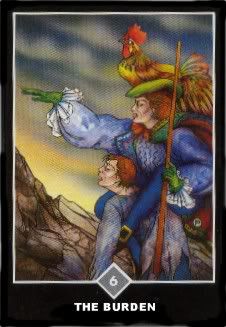
Osho Zen's Burden: I love this one. The 'Burden' carried by the stooping man beneath is an improbably bright, extravagantly attired version of himself with a chicken on its head. This is an awesome Six of Swords because it's so true; carting a ludicrously large ego about is the quickest way to back yourself into that corner where you have to walk away, set it down and cross the sea.
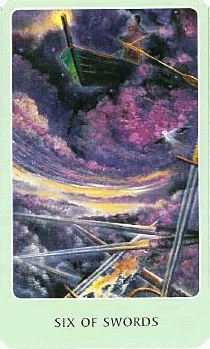
Roots Of Asia: the boat sails not over the sea, but through the clouds, leaving the swords far below.
Looking back is not so important as escape
The way behind is gone from us, and the way ahead
It needs my eyes, your hands
I watch the cutting waters, and I know you'll see us through
There is nothing left behind so dear as what I hold
No memory worth as much as the future
No anything before us,
though it show us six points of steel,
more treacherous than the nothing behind.
Til I wrote that just now, I had no idea how rational this card was. Well duh, it's an Air card; it's done its sums, okay. It did what it had to do; by crossing water, it threw me off the scent.
Even in the water, there are sharp pointy things. Ideas. I think the Rider-Waite-Smith deck has them carried in the boat with the robed one and the child; the Intuitive deck has them ahead in the water, hazards to be navigated. That's a huge difference, really - are you trying to take them with you, or stop them from holding you back - or from sinking you into the sea?
Either way; sometimes you've got to move on. The way some people read Air cards, those swords are not just logic but pain, and I think the two possible positions are two ways of dealing with pain; setting it aside as you cross the surface of the Waters, or navigated around as you do the same. I've done both, at different times, with the same burdens; while many would call the second a more worthy way of coping, I honestly think they're much the same.
If you draw this card reversed; well, I hope you can swim.
Images of the Six of Swords:
Osho Zen's Burden: I love this one. The 'Burden' carried by the stooping man beneath is an improbably bright, extravagantly attired version of himself with a chicken on its head. This is an awesome Six of Swords because it's so true; carting a ludicrously large ego about is the quickest way to back yourself into that corner where you have to walk away, set it down and cross the sea.
Roots Of Asia: the boat sails not over the sea, but through the clouds, leaving the swords far below.
Subscribe to:
Posts (Atom)