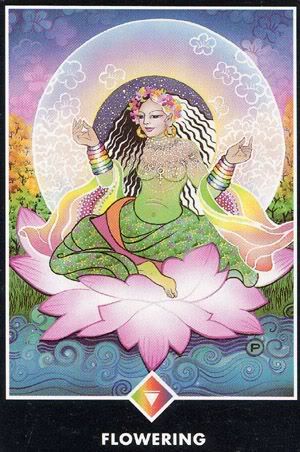
and the sunshine
the light the fire that turns that gives us all that is our joy that is us
the light that brings our hands together
the light that makes the flowers bloom below our feet
the light the sky would not be sky without, the earth would not be earth without
the light that turns the waters into rain
the light that makes us small, that makes us young, the light that says to us;
it has only been four billion years
there is yet time to play.
The Sun; it's not just a big rotating fission process in the sky. It's the sunlight on the ground that's what matters, what makes us possible. You can't look at it directly, anyway - only its reflections, its works. You can feel it, experience what it brings to the world, but never meet its eye.
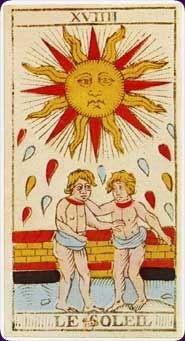
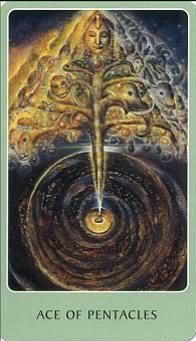
The daylight doesn't last forever; it's a contained time, one which varies in scope throughout the year. Most Sun cards feature a walled garden, or some other natural barrier; the Intuitive card has its characters dancing on a tiny flowerbed, seemingly adrift in a black sky. It is life, play, and a way to rebuild the lost garden-state of childhood. For that's what a Garden of Eden is, a place where your needs are easily cared for, where you are innocent of rights and wrongs, where you can run naked in a garden tended by another's hands - that's childhood. The Sun can give it back to you. Suns commonly feature one or two naked children playing.
Many cultures have pinned wishes and rituals to the journey of the Sun; rituals or sacrifices made to ensure (or simply to mark) its return at dawn, or its strengthening in springtime. The Sun is a parent we can't trust to return when it leaves us; even now we know the maths of dawns and solstices, we look to an uncertain ending, a time billions of years hence when our sun will swallow our world whole. Individuals have their own misgivings - I remember grumblings throughout my childhood about short English summers, and then I remember the storm season in London in 2002, and the dreamlike heat of 2003 - the latter of which changed the meaning of summer forever. (And my favourite sun story is China Mountain Zhang by Maureen McHugh, part of which features one character fighting to cope with an Arctic winter).
Make hay, because it might not return. We might never be children again, can you imagine? And cultivate - make a summer garden ready for your bursts of childhood. It's not innocence, not since it's come through the Moon - it's taken a lot of work and a world of hurt to enter childhood again.
The Sun is opposed to the High Priestess, who prefers to sit in shadow, and be wise with thoughts and words rather than young with joy and playfulness; the Sun's younger is the Wheel Of Fortune, which similarly rotates between joy and disaster, but without the Sun's reason.
Images of the Sun:
The Marseilles Sun - an image echoed by many later decks.
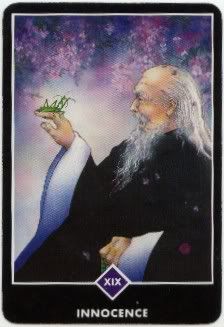
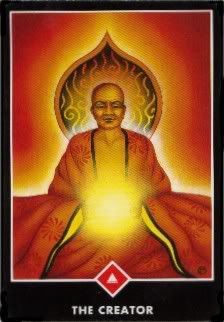
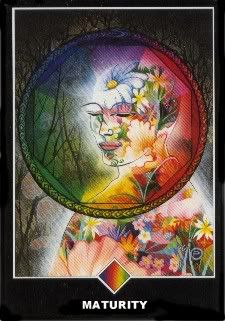
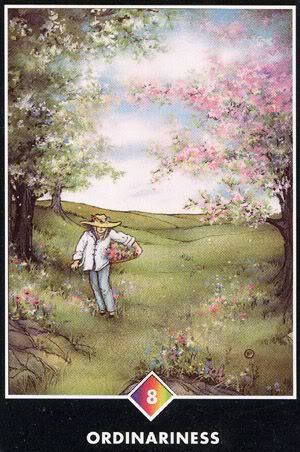
Innocence - the Osho Zen card deviates by showing not a child, but an old man, sat before a natural wall of blossom.
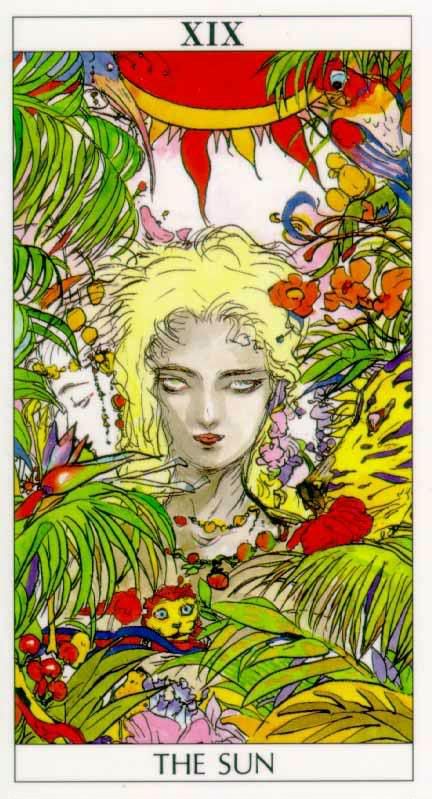
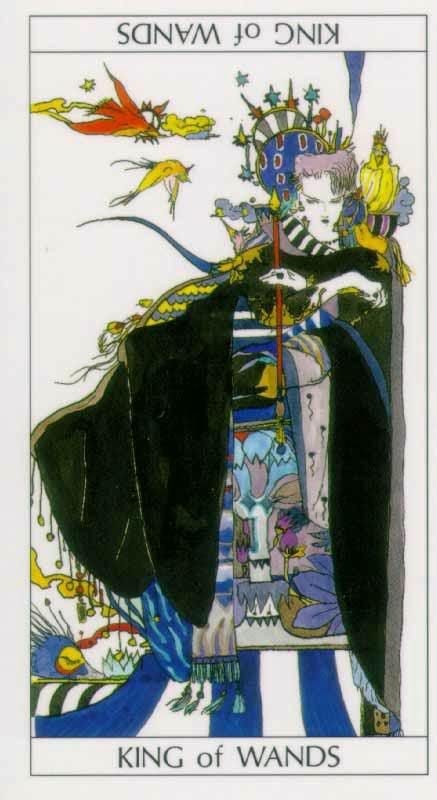
Amano's Sun - red, and presumably feminine - has made a wild, lush garden, that seems to need no wall because it's created barriers all by itself.

Index
All cards / Latest Cards / All other posts / Notes from Agla
Major Arcana / Minor Arcana / Court Cards
Wands / Pentacles / Cups / Swords
(For a list of all card articles, open March 2008 on the sidebar).
Friday, 7 March 2008

Judgement
I owe you.
So I offer that up
I put it in the fire
with my hands
my burning hands
to send the past up high
to bask in its warmth
to breathe its incense-scent
to see your shadow in its light again
to guide you home
to guide you home.
We take the charcoal-wreck of life
the burned remains
of small disasters
we turn it into fuel
to light,
to patterns revealed unto our eyes
to truths before unseen
into forgiveness to each other
(and to ourselves)
and on this pyre we might
cast our waxen bodies
burned up by truth
burned up by truth
[Epic derail: I pulled this card and wrote the above lines months ago, but then went off and wrote a little thing called Ghost Stories which more or less disposed of my feelings about Judgement for a time. But Judgement will never away for long.]
There is a void in this page I'm tempted to fill with lines used in Alpha Centauri. Nietzsche: 'A dangerous on-the-way, a dangerous looking-back, a dangerous shuddering and stopping.' Kirkegaard: 'And when the hourglass has run out [...] then eternity asks you and every individual in these millions and millions about only one thing: whether you have lived in despair or not.'
That I know these words is Judgement; I look back, and there they are - part of the rope of my life. They're some of few threads I have of the men who wrote them. Nietzsche's added other strands, a book full of metaphors and a list of chapter titles that was swallowed by something else entirely; Kirkegaard's touched me with little except those words. But with these tendril-touches, we reach each other, we know each other, we live together.
I don't know that that is Judgement. It isn't the the World - the World is where all those rainbow colours mix into an all-encompassing white - though I suspect it is somehow to do with the Moon. If Judgement were one question, it would be 'Was it worth it?'
(I was going to write that the one answer to that is 'Yes' but...is it? I don't think that there's a 'yes' here without the possibility of a 'no'. I also suspect that Judgement likes its 'maybes'. Designs vary, but often feature shades of grey.)
Judgement can see the big picture. Judgement remembers everything. Judgement, because it measures consequences, possibly sees the future too; Judgement definitely sees how things connect, and can present you with some beautiful collisions and coincidences. Judgement understands time, and values it. Judgement understands distance, perspective, and experience - all of these are just a series of tiny moments.
In terms of images and symbols, Judgement is usually linked to death. Or undeath. It's the Last Judgement and some angel is waking people up with his great big trumpet, or it's the end of your days and some god is leading you onward. There isn't that much space here for those of us who don't have any beliefs about life after death. The Intuitive deck kindly provides some, in the form of three figures melding into a bonfire. Their lives are fuel. Their identities are shadows cast on the walls. They have made light.
Judgement's opposite is the Magician, who never looks back and may (think he does) not have anything to look back on. His all-power-all-in-the-moment attitude is hard to square with Judgement's quiet estimations - but, curiously, in the Mythic Tarot both the Magician and Judgement are represented by the same god (Hermes, the Messenger and the Psychopomp).
Judgement is the eldest of a family that also includes Justice and the High Priestess. There's a detachment they have in common - a detachment that looks outwards rather than in.
Images of Judgement
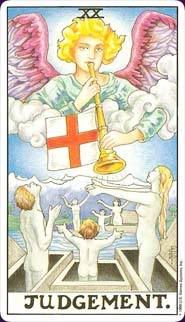
The RWS, getting its Revalation on. This is the dead being resurrected in body because it's time for the past to walk again.
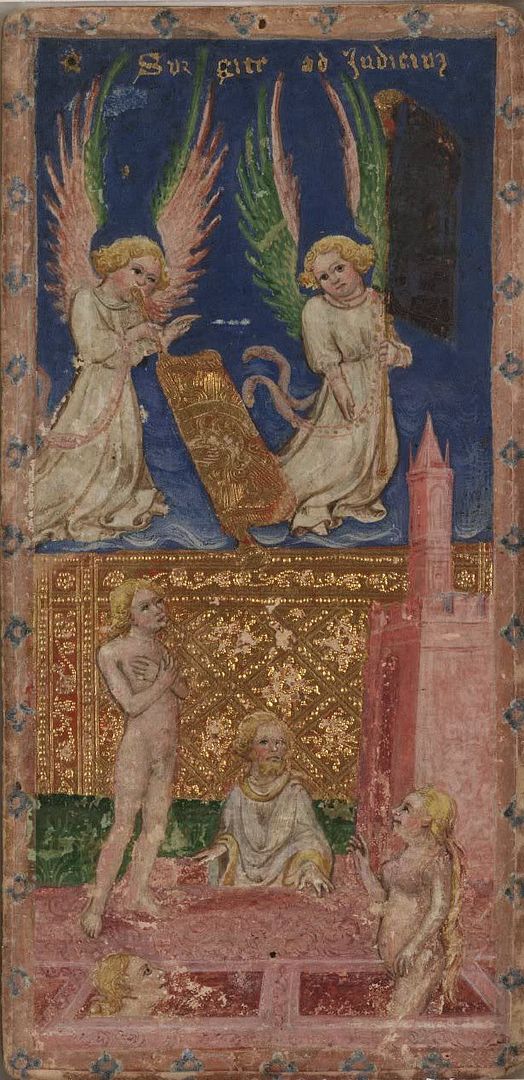
The Visconti-Sforza, an older version of the same but...to me, it looks more questioning. The woman seems curious, the men in various stages of shy, prayerful, and distinctly not sure - and while one of the angels calls them upward, the other seems ready to move on if the humans aren't ready to go. This is Judgement not as a final destination but as a ride you can either catch, or allow to pass on by. Are you ready to leave your closed world and move on? The journey won't wait for you, if not.
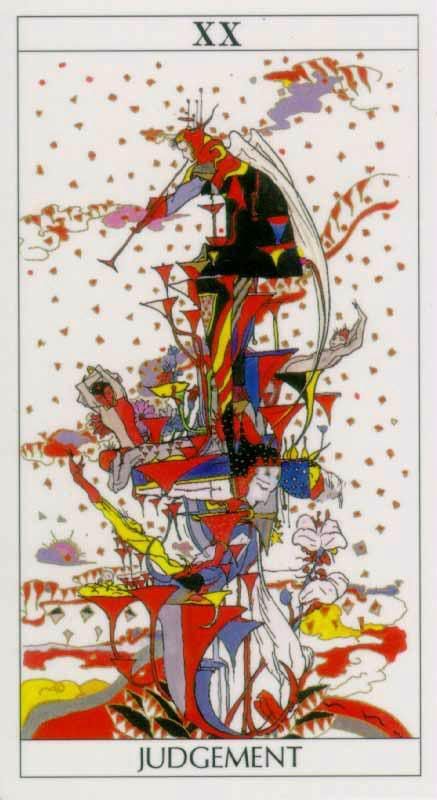
Amano's is a strange spire, one that seems to grow from an open flower, and if we are to ascend it, we must climb up this mountain of dreams ourselves. The trumpeter on top is just calling, and it's up to us to respond.
So I offer that up
I put it in the fire
with my hands
my burning hands
to send the past up high
to bask in its warmth
to breathe its incense-scent
to see your shadow in its light again
to guide you home
to guide you home.
We take the charcoal-wreck of life
the burned remains
of small disasters
we turn it into fuel
to light,
to patterns revealed unto our eyes
to truths before unseen
into forgiveness to each other
(and to ourselves)
and on this pyre we might
cast our waxen bodies
burned up by truth
burned up by truth
[Epic derail: I pulled this card and wrote the above lines months ago, but then went off and wrote a little thing called Ghost Stories which more or less disposed of my feelings about Judgement for a time. But Judgement will never away for long.]
There is a void in this page I'm tempted to fill with lines used in Alpha Centauri. Nietzsche: 'A dangerous on-the-way, a dangerous looking-back, a dangerous shuddering and stopping.' Kirkegaard: 'And when the hourglass has run out [...] then eternity asks you and every individual in these millions and millions about only one thing: whether you have lived in despair or not.'
That I know these words is Judgement; I look back, and there they are - part of the rope of my life. They're some of few threads I have of the men who wrote them. Nietzsche's added other strands, a book full of metaphors and a list of chapter titles that was swallowed by something else entirely; Kirkegaard's touched me with little except those words. But with these tendril-touches, we reach each other, we know each other, we live together.
I don't know that that is Judgement. It isn't the the World - the World is where all those rainbow colours mix into an all-encompassing white - though I suspect it is somehow to do with the Moon. If Judgement were one question, it would be 'Was it worth it?'
(I was going to write that the one answer to that is 'Yes' but...is it? I don't think that there's a 'yes' here without the possibility of a 'no'. I also suspect that Judgement likes its 'maybes'. Designs vary, but often feature shades of grey.)
Judgement can see the big picture. Judgement remembers everything. Judgement, because it measures consequences, possibly sees the future too; Judgement definitely sees how things connect, and can present you with some beautiful collisions and coincidences. Judgement understands time, and values it. Judgement understands distance, perspective, and experience - all of these are just a series of tiny moments.
In terms of images and symbols, Judgement is usually linked to death. Or undeath. It's the Last Judgement and some angel is waking people up with his great big trumpet, or it's the end of your days and some god is leading you onward. There isn't that much space here for those of us who don't have any beliefs about life after death. The Intuitive deck kindly provides some, in the form of three figures melding into a bonfire. Their lives are fuel. Their identities are shadows cast on the walls. They have made light.
Judgement's opposite is the Magician, who never looks back and may (think he does) not have anything to look back on. His all-power-all-in-the-moment attitude is hard to square with Judgement's quiet estimations - but, curiously, in the Mythic Tarot both the Magician and Judgement are represented by the same god (Hermes, the Messenger and the Psychopomp).
Judgement is the eldest of a family that also includes Justice and the High Priestess. There's a detachment they have in common - a detachment that looks outwards rather than in.
Images of Judgement
The RWS, getting its Revalation on. This is the dead being resurrected in body because it's time for the past to walk again.
The Visconti-Sforza, an older version of the same but...to me, it looks more questioning. The woman seems curious, the men in various stages of shy, prayerful, and distinctly not sure - and while one of the angels calls them upward, the other seems ready to move on if the humans aren't ready to go. This is Judgement not as a final destination but as a ride you can either catch, or allow to pass on by. Are you ready to leave your closed world and move on? The journey won't wait for you, if not.
Amano's is a strange spire, one that seems to grow from an open flower, and if we are to ascend it, we must climb up this mountain of dreams ourselves. The trumpeter on top is just calling, and it's up to us to respond.
The World
I turn
and my world follows me
you are the rainbow
and I am the white light
I turn my head toward the stars
I see eyes, see friendly faces
I see my self shine like they do
I see a world beginning
and I dance
and I am watching
as it watches me, I'm watching
and my light my self turns with me
and the world is dancing with me
time is stopping, starting, over
born anew
I'm falling upwards
I will be part of the new world
it will give birth to the new me.
It took a long time to get that out. Sticking words around the World is never easy, and rarely even pointful. It's like the Fool in that regard. The World is the best thing about tarot, and it's the reason why I've used tarot only irregularly since 2004.
I've been doing three of these a night, quite faithfully; the World alone has stopped me dead for two days. I've been wondering why I'm doing this - am I exploring, am I recording the knowledge I've gathered, am I engaging in pointless intellectual posturing? Am I looking for the dance again? (ideally: yes).
I grokked the World in bits and pieces, in 2004 and 2005. Hardly ever in the card itself - I'd see it in a shadow under a bus shelter, or in a class on Buddhist theology, at the end of a videogame, or in the words I heard before someone said them aloud. The card usually just gave me hints along the way, but there was one time - at 5.30am on August 25th 2005, when I hadn't slept, when I had a resit exam I hadn't revised for in three and a half hours, and I was going straight to the railway station from there - when I reached for a card, and knew it would be there before I turned it over. I won't say I haven't looked back since. I look back all the fucking time. I just don't need to, is all.
I am talking circles around her.
The form of the World is pretty consistent; a female, hermaphroditic or ambiguous figure dancing in a circle (often a wreath or an ouroboros); she is often dancing in the sky, with the world far below her.
(But the card is not The World-Dancer - it's The World. The character isn't the subject. The same goes for the charioteer, and the Lady. The subject of the card is the dance she's dancing, the surface she's dancing upon).
I think the World is easiest to find in that living circle - in the ouroboros that eats its own tail. There are times when the end of a thing has swallowed and satisfied its small beginnings; when something has ended in the same place where it began; when time is a circle instead of a line, and the cause of something seems to have occurred long after the consequences.
As I mentioned in the 2005 notes, there are some very, very good stories that do just that - come round to their beginnings and swallow them up. God help me, but I'm exhausted and I want to write something about The Joy here, but I can't think of a way to word it that doesn't sound completely stupid. Look, there's just this videogame - MGS3 - where one of the main characters is the World-Dancer, and she crosses lines that no one else will cross because she believes that the World is all one, and she dances in a field of white flowers, and you only realise out how it began for her once she's gone and the flowers turn red with her blood. That summer, I used to pass a church signboard on my way to work which read 'JOY IS NOT THE ABSENCE OF SORROW - IT IS THE PRESENCE OF GOD'. Because Jesus Christ plays Metal Gear. Because it's true and it's wonderful. The names of her allies were all explained and made into plot points - The Fear, The Fury, The Pain, The End, The Sorrow. Hers never was; the World-Dancer's joy is wordless, and it leaves you to draw your own conclusions, and find your own way.
All things are one thing, created in the same instant long ago, never truly divided, never changed, never taken apart. Knowing this will change the Fool forever - the World is not just self-awareness, but awareness of all creation. (And I was out here listening all the time).
Images of the World:
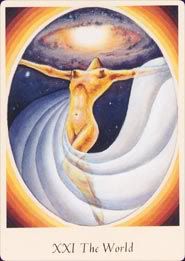
The Intuitive image.
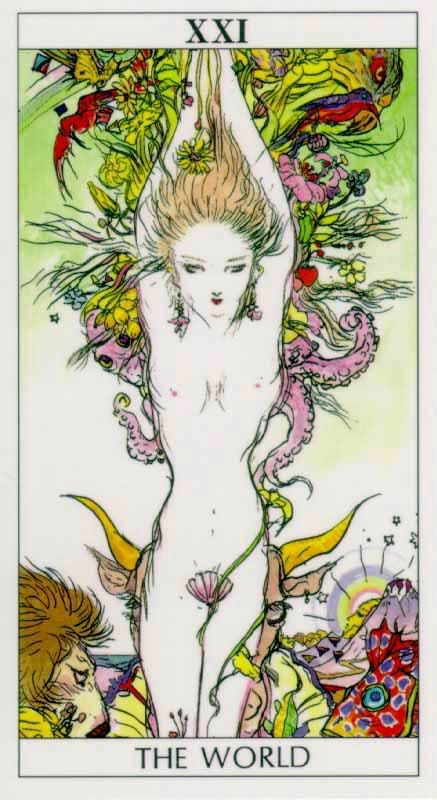
Fuck me if this by Amano isn't Ama-no-Uzume. When Amaterasu (Amano's Priestess) hid in the cave, Uzume put a mirror against a nearby tree, got on top of an upturned tub, and started dancing. Dancing meaning stripping. The other gods gathered around her and laughed at her performance - Uzume's naked dancing wasn't sex, it was humour. Amaterasu stuck her head out to ask someone what the fuss was about. The someone told her that a new goddess had arrived, and pointed towards the mirror.
Amaterasu had never seen her reflection before. While she looked upon herself, the other gods blocked up the cave behind her.
Uzume, the World, will make you be aware of yourself, and of the radiance within you, and after that, there is no going back to the darkness.
(In the interests of full disclosure; I'm fond of Uzume because there is a spirit of dawn and mischief who appears fond of me and my dear ones. We call her Rori, and blame her for many things).
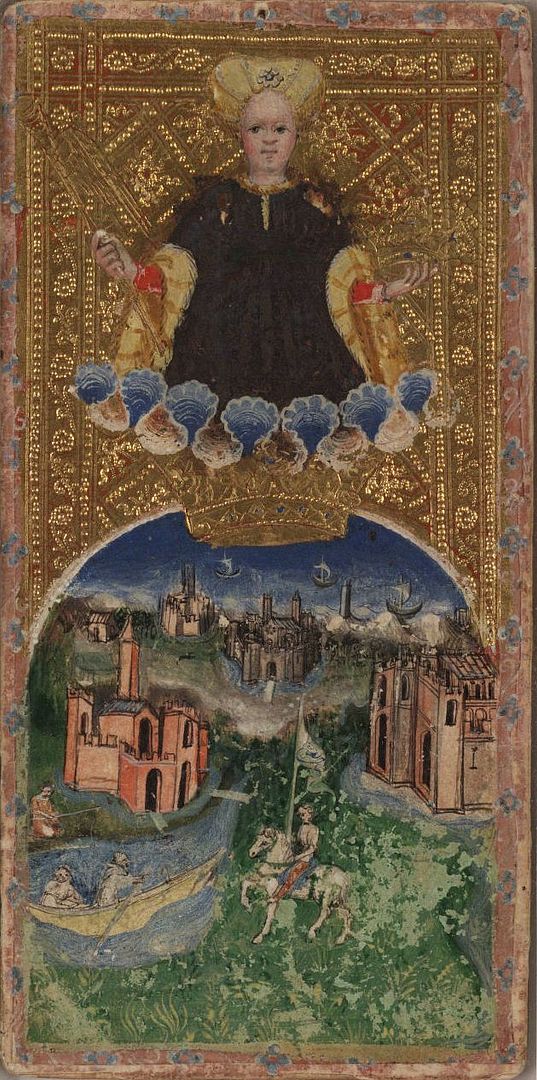
The Visconti-Sforza World shows its 'dancer' (not a dancer) floating above us, letting us be the object of the image.
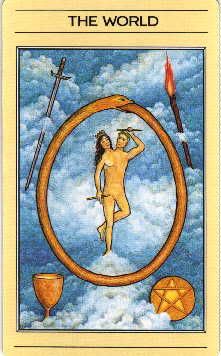
Hermaphroditus is the Mythic Tarot World, and sie stands inside an ouroboros. Sie carries a wand in each hand - it's part of the dance, part of joy, not something to be used to convey power or authority (unlike the Magician's wand or the Emperor's sceptre). Most World-Dancers carry such wands.
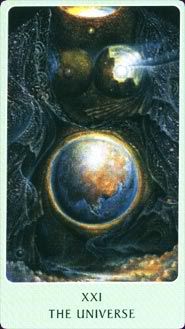
The Roots of Asia World is an echo of the Roots of Asia Empress, whose body was the earth; here, the earth is shining through the belly of the World-Dancer - it's only one part of her greater whole.
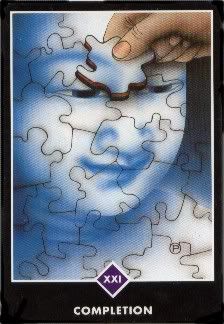
'Completion' from the Osho Zen. The end of a jigsaw puzzle? It can be like that, sure. Like having finally built up the whole image, after starting from nothing. Having your hands empty for the first time in a long while.
What I said about The World in 2005 - Part I:
Because I've been stumbling about with academic Buddhism lately, The World appears to me to appeal to that special shiny tenet of Zen; that everyone, every being, is already in a state of enlightenment and just has to be made, by means of koans and Zen slaps and so on, to remember it. It makes sense to me; we have all the pieces already, there's nothing there we can't reach. Truth is about as much news to a life as the laws of motion are to a body; it already lives in it, it already knows, and it is more fully aware of what is and where to go the more the mind is stilled.
And like the Fool, she dances.
I've seen her once or twice...usually just out of the corner of my eye, hovering over the horizon. But not always. One or twice it's been full in the eye, and it's never, ever, ever what you expected. There's no point describing; it isn't about words. I think the attempted application of words actively made me lose it again at least once. Words are shallow little things, just a simulation of reality, and to see the World requires reaching past them.
Numbers, I think, might get a little closer. Making the World from things that add up to 21 is a nice little game; twist your head til the Tower and the Hierophant, or the Moon and the Empress, or Temperance and the Chariot are both the same thing and neither of them what you thought they were, and you might see it. Zen slaps work. It is absurdity that brings the walls down and makes the World beneath become visible, and it is in absurdity that it is most easy to find the connections. Like Schrödinger's Cat, really...if you try the whole reducio ad absurdam thing and it still works, perhaps even better than before, then you're touching something...
Maybe you just need to reseal that first crack between the Magician and Prietess; between all things being the same and all things being different. To that, the Fool says nothing and the World says everything, but even then they are one and the same.
Part II - ourobori [originally posted on my LJ] :
No, I don't care if I just made that word up.
There were three stories this year. I've been less of a media whore than usual (until recently - I've been playing videogames and going to the pictures, and reading a bit when I can), and these three, each of a different medium, have poked their scaled heads up and become keepers. The second I read in early June - a gift from Ashrose. It's called Prospero's Children, it's by Jan Siegel, and it ties a perfect closed loop. I don't know if there's a word for a story that, in ending, swallows its own beginning and transforms it, so I will keep to that image; the snake that eats its own tail. It's the creature that circles the World, stirring in the deep trenches of the sea or painted across the spine of the night sky. It is unity, and as it forms the barrier between the within and the without, it is division also. It is everything and everything outside everything. It is the beginning and the end that are both the same. It is continually overcoming itself and proving to be greater than itself.
It was a great book, not least in the way it made self-references to self-referrentialness. It was beautiful and true and a world I want to live in and, and, I need to write to Rose, I really do ;____;. [NB: three years on and I still haven't done it.] What was really interesting about my attitude to it was that it was not quite satisfying until the very last line, at which point it became totally and thoroughly satisfying, far more so than it would have been if it had been satisfying beforehand. Ouroboros; it ate its own tail.
I finished the book whilst waiting to get on a plane to something entirely new. I need to write to Rose. The third story was awaiting me on the other side of the water; I had to wade through a couple of other things to get there (a more complete story of my/our Metal Gear obsession will have to be told later), but yes, Snake Eater killed me. I remember awakening the next morning (it was a Wednesday) and feeling that now The Game was gone and I had an enormous void in my life and nothing I could do would be sufficient to fill it. That was, of course, when I first considered writing on Livejournal again, but London exploded the next morning and I had seikenshin, kitsunejin and hell_san all enquire after my health, not realising I was over four thousand miles away from London, and I realised I had too many things to write down and I couldn't be arsed. Nice, gave me more time to think about it all.
Which was good, because the ouroboros symbol I hadn't even properly noticed at that point. I should've seen it coming a million miles away, with a subtitle like Snake Eater, but I didn't spot the ouroboros reference til after I'd finished the game and, in the bath one evening, started thinking 'I need to write to Rose' again and then had it catch me upside the head. Muppet ;___; It's all over the place too - the name, the structure, the plot, even the Joy's (I refer to her as such because I like to) last speech, about consummation and continuation, about legacies and change, about the world. About the World. I thought, there and then, of the World-Dancer, but I somehow forgot the encircling snake til a couple of days later.
It killed my mind. Her refusal to accept the arbitrary lines across the earth, her giving and giving and giving, the white flowers; the joy. That's what I took from it most of all; that when there was nothing else, when you have given up all your knowledge, given up your body, your name, your life, what was there left, there among the white flowers? Joy. This is the World and before this year I had barely ever seen her, just flashes, glimpses; I thought her unillustratable but here she was illustrated and she completely killed me.
She killed me, but not before I'd killed her. So yeah, I beat the World-Dancer to a bloody pulp and then had no idea what to do with myself. But things came up - a lot of things, and I'll try to jot some of them down sometime soon, along with a lot more of the Metal Gear obsession, no doubt. Til then, be joyful.
(The first story was an album, Frances The Mute by The Mars Volta, who I get to go see on stage in a few weeks. Yey.)
and my world follows me
you are the rainbow
and I am the white light
I turn my head toward the stars
I see eyes, see friendly faces
I see my self shine like they do
I see a world beginning
and I dance
and I am watching
as it watches me, I'm watching
and my light my self turns with me
and the world is dancing with me
time is stopping, starting, over
born anew
I'm falling upwards
I will be part of the new world
it will give birth to the new me.
It took a long time to get that out. Sticking words around the World is never easy, and rarely even pointful. It's like the Fool in that regard. The World is the best thing about tarot, and it's the reason why I've used tarot only irregularly since 2004.
I've been doing three of these a night, quite faithfully; the World alone has stopped me dead for two days. I've been wondering why I'm doing this - am I exploring, am I recording the knowledge I've gathered, am I engaging in pointless intellectual posturing? Am I looking for the dance again? (ideally: yes).
I grokked the World in bits and pieces, in 2004 and 2005. Hardly ever in the card itself - I'd see it in a shadow under a bus shelter, or in a class on Buddhist theology, at the end of a videogame, or in the words I heard before someone said them aloud. The card usually just gave me hints along the way, but there was one time - at 5.30am on August 25th 2005, when I hadn't slept, when I had a resit exam I hadn't revised for in three and a half hours, and I was going straight to the railway station from there - when I reached for a card, and knew it would be there before I turned it over. I won't say I haven't looked back since. I look back all the fucking time. I just don't need to, is all.
I am talking circles around her.
The form of the World is pretty consistent; a female, hermaphroditic or ambiguous figure dancing in a circle (often a wreath or an ouroboros); she is often dancing in the sky, with the world far below her.
(But the card is not The World-Dancer - it's The World. The character isn't the subject. The same goes for the charioteer, and the Lady. The subject of the card is the dance she's dancing, the surface she's dancing upon).
I think the World is easiest to find in that living circle - in the ouroboros that eats its own tail. There are times when the end of a thing has swallowed and satisfied its small beginnings; when something has ended in the same place where it began; when time is a circle instead of a line, and the cause of something seems to have occurred long after the consequences.
As I mentioned in the 2005 notes, there are some very, very good stories that do just that - come round to their beginnings and swallow them up. God help me, but I'm exhausted and I want to write something about The Joy here, but I can't think of a way to word it that doesn't sound completely stupid. Look, there's just this videogame - MGS3 - where one of the main characters is the World-Dancer, and she crosses lines that no one else will cross because she believes that the World is all one, and she dances in a field of white flowers, and you only realise out how it began for her once she's gone and the flowers turn red with her blood. That summer, I used to pass a church signboard on my way to work which read 'JOY IS NOT THE ABSENCE OF SORROW - IT IS THE PRESENCE OF GOD'. Because Jesus Christ plays Metal Gear. Because it's true and it's wonderful. The names of her allies were all explained and made into plot points - The Fear, The Fury, The Pain, The End, The Sorrow. Hers never was; the World-Dancer's joy is wordless, and it leaves you to draw your own conclusions, and find your own way.
All things are one thing, created in the same instant long ago, never truly divided, never changed, never taken apart. Knowing this will change the Fool forever - the World is not just self-awareness, but awareness of all creation. (And I was out here listening all the time).
Images of the World:
The Intuitive image.
Fuck me if this by Amano isn't Ama-no-Uzume. When Amaterasu (Amano's Priestess) hid in the cave, Uzume put a mirror against a nearby tree, got on top of an upturned tub, and started dancing. Dancing meaning stripping. The other gods gathered around her and laughed at her performance - Uzume's naked dancing wasn't sex, it was humour. Amaterasu stuck her head out to ask someone what the fuss was about. The someone told her that a new goddess had arrived, and pointed towards the mirror.
Amaterasu had never seen her reflection before. While she looked upon herself, the other gods blocked up the cave behind her.
Uzume, the World, will make you be aware of yourself, and of the radiance within you, and after that, there is no going back to the darkness.
(In the interests of full disclosure; I'm fond of Uzume because there is a spirit of dawn and mischief who appears fond of me and my dear ones. We call her Rori, and blame her for many things).
The Visconti-Sforza World shows its 'dancer' (not a dancer) floating above us, letting us be the object of the image.
Hermaphroditus is the Mythic Tarot World, and sie stands inside an ouroboros. Sie carries a wand in each hand - it's part of the dance, part of joy, not something to be used to convey power or authority (unlike the Magician's wand or the Emperor's sceptre). Most World-Dancers carry such wands.
The Roots of Asia World is an echo of the Roots of Asia Empress, whose body was the earth; here, the earth is shining through the belly of the World-Dancer - it's only one part of her greater whole.
'Completion' from the Osho Zen. The end of a jigsaw puzzle? It can be like that, sure. Like having finally built up the whole image, after starting from nothing. Having your hands empty for the first time in a long while.
What I said about The World in 2005 - Part I:
Because I've been stumbling about with academic Buddhism lately, The World appears to me to appeal to that special shiny tenet of Zen; that everyone, every being, is already in a state of enlightenment and just has to be made, by means of koans and Zen slaps and so on, to remember it. It makes sense to me; we have all the pieces already, there's nothing there we can't reach. Truth is about as much news to a life as the laws of motion are to a body; it already lives in it, it already knows, and it is more fully aware of what is and where to go the more the mind is stilled.
And like the Fool, she dances.
I've seen her once or twice...usually just out of the corner of my eye, hovering over the horizon. But not always. One or twice it's been full in the eye, and it's never, ever, ever what you expected. There's no point describing; it isn't about words. I think the attempted application of words actively made me lose it again at least once. Words are shallow little things, just a simulation of reality, and to see the World requires reaching past them.
Numbers, I think, might get a little closer. Making the World from things that add up to 21 is a nice little game; twist your head til the Tower and the Hierophant, or the Moon and the Empress, or Temperance and the Chariot are both the same thing and neither of them what you thought they were, and you might see it. Zen slaps work. It is absurdity that brings the walls down and makes the World beneath become visible, and it is in absurdity that it is most easy to find the connections. Like Schrödinger's Cat, really...if you try the whole reducio ad absurdam thing and it still works, perhaps even better than before, then you're touching something...
Maybe you just need to reseal that first crack between the Magician and Prietess; between all things being the same and all things being different. To that, the Fool says nothing and the World says everything, but even then they are one and the same.
Part II - ourobori [originally posted on my LJ] :
No, I don't care if I just made that word up.
There were three stories this year. I've been less of a media whore than usual (until recently - I've been playing videogames and going to the pictures, and reading a bit when I can), and these three, each of a different medium, have poked their scaled heads up and become keepers. The second I read in early June - a gift from Ashrose. It's called Prospero's Children, it's by Jan Siegel, and it ties a perfect closed loop. I don't know if there's a word for a story that, in ending, swallows its own beginning and transforms it, so I will keep to that image; the snake that eats its own tail. It's the creature that circles the World, stirring in the deep trenches of the sea or painted across the spine of the night sky. It is unity, and as it forms the barrier between the within and the without, it is division also. It is everything and everything outside everything. It is the beginning and the end that are both the same. It is continually overcoming itself and proving to be greater than itself.
It was a great book, not least in the way it made self-references to self-referrentialness. It was beautiful and true and a world I want to live in and, and, I need to write to Rose, I really do ;____;. [NB: three years on and I still haven't done it.] What was really interesting about my attitude to it was that it was not quite satisfying until the very last line, at which point it became totally and thoroughly satisfying, far more so than it would have been if it had been satisfying beforehand. Ouroboros; it ate its own tail.
I finished the book whilst waiting to get on a plane to something entirely new. I need to write to Rose. The third story was awaiting me on the other side of the water; I had to wade through a couple of other things to get there (a more complete story of my/our Metal Gear obsession will have to be told later), but yes, Snake Eater killed me. I remember awakening the next morning (it was a Wednesday) and feeling that now The Game was gone and I had an enormous void in my life and nothing I could do would be sufficient to fill it. That was, of course, when I first considered writing on Livejournal again, but London exploded the next morning and I had seikenshin, kitsunejin and hell_san all enquire after my health, not realising I was over four thousand miles away from London, and I realised I had too many things to write down and I couldn't be arsed. Nice, gave me more time to think about it all.
Which was good, because the ouroboros symbol I hadn't even properly noticed at that point. I should've seen it coming a million miles away, with a subtitle like Snake Eater, but I didn't spot the ouroboros reference til after I'd finished the game and, in the bath one evening, started thinking 'I need to write to Rose' again and then had it catch me upside the head. Muppet ;___; It's all over the place too - the name, the structure, the plot, even the Joy's (I refer to her as such because I like to) last speech, about consummation and continuation, about legacies and change, about the world. About the World. I thought, there and then, of the World-Dancer, but I somehow forgot the encircling snake til a couple of days later.
It killed my mind. Her refusal to accept the arbitrary lines across the earth, her giving and giving and giving, the white flowers; the joy. That's what I took from it most of all; that when there was nothing else, when you have given up all your knowledge, given up your body, your name, your life, what was there left, there among the white flowers? Joy. This is the World and before this year I had barely ever seen her, just flashes, glimpses; I thought her unillustratable but here she was illustrated and she completely killed me.
She killed me, but not before I'd killed her. So yeah, I beat the World-Dancer to a bloody pulp and then had no idea what to do with myself. But things came up - a lot of things, and I'll try to jot some of them down sometime soon, along with a lot more of the Metal Gear obsession, no doubt. Til then, be joyful.
(The first story was an album, Frances The Mute by The Mars Volta, who I get to go see on stage in a few weeks. Yey.)
Thursday, 6 March 2008
Two Of Wands
you would open your wings
and draw a line across the sun
you would pull back the curtain
and take all that is yours in your hand
and you'd throw it over the fields
and you'd not know where it was going
but you'd have the faith to see it done
As previously mentioned, I'm doing these in the order the deck wants them done. This is the seventh. The last two were the High Priestess and the Queen of Pentacles - ladies about robes and veils.
Fuck me if this isn't a wide-open curtain.
An Ace is energy at its source; a Two, therefore, is a vector - a moving thing (of fire, this time), but where does it go? It's cheesy, but I see the Two of Wands as being in a state of superposition; sure of its momentum, but what it is is no longer material.
There is something pretty damn phallic about all this. I could more easily draw you a diagram than put it into words; the Two of Wands is a Two of Chokhma, for starters, a first jag of lightning from the source, looking for a shape to hold it. Many decks have it that the Two then faces a forked path, which from that part on the Tree is true enough; down it must go, but it may or may not take the path of least resistance.
Images of the Two of Wands:
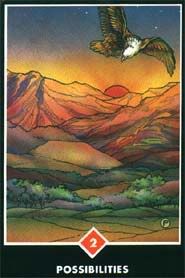
Need to scan the Intuitive one. Til then, here's the Osho Zen - flying away from the setting sun.
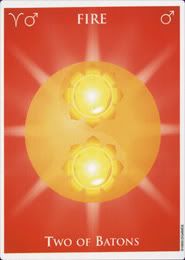
See also the One World Two: a pip card, but note the corner symbols - Aries (as in zodiac), Mars (as in planet), and another Mars for good measure. This is what tipped me off about the penis thing.
and draw a line across the sun
you would pull back the curtain
and take all that is yours in your hand
and you'd throw it over the fields
and you'd not know where it was going
but you'd have the faith to see it done
As previously mentioned, I'm doing these in the order the deck wants them done. This is the seventh. The last two were the High Priestess and the Queen of Pentacles - ladies about robes and veils.
Fuck me if this isn't a wide-open curtain.
An Ace is energy at its source; a Two, therefore, is a vector - a moving thing (of fire, this time), but where does it go? It's cheesy, but I see the Two of Wands as being in a state of superposition; sure of its momentum, but what it is is no longer material.
There is something pretty damn phallic about all this. I could more easily draw you a diagram than put it into words; the Two of Wands is a Two of Chokhma, for starters, a first jag of lightning from the source, looking for a shape to hold it. Many decks have it that the Two then faces a forked path, which from that part on the Tree is true enough; down it must go, but it may or may not take the path of least resistance.
Images of the Two of Wands:
Need to scan the Intuitive one. Til then, here's the Osho Zen - flying away from the setting sun.
See also the One World Two: a pip card, but note the corner symbols - Aries (as in zodiac), Mars (as in planet), and another Mars for good measure. This is what tipped me off about the penis thing.
Three Of Wands
I bowed my head and reached into
the light inside and out I pulled
a ribbon and another
(spiral up in to the trees)
ravelling out and out and then
in my hands
the world.
white smoke-threads in my branches
and in my hands
the world.
So whatever's in that Ace spills out, revs up the Two, and then becomes a form. The fire inside becomes the blueprint for a whole new world - and most Threes of Wands have this 'but now what?' expression; a mixture of pride, awe and confusion. This one has taken his creation straight from the fire, and seems to touch it gingerly, as if it burns. The ribbons are trails of smoke. If he had a name, it might be Fëanor. What has he done now?
One suggested solution to this card is that thing Fëanor didn't do; humility. Another is simply to let the awe roll over you and keep your hands in the furnace. Three is Binah's number; a two is wisdom (a tool), and a three is understanding (the scope of a tool, the work it's done. We speak of Fire here; if we spoke of Water, then I'd say a Three is the glass that catches the flow of Two). It's natural to pause in the hope of gaining understanding, but truly understanding the way your dreams are coming to life in your hands requires that you keep sodding working.
Images of the Three of Wands:
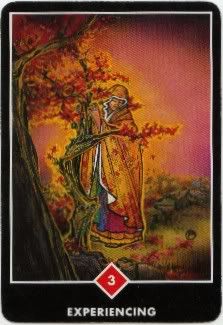
'Experiencing' from the Osho Zen. The point here is that world around you is, if you just choose to commune with it, divine. Awe is a perfectly natural response to that. The Osho Zen in general puts a great emphasis on doing, which is the natural realm of the Wands in any case; you trip up over the Three of Wands because its potential has suddenly become real, and when that happens, it's hard to just keep doing it.
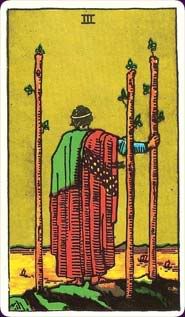
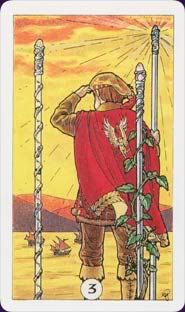
The RWS, an image that some refer to as 'Alexander' - okay, so here's India, but wtf have I done? The Robin Wood image is similar, but the figure seems to send a different message.
the light inside and out I pulled
a ribbon and another
(spiral up in to the trees)
ravelling out and out and then
in my hands
the world.
white smoke-threads in my branches
and in my hands
the world.
So whatever's in that Ace spills out, revs up the Two, and then becomes a form. The fire inside becomes the blueprint for a whole new world - and most Threes of Wands have this 'but now what?' expression; a mixture of pride, awe and confusion. This one has taken his creation straight from the fire, and seems to touch it gingerly, as if it burns. The ribbons are trails of smoke. If he had a name, it might be Fëanor. What has he done now?
One suggested solution to this card is that thing Fëanor didn't do; humility. Another is simply to let the awe roll over you and keep your hands in the furnace. Three is Binah's number; a two is wisdom (a tool), and a three is understanding (the scope of a tool, the work it's done. We speak of Fire here; if we spoke of Water, then I'd say a Three is the glass that catches the flow of Two). It's natural to pause in the hope of gaining understanding, but truly understanding the way your dreams are coming to life in your hands requires that you keep sodding working.
Images of the Three of Wands:
'Experiencing' from the Osho Zen. The point here is that world around you is, if you just choose to commune with it, divine. Awe is a perfectly natural response to that. The Osho Zen in general puts a great emphasis on doing, which is the natural realm of the Wands in any case; you trip up over the Three of Wands because its potential has suddenly become real, and when that happens, it's hard to just keep doing it.
The RWS, an image that some refer to as 'Alexander' - okay, so here's India, but wtf have I done? The Robin Wood image is similar, but the figure seems to send a different message.
Six Of Wands
one
the first step of a thousand miles
two
the open roads before me
three
I am rising
four
I am stooping under the sun
five
the climb is steep, and I am tired
six
and I am here.
The Six of Wands is suspiciously benign. It is victory, and it is celebration of victory; it is a triumph parade after a long, deliberate effort. The Six of Wands never comes from nowhere, and is rarely a surprise. The Six of Wands says you earned this. On the other hand, it says and now you have to live up to it, which is perhaps why the Wands get so complicated from here on up.
Conway's image has, as far as I know, only one commonality with most Sixes of Wands; it's daylight. Her figure (seemingly naked, possibly male) has climbed his steep curve, and now raises merry arms to the sun. But I am a dawnwatcher, and I think the sun in the image looks like a setting sun.
The Six of Wands tells you to raise your hands and celebrate the ways that your dreams and ideas have come about, but it advises against resting on your laurels; a reversed card may be doing just that, though I'd be more inclined to read a reversal as meaning a failure to celebrate what you have done. Celebration is a moment in every soul, and it is not wrong to bring it to the surface. That said, go read verse 31 of the Tao Te Ching; its message, that war ends with a funeral, not with triumph, was recently echoed by Our Crucial Pamphlet from Penny Arcade.
Images of the Six of Wands:
The Dragon Tarot has the first Six of Wands I fell for; a black letter V, and a diamond beneath it. In my head this card will always be linked to - owned by, part of - Gaiety, the Knight of Wands.
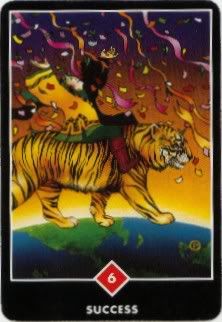
In the Osho Zen, Success is a man astride a tiger, walking over the world.
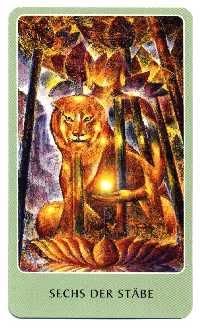
The Roots of Asia also has a great cat, resting in the shade - this card suggests a Six in territorial victory.
the first step of a thousand miles
two
the open roads before me
three
I am rising
four
I am stooping under the sun
five
the climb is steep, and I am tired
six
and I am here.
The Six of Wands is suspiciously benign. It is victory, and it is celebration of victory; it is a triumph parade after a long, deliberate effort. The Six of Wands never comes from nowhere, and is rarely a surprise. The Six of Wands says you earned this. On the other hand, it says and now you have to live up to it, which is perhaps why the Wands get so complicated from here on up.
Conway's image has, as far as I know, only one commonality with most Sixes of Wands; it's daylight. Her figure (seemingly naked, possibly male) has climbed his steep curve, and now raises merry arms to the sun. But I am a dawnwatcher, and I think the sun in the image looks like a setting sun.
The Six of Wands tells you to raise your hands and celebrate the ways that your dreams and ideas have come about, but it advises against resting on your laurels; a reversed card may be doing just that, though I'd be more inclined to read a reversal as meaning a failure to celebrate what you have done. Celebration is a moment in every soul, and it is not wrong to bring it to the surface. That said, go read verse 31 of the Tao Te Ching; its message, that war ends with a funeral, not with triumph, was recently echoed by Our Crucial Pamphlet from Penny Arcade.
Images of the Six of Wands:
The Dragon Tarot has the first Six of Wands I fell for; a black letter V, and a diamond beneath it. In my head this card will always be linked to - owned by, part of - Gaiety, the Knight of Wands.
In the Osho Zen, Success is a man astride a tiger, walking over the world.
The Roots of Asia also has a great cat, resting in the shade - this card suggests a Six in territorial victory.
Eight Of Wands
ready, set, now or never
horizon close and sky too low
take a straight line in any direction
stretch out hand, foot, eye -
- go
go past the dark and see no walls
go cut the wind, be storm, be light
go find your new destination
go be the journey, be the -
- flight
I haven't done this in a while, so my verse sucks worse than usual, but the picture here - eight abstract figures, lining up to a vanishing point, as if preparing for a race - is evoking the base laws of nature. The figures are identical in form, only shrinking in size towards the vanishing point, and they make me think of photons, and the world's only real speed limit: c.
Eight is the last, hardest turn; between those crazy sevens and the bloodyminded nines; the Eight of Wands is fire in motion, with it all finally figured out and on the go. Traditional readers might say it symbolises travel; perhaps so, but as much of the soul as of the body. If you just changed your mind and are throwing your life into something new and exciting, you might find yourself here. Mind you keep a foot on the ground, though.
(The Intuitive card came out of the deck firmly attached to the Empress, btw. What's with that?)
Images of the Eight of Wands
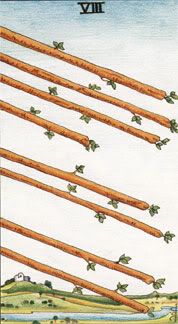
The Eight of Wands is one of very few RWS cards that includes no human figure (offhand the only others I can think of are the four Aces and the Moon). That implies a lack of humanity - and a lack of human frailty - in the energies symbolised here. Smith's design speaks of flight, and perhaps of the sky and the eight directions of the wind - prior to the RWS, Wands were associated with air and Swords with fire, and there's a dose of the former element here.
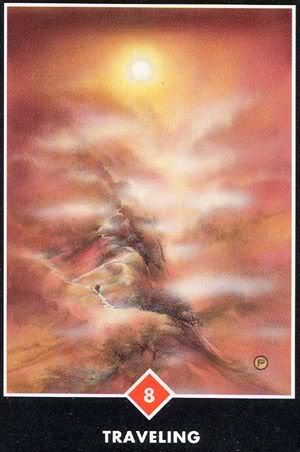
The Osho Zen card is Travelling, one of the more simple in the deck; the mountains imply a difficult road, and it seems to be close to nightfall, but I for one see a lot to look forward to in that picture.
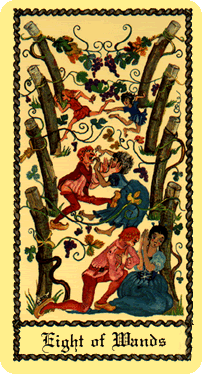
In the Medieval Scapini, a comic-like story is told; for some reason I read it bottom-to-top, and see two lovers speaking coyly, then dancing, then moving apart. It can equally be read top-to-bottom, with the two meeting in a wild dance and then settling down to canoodle. That's the trouble with the Eight of Wands - you never know if you're running from or running to.
horizon close and sky too low
take a straight line in any direction
stretch out hand, foot, eye -
- go
go past the dark and see no walls
go cut the wind, be storm, be light
go find your new destination
go be the journey, be the -
- flight
I haven't done this in a while, so my verse sucks worse than usual, but the picture here - eight abstract figures, lining up to a vanishing point, as if preparing for a race - is evoking the base laws of nature. The figures are identical in form, only shrinking in size towards the vanishing point, and they make me think of photons, and the world's only real speed limit: c.
Eight is the last, hardest turn; between those crazy sevens and the bloodyminded nines; the Eight of Wands is fire in motion, with it all finally figured out and on the go. Traditional readers might say it symbolises travel; perhaps so, but as much of the soul as of the body. If you just changed your mind and are throwing your life into something new and exciting, you might find yourself here. Mind you keep a foot on the ground, though.
(The Intuitive card came out of the deck firmly attached to the Empress, btw. What's with that?)
Images of the Eight of Wands
The Eight of Wands is one of very few RWS cards that includes no human figure (offhand the only others I can think of are the four Aces and the Moon). That implies a lack of humanity - and a lack of human frailty - in the energies symbolised here. Smith's design speaks of flight, and perhaps of the sky and the eight directions of the wind - prior to the RWS, Wands were associated with air and Swords with fire, and there's a dose of the former element here.
The Osho Zen card is Travelling, one of the more simple in the deck; the mountains imply a difficult road, and it seems to be close to nightfall, but I for one see a lot to look forward to in that picture.
In the Medieval Scapini, a comic-like story is told; for some reason I read it bottom-to-top, and see two lovers speaking coyly, then dancing, then moving apart. It can equally be read top-to-bottom, with the two meeting in a wild dance and then settling down to canoodle. That's the trouble with the Eight of Wands - you never know if you're running from or running to.
Nine Of Wands
So look what lies behind me
the night
the forest
embers
this is my fortress
look upon my body
the scars
the strength
the journey
this is my engine of war.
look what lies before me:
nothing?
We shall see.
When I first started learning, in 1999 (or possibly 1998), this was my favourite card in the deck. It chimed with my whole attitude to life at the time; bloodied, unbowed, determined as ever, putting on a tired show of force (or a show of tired force, one of those), not in the least inclined to give in. It's the only stance you can take when you're backed into a corner and can't get out and can't be driven further back either. I've toyed with other cards to represent insomnia - the Knight of Swords or the Tower - but I think it could belong here, at home.
You don't need to reverse this card; it reverses itself perfectly fucking well.
This is, incidentally, the butchest card image I've ever seen in my life, even among Nines of Wands. Big, male, naked, with wands formed into spearpoints, something I haven't noticed on any other Wand thus far. The figure's genitals are fully displayed and his arms are spread wide - not invitingly, not entreatingly, just to show you what he's made of. The whole show is just a ridiculous representation - there is no card like this for masculine posturing, or for base territoriality, or for pride bruised to a pulp but still intact and unyielding. Fuck every other word I've said; this card is your survival.
Like other nines, the spot is secure and lonely and rewarding; we've seen the card of harvest, and the card of the spring tide, and the whirlwind is yet to come; here we have old embers, charcoal, fires burned twice.
Images of the Nine of Wands:
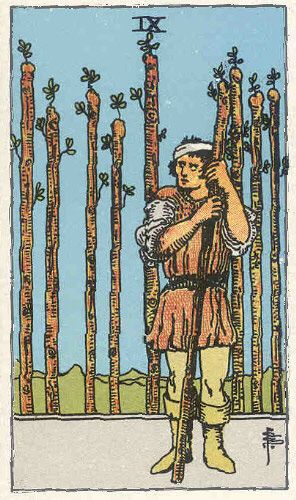
RWS. Love.
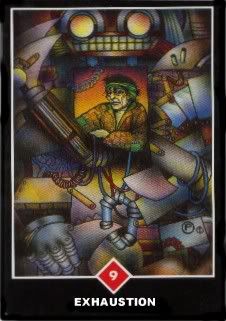
Exhaustion - the Osho Zen Nine, trapped in the machine.
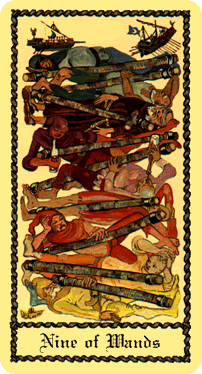
Medieval Scapini Nine of Wands. Crushed and at sea - notably less posturing than most Nines and yet sending the exact same message.
the night
the forest
embers
this is my fortress
look upon my body
the scars
the strength
the journey
this is my engine of war.
look what lies before me:
nothing?
We shall see.
When I first started learning, in 1999 (or possibly 1998), this was my favourite card in the deck. It chimed with my whole attitude to life at the time; bloodied, unbowed, determined as ever, putting on a tired show of force (or a show of tired force, one of those), not in the least inclined to give in. It's the only stance you can take when you're backed into a corner and can't get out and can't be driven further back either. I've toyed with other cards to represent insomnia - the Knight of Swords or the Tower - but I think it could belong here, at home.
You don't need to reverse this card; it reverses itself perfectly fucking well.
This is, incidentally, the butchest card image I've ever seen in my life, even among Nines of Wands. Big, male, naked, with wands formed into spearpoints, something I haven't noticed on any other Wand thus far. The figure's genitals are fully displayed and his arms are spread wide - not invitingly, not entreatingly, just to show you what he's made of. The whole show is just a ridiculous representation - there is no card like this for masculine posturing, or for base territoriality, or for pride bruised to a pulp but still intact and unyielding. Fuck every other word I've said; this card is your survival.
Like other nines, the spot is secure and lonely and rewarding; we've seen the card of harvest, and the card of the spring tide, and the whirlwind is yet to come; here we have old embers, charcoal, fires burned twice.
Images of the Nine of Wands:
RWS. Love.
Exhaustion - the Osho Zen Nine, trapped in the machine.
Medieval Scapini Nine of Wands. Crushed and at sea - notably less posturing than most Nines and yet sending the exact same message.
Ten Of Wands
and it started with a skeleton
a structure made of code
an architecture, a paper destination
and the dark clouds are gathering
and the city is so far.
no one else lifts for you
and you're tired but you're still lifting
still not there
you never will be
there is no time to stop and stare
because it's out there, it's real, and all you do
is try to pad the words around it
try to put flesh on the skeleton
seventy-eight bones
and the words are never perfect
can't be exhausted
you're never right
you'll never say it all
you'll never reach the end
and your words will rot
will be forgotten
your lifting lost, yet those bones will last
and centuries hence, a girl will take her deck
her seventy-eight shards of information
will shuffle, will draw the ten of wands
and she'll nod her head
and feel tired of words,
and you and she
will have the same old bones.
This is a great card for being irritatingly close to finished with your tarot project, for srs. I have, idk, maybe 18 more to go after this one and at the pace I started off at I'd've been done in under a week but now I'm out of focus and only adding one every so often and I planned to be done before this time last year and and oh come on we've all felt like this and that's why there's a goddamn card for it. Hello. I am Thene, and this is the Ten of Wands. It's heavy, but that's the point - some things are, especially things that are very close to payoff. Drawing it is like a promise. Just think of what you can do, how free you'll be, if you can just lug it around the next corner.
I really like the Intuitive Tarot version of it, too - it's a person building the frame of a house, far from the city, and so the burden is also going to give them lasting shelter - but it's a huge and lonely burden, and the clouds are coming. It's still seemingly less pointless than the RWS et al. It's more than just firewood. Some things we labour over can last longer than our lifetimes - our words are still there even if they have no more readers, our homes will last on even if they stand abandoned and empty - and I've posted scans here of the Visconti tarot, drawn hundreds of years ago. Whatever time you put into anything becomes part of the landscape of the world - doesn't matter how little or how much it means, because its presence is enough for the Wands. You dreamed and you did and you're tired and they're done with numbers, they're happy.
And you put down your deck, and tarot goes on.
Images of the Ten of Wands
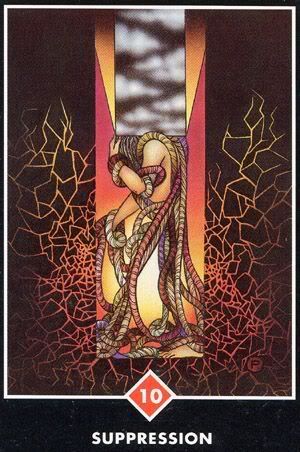
The Osho Zen deck is going with a Freudian word, 'Suppression', and its character is roped-up and weighed down by a box full of cloudy nothing. It's showing the illusory nature of the Ten of Wands; you really can just up sticks and leave at any time. Nothing's stopping you from freeing yourself from the burden. But sometimes, you want to keep holding them up until you're through.
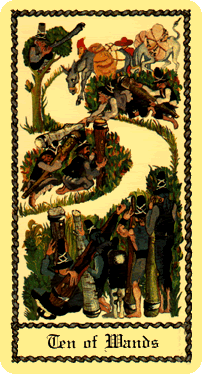
Scapini's is a long road with many people on it. I'm not up enough on the whole Catholic thing to really know, but I think it might be reflecting one of the Stations of the Cross. Not that Wands are into hyperbole or anything like that.
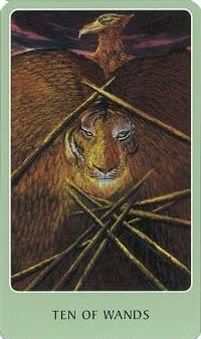
The Roots of Asia is a sky blotted out by wings, and the feeling I have about what's going on there is that they've built their own trap and fallen into it.
a structure made of code
an architecture, a paper destination
and the dark clouds are gathering
and the city is so far.
no one else lifts for you
and you're tired but you're still lifting
still not there
you never will be
there is no time to stop and stare
because it's out there, it's real, and all you do
is try to pad the words around it
try to put flesh on the skeleton
seventy-eight bones
and the words are never perfect
can't be exhausted
you're never right
you'll never say it all
you'll never reach the end
and your words will rot
will be forgotten
your lifting lost, yet those bones will last
and centuries hence, a girl will take her deck
her seventy-eight shards of information
will shuffle, will draw the ten of wands
and she'll nod her head
and feel tired of words,
and you and she
will have the same old bones.
This is a great card for being irritatingly close to finished with your tarot project, for srs. I have, idk, maybe 18 more to go after this one and at the pace I started off at I'd've been done in under a week but now I'm out of focus and only adding one every so often and I planned to be done before this time last year and and oh come on we've all felt like this and that's why there's a goddamn card for it. Hello. I am Thene, and this is the Ten of Wands. It's heavy, but that's the point - some things are, especially things that are very close to payoff. Drawing it is like a promise. Just think of what you can do, how free you'll be, if you can just lug it around the next corner.
I really like the Intuitive Tarot version of it, too - it's a person building the frame of a house, far from the city, and so the burden is also going to give them lasting shelter - but it's a huge and lonely burden, and the clouds are coming. It's still seemingly less pointless than the RWS et al. It's more than just firewood. Some things we labour over can last longer than our lifetimes - our words are still there even if they have no more readers, our homes will last on even if they stand abandoned and empty - and I've posted scans here of the Visconti tarot, drawn hundreds of years ago. Whatever time you put into anything becomes part of the landscape of the world - doesn't matter how little or how much it means, because its presence is enough for the Wands. You dreamed and you did and you're tired and they're done with numbers, they're happy.
And you put down your deck, and tarot goes on.
Images of the Ten of Wands
The Osho Zen deck is going with a Freudian word, 'Suppression', and its character is roped-up and weighed down by a box full of cloudy nothing. It's showing the illusory nature of the Ten of Wands; you really can just up sticks and leave at any time. Nothing's stopping you from freeing yourself from the burden. But sometimes, you want to keep holding them up until you're through.
Scapini's is a long road with many people on it. I'm not up enough on the whole Catholic thing to really know, but I think it might be reflecting one of the Stations of the Cross. Not that Wands are into hyperbole or anything like that.
The Roots of Asia is a sky blotted out by wings, and the feeling I have about what's going on there is that they've built their own trap and fallen into it.
Page Of Wands
I've walked across the forest
through brush and rivers, in its hands
and I walk on-
I've walked across the sky
four winds, five rainstorms, in its clouds
and I walk on-
and now into the desert.
I feel no heat; I have shade.
I feel no thirst; the rains are with me.
The forest is inside me.
The sky rest on my brow.
I like this Page of Wands; it seems a wiser young adventurer than many. The card always reminds me of a someone who I never really knew, someone I hope I'll know better one day - her name is Dominique, and I think the reason why she is adventurous is because everywhere around her she sees the rewards of adventurousness. The Page Of Wands, you might say, knows only the survivors.
A Wand could never tumble into the pitfalls of the Page Of Swords; Wands, even a Wand who doesn't have it herself, value lived experience, value realities - they just value dreams equally so. That's not perverse, just nature - you can't love anything without being drawn to its opposite, and the Wands are up-down channels between one world and the next. Their flames need fuel. She's only just setting out, but the Page of Wands is carrying her journey upon her sturdy back. She only knows the survivors. Her eyes are wide, but alert. She has yet to see disaster.
Images of the Page of Wands:
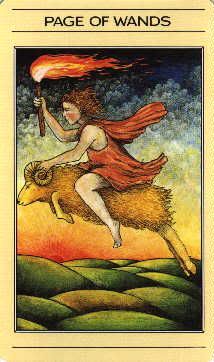
Phrixus, the Mythic Page - the image shows him fleeing from his evil stepmother, on the back of what later became the Golden Fleece. His twin sister took a nosedive into the sea shortly before this image was sketched.
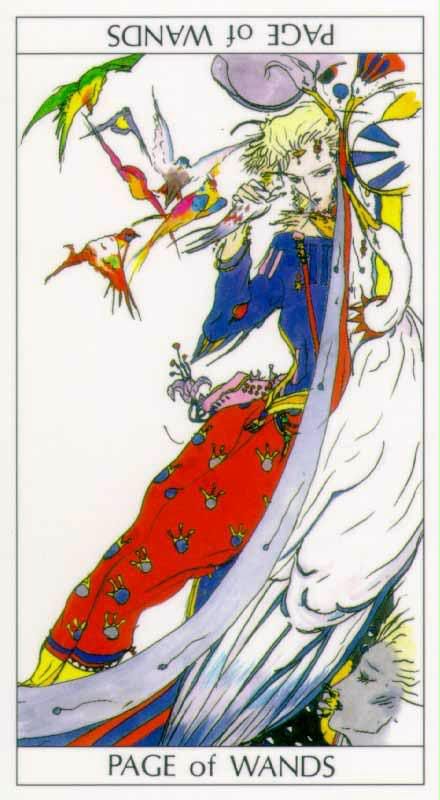
Amano brings out a possible reverse meaning of his Page of Wands; he's dreaming. I think all of Amano's pages have two faces; this shows one daylit face, playing with a flock of birds - and in the corner of the card, blocked from the other figure by a swan, is a shadowed face, eyes closed, surrounded by darkness and stars. This Page seems to be yet to leave his bedroom; the birds are, perhaps, his colourful dreams. (And damn, now I wish I knew what the swan means in Japanese myth).
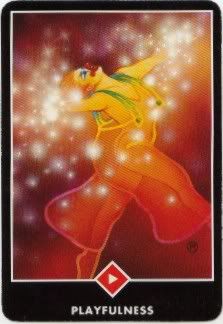
The Osho Zen Page says life is a jape, and she and all the rest of us are clowns.
through brush and rivers, in its hands
and I walk on-
I've walked across the sky
four winds, five rainstorms, in its clouds
and I walk on-
and now into the desert.
I feel no heat; I have shade.
I feel no thirst; the rains are with me.
The forest is inside me.
The sky rest on my brow.
I like this Page of Wands; it seems a wiser young adventurer than many. The card always reminds me of a someone who I never really knew, someone I hope I'll know better one day - her name is Dominique, and I think the reason why she is adventurous is because everywhere around her she sees the rewards of adventurousness. The Page Of Wands, you might say, knows only the survivors.
A Wand could never tumble into the pitfalls of the Page Of Swords; Wands, even a Wand who doesn't have it herself, value lived experience, value realities - they just value dreams equally so. That's not perverse, just nature - you can't love anything without being drawn to its opposite, and the Wands are up-down channels between one world and the next. Their flames need fuel. She's only just setting out, but the Page of Wands is carrying her journey upon her sturdy back. She only knows the survivors. Her eyes are wide, but alert. She has yet to see disaster.
Images of the Page of Wands:
Phrixus, the Mythic Page - the image shows him fleeing from his evil stepmother, on the back of what later became the Golden Fleece. His twin sister took a nosedive into the sea shortly before this image was sketched.
Amano brings out a possible reverse meaning of his Page of Wands; he's dreaming. I think all of Amano's pages have two faces; this shows one daylit face, playing with a flock of birds - and in the corner of the card, blocked from the other figure by a swan, is a shadowed face, eyes closed, surrounded by darkness and stars. This Page seems to be yet to leave his bedroom; the birds are, perhaps, his colourful dreams. (And damn, now I wish I knew what the swan means in Japanese myth).
The Osho Zen Page says life is a jape, and she and all the rest of us are clowns.
Knight Of Wands
fire can look like anything
like an eye
a cloud
an open flower
like the shape of a man
like his eyes
his smile
like anything
I know you
know your footsteps on the path outside
know the calm blue inside you, just before-
doesn't seem so, all looks so still now,
but all will burn.
This is such a cool-looking Knight of Wands, the coolest I am ever likely to see; he's barely even smiling. But we know. We know it's easier to ask for forgiveness than for permission. We know that if something can be done, then something must be done. We know that it will never be enough.
There is a girl dancing in my head.
When I wrote the King of Swords, I said I'd tell you about these guys, these sublime people. But I never know where to begin. Her name is Gaiety. And she doesn't care what you think. Her purposes will become clear once the smoke blows over. Possibly, anyway. You don't even know, for certain, that it was her who did it, but it always is.
It just looks like she's not holding the reins.
Wands are about seeing-dreaming-doing-changing, and Knights are a suit's champions, the ones who go too far on purpose. This is fire-of-fire. And when they burn out, they burn out bad. Also, reversed Wand-Knights tend to be nihilists; a profoundly irritating bunch.
Images of the Knight of Wands:
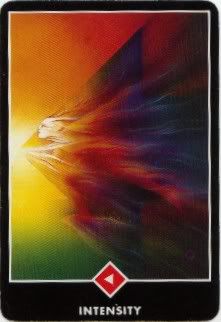
Intensity: the Osho Zen Knight, not waiting around.
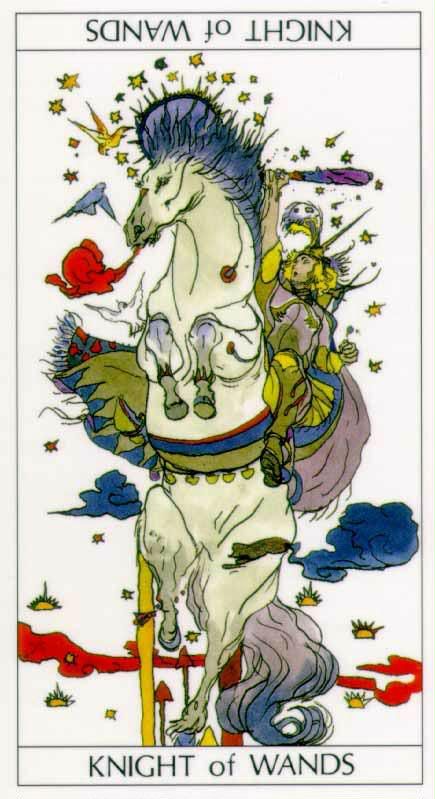
Amano's Knight, barely visible behind the things he's set in motion. If a Knight of Wands is shown mounted, it's traditional for the horse to be bucking on its back feet; ready to move and looking damn swish.
like an eye
a cloud
an open flower
like the shape of a man
like his eyes
his smile
like anything
I know you
know your footsteps on the path outside
know the calm blue inside you, just before-
doesn't seem so, all looks so still now,
but all will burn.
This is such a cool-looking Knight of Wands, the coolest I am ever likely to see; he's barely even smiling. But we know. We know it's easier to ask for forgiveness than for permission. We know that if something can be done, then something must be done. We know that it will never be enough.
There is a girl dancing in my head.
When I wrote the King of Swords, I said I'd tell you about these guys, these sublime people. But I never know where to begin. Her name is Gaiety. And she doesn't care what you think. Her purposes will become clear once the smoke blows over. Possibly, anyway. You don't even know, for certain, that it was her who did it, but it always is.
It just looks like she's not holding the reins.
Wands are about seeing-dreaming-doing-changing, and Knights are a suit's champions, the ones who go too far on purpose. This is fire-of-fire. And when they burn out, they burn out bad. Also, reversed Wand-Knights tend to be nihilists; a profoundly irritating bunch.
Images of the Knight of Wands:
Intensity: the Osho Zen Knight, not waiting around.
Amano's Knight, barely visible behind the things he's set in motion. If a Knight of Wands is shown mounted, it's traditional for the horse to be bucking on its back feet; ready to move and looking damn swish.
Queen Of Wands
my wand;
raises bubbles of fire from the earth to the sky
charms snakes,
snakes of fortunes,
tails wrapped around gold
my wand;
lifts my head high, crowns it with riches and rainbows
charms others,
with my body,
makes all things golden.
makes flesh be fire.
(I feel particularly uninspired tonight. Damn).
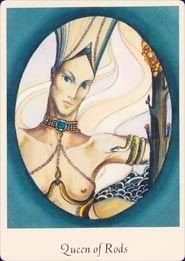
As with other Queens we have discussed, this lady is in control, not in command. That's fitting for a snake-charmer; using her arts and skills to turn risk into good fortune. In China, snakes stand for prosperity - I wonder if Conway was instead thinking of the Queen's snake as sinister, or as a bringer of forbidden knowledge, or as a sexual symbol? I read it as a good sign and as a dangerous one.
She hardly needs more sexual symbols; she's not naked, but adorned - bare breasts ringed with gold and with a beaded chain. To me the getup looks deliberately sexually submissive, but is it my eyes she has in mind? I can't know, can't know more than what I'd make of so many jewels, so much eye-makeup. She is the Queen of Wands. Her rod is budding fire. She controls the channel between dreamings and doings - she sees that creations are made real, she guides fantasy into reality.
Did Conway intend her to give the seeming of a prostitute? I hope not; I hope not because there are plenty of real prostitutes out there and they are more than just people who make other people's dreams come true; they are themselves, like everyone else. But it sure looks like Conway was doing that, and if she was, she's made it look like the ever-downside of all Queens; it's a trap. Why does this Queen display her bounties, and adorn her flesh rather than enjoy it in comfort? (The image is not of a strong woman - her arms shows no muscle tone, her collarbone is deeply recessed, her breasts are very small. Only the neck that supports her jewelled collar shows and strength).
I know I must come back here one day; I am uninspired, I can't hear in my right ear and that's fucking with my proprioception, and I can't see the upside here at all. There must be one, somewhere.
Images of the Queen of Wands:
The Intuitive Queen - yes, just this once, you can see the lady I was looking at.
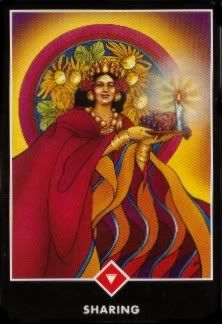
Sharing - the Osho Zen Queen. The idea here is that the Queen of Wands has so much that she can share without noticing. Maybe Conway was aiming for that too, a sharing of treasure and sensuality and experience from someone who had much to give, but she fucked up for me with that frail body and that unfortunate collar. (though, again, those who wear collars often do have power and experience to share - but you can't aim that niche, lady, you just can't, because tarot images are images, representations meant to be read).
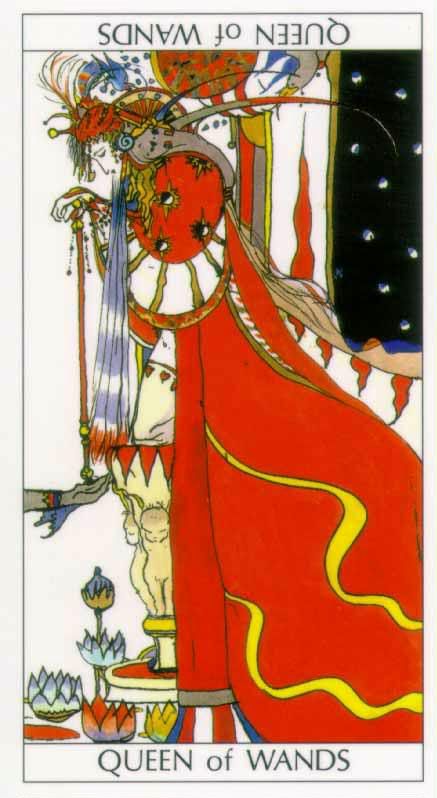
Amano's Queen of Wands - head bowed, rod resting on a hand notably darker than her own. It's very hard to see where this Queen ends - she seems half-pedestal, half-architecture.
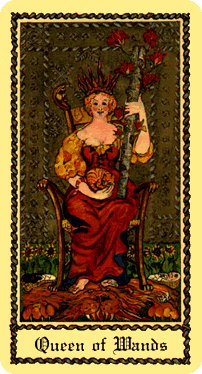
The Scapini Queen - I included this because it includes a common icon of the Queen of Wands; a cat. In the RWS, this cat is black - here it's a ginger tabby. Sometimes, it's a tigress.
raises bubbles of fire from the earth to the sky
charms snakes,
snakes of fortunes,
tails wrapped around gold
my wand;
lifts my head high, crowns it with riches and rainbows
charms others,
with my body,
makes all things golden.
makes flesh be fire.
(I feel particularly uninspired tonight. Damn).
As with other Queens we have discussed, this lady is in control, not in command. That's fitting for a snake-charmer; using her arts and skills to turn risk into good fortune. In China, snakes stand for prosperity - I wonder if Conway was instead thinking of the Queen's snake as sinister, or as a bringer of forbidden knowledge, or as a sexual symbol? I read it as a good sign and as a dangerous one.
She hardly needs more sexual symbols; she's not naked, but adorned - bare breasts ringed with gold and with a beaded chain. To me the getup looks deliberately sexually submissive, but is it my eyes she has in mind? I can't know, can't know more than what I'd make of so many jewels, so much eye-makeup. She is the Queen of Wands. Her rod is budding fire. She controls the channel between dreamings and doings - she sees that creations are made real, she guides fantasy into reality.
Did Conway intend her to give the seeming of a prostitute? I hope not; I hope not because there are plenty of real prostitutes out there and they are more than just people who make other people's dreams come true; they are themselves, like everyone else. But it sure looks like Conway was doing that, and if she was, she's made it look like the ever-downside of all Queens; it's a trap. Why does this Queen display her bounties, and adorn her flesh rather than enjoy it in comfort? (The image is not of a strong woman - her arms shows no muscle tone, her collarbone is deeply recessed, her breasts are very small. Only the neck that supports her jewelled collar shows and strength).
I know I must come back here one day; I am uninspired, I can't hear in my right ear and that's fucking with my proprioception, and I can't see the upside here at all. There must be one, somewhere.
Images of the Queen of Wands:
The Intuitive Queen - yes, just this once, you can see the lady I was looking at.
Sharing - the Osho Zen Queen. The idea here is that the Queen of Wands has so much that she can share without noticing. Maybe Conway was aiming for that too, a sharing of treasure and sensuality and experience from someone who had much to give, but she fucked up for me with that frail body and that unfortunate collar. (though, again, those who wear collars often do have power and experience to share - but you can't aim that niche, lady, you just can't, because tarot images are images, representations meant to be read).
Amano's Queen of Wands - head bowed, rod resting on a hand notably darker than her own. It's very hard to see where this Queen ends - she seems half-pedestal, half-architecture.
The Scapini Queen - I included this because it includes a common icon of the Queen of Wands; a cat. In the RWS, this cat is black - here it's a ginger tabby. Sometimes, it's a tigress.
King Of Wands
the fire in my hands
is the fire of the sky
is the fire of my crown
is the fire of the waters
is all fire; all fire kindled as one fire,
held as one fire,
wielded as one fire.
it illuminates the darkest hour
and yet
still it is dark.
This guy. Is the first card back after the break I took following the World. I've lost my thread, but that's okay; the big snake would've eaten it anyway. And this kind of writing is still easy, is still good. I think I have adopted his attitude to creation; it should be what is most natural for you to create, it should rest easily in your hands, and should allow the fire inside you to guide your hands smoothly; it should seem to connect you to what is above, and to what is in the flow of life. The King of Wands has it cracked.
He's a raving egomaniac too, but tends to be blind to it because he regards his dreams as being separate from himself when everyone else can clearly see just how much his confidence, and his very self, rest upon his fires. Yes, he's powerful (and a helpful card to draw), but not necessarily stable, or substantial. The fires in his hands and mind are also a candle that burns at both ends.
Images of the King of Wands:
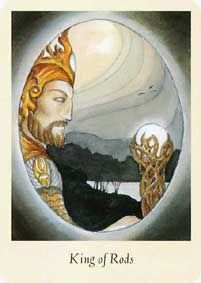
From the Intuitive Tarot.
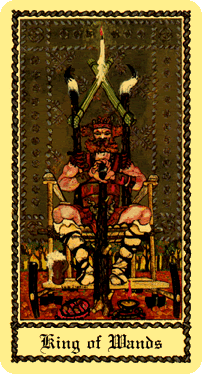
The Scapini image brings out the King's aggression; he has a big stick and he's ready to use it. This ties in to the sex/phallic aspect of Wandiness that I tend to overlook because literal anatomy has no discernible bearing on Wandiness; but the guy is showing off his body and is ready to lift that big stick - and all the while the fire burns above him, pointing upward.
The Osho Zen, by contrast, couldn't be more serene, and he's got there by turning fire upon himself. Fire is destructive in careless hands, but creative if you put care and time into knowing of it - and this person is making himself, shaping himself, in the warmth of the flames.
Amano's King of Wands has big rings and delicate fingers.
The Mythic King of Wands is Theseus of Athens - adventurer and hero, but leader and lover too. [For a given value of love.]
is the fire of the sky
is the fire of my crown
is the fire of the waters
is all fire; all fire kindled as one fire,
held as one fire,
wielded as one fire.
it illuminates the darkest hour
and yet
still it is dark.
This guy. Is the first card back after the break I took following the World. I've lost my thread, but that's okay; the big snake would've eaten it anyway. And this kind of writing is still easy, is still good. I think I have adopted his attitude to creation; it should be what is most natural for you to create, it should rest easily in your hands, and should allow the fire inside you to guide your hands smoothly; it should seem to connect you to what is above, and to what is in the flow of life. The King of Wands has it cracked.
He's a raving egomaniac too, but tends to be blind to it because he regards his dreams as being separate from himself when everyone else can clearly see just how much his confidence, and his very self, rest upon his fires. Yes, he's powerful (and a helpful card to draw), but not necessarily stable, or substantial. The fires in his hands and mind are also a candle that burns at both ends.
Images of the King of Wands:
From the Intuitive Tarot.
The Scapini image brings out the King's aggression; he has a big stick and he's ready to use it. This ties in to the sex/phallic aspect of Wandiness that I tend to overlook because literal anatomy has no discernible bearing on Wandiness; but the guy is showing off his body and is ready to lift that big stick - and all the while the fire burns above him, pointing upward.
The Osho Zen, by contrast, couldn't be more serene, and he's got there by turning fire upon himself. Fire is destructive in careless hands, but creative if you put care and time into knowing of it - and this person is making himself, shaping himself, in the warmth of the flames.
Amano's King of Wands has big rings and delicate fingers.
The Mythic King of Wands is Theseus of Athens - adventurer and hero, but leader and lover too. [For a given value of love.]
Ace Of Pentacles
Come into my parlour
then through the door
past the curtain
step inside the portal
and lift the top layer
enter the circle
put your hands upon the mandala
and open the box inside the dial
follow the money
keep digging-
Will I find the root? No.
I'll reach the stars.
An Ace is element at its starting-point. It could go anywhere. By the time you get to the Three, it probably already did.
When tarot readers and other occult folk talk of elements, they might talk of Earth as representing your physical existence, your home, your work, your security and your bodily health; I don't think that's accurate. I say earth is. Earth is real, it's one of the constituent parts of the world occultists live in; it might manifest in your life as work, home, body, but those are just the consequences of something that is more deeply present.
[What I wrote next later got snipped off into the Elements article.]
An Ace of Pentacles is Earth landing in your world - maybe like a rock on a muddy pond-bed, maybe like a meteorite. It's heralding a change of a practical nature - reversed, it may be encouraging such change - and this isn't so much about rearranging the furniture (though that itself is Earth magic at its finest - try it, you'll see how it works) as about Earth itself becoming a stronger current in your life.
(I really like this card, btw; it is layers within boxes within wheels within dials, with a star of David in the middle, and perhaps an eye in the middle of that. An Ace of Pentacles opens doors, and with Pentacles, inside every door is another door).
Images of the Ace of Pentacles:
Roots of Asia - similarly layered. A seed, planted in a spiral, becomes a tree of many triangles; in spite of the geometric forms, the card feels very natural compared to the Intuitive card. Earth is both things - both the world made by people, and the world just as it is.
The Robin Wood Tarot sets the Ace of Pentacles in a wood, above a long path lined by flowers.
'Maturity', the Osho Zen Ace of Pentacles, shows a man whose being is within a rainbow circle, brighter than the world outside. The Zen view of people is that we are all already enlightened, and just need to be nudged into remembering it; we carry springtime within us. The Earth in your life is already there - the Ace of Pentacles is prompting you to let it bloom.
then through the door
past the curtain
step inside the portal
and lift the top layer
enter the circle
put your hands upon the mandala
and open the box inside the dial
follow the money
keep digging-
Will I find the root? No.
I'll reach the stars.
An Ace is element at its starting-point. It could go anywhere. By the time you get to the Three, it probably already did.
When tarot readers and other occult folk talk of elements, they might talk of Earth as representing your physical existence, your home, your work, your security and your bodily health; I don't think that's accurate. I say earth is. Earth is real, it's one of the constituent parts of the world occultists live in; it might manifest in your life as work, home, body, but those are just the consequences of something that is more deeply present.
[What I wrote next later got snipped off into the Elements article.]
An Ace of Pentacles is Earth landing in your world - maybe like a rock on a muddy pond-bed, maybe like a meteorite. It's heralding a change of a practical nature - reversed, it may be encouraging such change - and this isn't so much about rearranging the furniture (though that itself is Earth magic at its finest - try it, you'll see how it works) as about Earth itself becoming a stronger current in your life.
(I really like this card, btw; it is layers within boxes within wheels within dials, with a star of David in the middle, and perhaps an eye in the middle of that. An Ace of Pentacles opens doors, and with Pentacles, inside every door is another door).
Images of the Ace of Pentacles:
Roots of Asia - similarly layered. A seed, planted in a spiral, becomes a tree of many triangles; in spite of the geometric forms, the card feels very natural compared to the Intuitive card. Earth is both things - both the world made by people, and the world just as it is.
The Robin Wood Tarot sets the Ace of Pentacles in a wood, above a long path lined by flowers.
'Maturity', the Osho Zen Ace of Pentacles, shows a man whose being is within a rainbow circle, brighter than the world outside. The Zen view of people is that we are all already enlightened, and just need to be nudged into remembering it; we carry springtime within us. The Earth in your life is already there - the Ace of Pentacles is prompting you to let it bloom.
Two Of Pentacles
I stood beside a mirror
and it cut me into two
Two eyes, two hands
two strange-shaped forms
two souls, two flames, two hearts
my crown is an hourglass
an infinite space in my mind
but all outside is an infinite wash of colour
and I am inside the mirror
small, still
frozen.
The Two of Pentacles is that life that happens while you're too busy doing other things. It is when that lovely spiffy earth energy from the Ace gathers momentum and eats every minute you put into it. That sounds bad, but I honestly miss this card; filling your every moment with accomplishments feels wonderful. But it's precarious - every hour, and every penny, will be allocated to something and an unexpected nudge can make it shatter.
The Two of Pentacles often contains a lemniscate (∞); a reminder, perhaps, that the resources which feel so stretched and fragile right now are, in truth, eternal. The Intuitive card shows this just above the head of a distorted silhouette; it's huge, white, swirled and symmetrical. The RWS shows a juggler with two objects wrapped in a ∞-shaped sash. Keeping things balanced, symmetrical, is important to this card; it requires the budgeting of time (and often money and other resources). But the balance includes the rest of the deck, in its infinite extent - it tells you to not neglect the rest of your needs. (Many Major Arcana cards involve balance - notably Justice, the High Priestess and Temperance; you can look to them for guidance when dealing with any Two, this one especially).
Images of the Two of Pentacles
The Marseilles shows two coins, a broken lemniscate that sprouts flowers, and - tellingly - is the card that features the deck's maker's mark, as the Ace of Spades sometimes does in modern 52s.
Did I mention the RWS juggler is doing his thing on the beach with the tide coming in behind him? This image makes me think of Morecambe Bay, which I used to live not far from; a treacherous six-mile stretch of sand which should only be negotiated with the aid of the official guide (who is paid £6 a year by royal decree). The bay is place of myth; it is pitted with quicksand, and it is said that the tide comes in faster than a galloping horse. It was on Morecambe Bay that 23 Chinese cockle-pickers were killed in February 2004. (I will not say they drowned or simply died; they were killed by their piece-of-shit gangmaster. Pentacles know the difference between what is and what is caused to be).
The Osho Zen 'Moment To Moment' card shows a man taking stepping stones over rainbows.
This is probably the only Thoth card I am ever going to link; here we see the balance of yin and yang, within a loop formed by the ouroboros. (This is a 8 rather than a ∞; eh?) As with most Thoth images, it's a very simple blending of symbols, one that emphasises symmetry.
And the Mythic Daedalus, whose work is just begun.
and it cut me into two
Two eyes, two hands
two strange-shaped forms
two souls, two flames, two hearts
my crown is an hourglass
an infinite space in my mind
but all outside is an infinite wash of colour
and I am inside the mirror
small, still
frozen.
The Two of Pentacles is that life that happens while you're too busy doing other things. It is when that lovely spiffy earth energy from the Ace gathers momentum and eats every minute you put into it. That sounds bad, but I honestly miss this card; filling your every moment with accomplishments feels wonderful. But it's precarious - every hour, and every penny, will be allocated to something and an unexpected nudge can make it shatter.
The Two of Pentacles often contains a lemniscate (∞); a reminder, perhaps, that the resources which feel so stretched and fragile right now are, in truth, eternal. The Intuitive card shows this just above the head of a distorted silhouette; it's huge, white, swirled and symmetrical. The RWS shows a juggler with two objects wrapped in a ∞-shaped sash. Keeping things balanced, symmetrical, is important to this card; it requires the budgeting of time (and often money and other resources). But the balance includes the rest of the deck, in its infinite extent - it tells you to not neglect the rest of your needs. (Many Major Arcana cards involve balance - notably Justice, the High Priestess and Temperance; you can look to them for guidance when dealing with any Two, this one especially).
Images of the Two of Pentacles
The Marseilles shows two coins, a broken lemniscate that sprouts flowers, and - tellingly - is the card that features the deck's maker's mark, as the Ace of Spades sometimes does in modern 52s.
Did I mention the RWS juggler is doing his thing on the beach with the tide coming in behind him? This image makes me think of Morecambe Bay, which I used to live not far from; a treacherous six-mile stretch of sand which should only be negotiated with the aid of the official guide (who is paid £6 a year by royal decree). The bay is place of myth; it is pitted with quicksand, and it is said that the tide comes in faster than a galloping horse. It was on Morecambe Bay that 23 Chinese cockle-pickers were killed in February 2004. (I will not say they drowned or simply died; they were killed by their piece-of-shit gangmaster. Pentacles know the difference between what is and what is caused to be).
The Osho Zen 'Moment To Moment' card shows a man taking stepping stones over rainbows.
This is probably the only Thoth card I am ever going to link; here we see the balance of yin and yang, within a loop formed by the ouroboros. (This is a 8 rather than a ∞; eh?) As with most Thoth images, it's a very simple blending of symbols, one that emphasises symmetry.
And the Mythic Daedalus, whose work is just begun.
Three Of Pentacles
place a grain of sand on another grain of sand
turn the wheel
press down
make a stone, layer by layer
place a block of stone on another block of stone
turn the wheel
you can see it
turn the wheel
cut teeth into a wheel, place a wheel -
- atop another wheel, make a gear
make a handle
let the handle turn the wheel -
let it go
let there be work within your working
without you working
iteration
grains of sand
Grains of sand.
(Yeah, I love Sid Meier's Alpha Centauri).
...I swore to god I'd done this bitch before. So much so that when I drew it, I went right past it looking for a new card to write about. Why did I think I'd pondered on its face before - its impossible Escherian architecture, its turning cogwheels, its tiny overseer?
This is the grind. It's never new, I guess.
I rather like structure; one reason this site feels so good to write on is that I know what I have to do each time a new card comes out of the deck - let it talk in italics, rant a while, post some pretty pictures, publish, check it's popped out in the right order, go add it to the list, rinse, x78. It's easy to go through the motions, and easy to pause and then get going again where I left off. On the other hand, it's no surprise at all that I burned out after about x50 and didn't pick it up again for another six months.
The Three of Cups is in it for the long run, and it's boring; the RWS shows the building of a cathedral, and that's a project that can run for decades or centuries. The most beautiful church in the world, Barcelona's Sagrada Familia, has been under construction since 1882 and still isn't ready yet, but it's getting there by inches and dear god will it ever be worth it when it's done.
You could say the same about human civilisation - with its impossible figures and shady construction schedule. (You don't want to ask about the budget).
I drew it alongside the Two of Pentacles ('you've always got time') and the Magician ('what you do for yourself matters for the world'). Those, yeah, I'd done already, and I thought 'right, sure, keep grinding, now move on to the next page.'
I guess this is a poke suggesting I be more meticulous in my work in future? Whatever.
Images of the Three of Pentacles
Here's Conway's picture. I think the overseer is shrugging and maybe wondering what the machine is accomplishing? But still it turns, beneath that structure that makes no sense, and still we keep building.
Scapini has also gone with stonework - I look at this and I see Lear and Caesar, I see a pyramid built of pyramids, and I see a whole edifice weeping at its own construction.
turn the wheel
press down
make a stone, layer by layer
place a block of stone on another block of stone
turn the wheel
you can see it
turn the wheel
cut teeth into a wheel, place a wheel -
- atop another wheel, make a gear
make a handle
let the handle turn the wheel -
let it go
let there be work within your working
without you working
iteration
grains of sand
Grains of sand.
(Yeah, I love Sid Meier's Alpha Centauri).
...I swore to god I'd done this bitch before. So much so that when I drew it, I went right past it looking for a new card to write about. Why did I think I'd pondered on its face before - its impossible Escherian architecture, its turning cogwheels, its tiny overseer?
This is the grind. It's never new, I guess.
I rather like structure; one reason this site feels so good to write on is that I know what I have to do each time a new card comes out of the deck - let it talk in italics, rant a while, post some pretty pictures, publish, check it's popped out in the right order, go add it to the list, rinse, x78. It's easy to go through the motions, and easy to pause and then get going again where I left off. On the other hand, it's no surprise at all that I burned out after about x50 and didn't pick it up again for another six months.
The Three of Cups is in it for the long run, and it's boring; the RWS shows the building of a cathedral, and that's a project that can run for decades or centuries. The most beautiful church in the world, Barcelona's Sagrada Familia, has been under construction since 1882 and still isn't ready yet, but it's getting there by inches and dear god will it ever be worth it when it's done.
You could say the same about human civilisation - with its impossible figures and shady construction schedule. (You don't want to ask about the budget).
I drew it alongside the Two of Pentacles ('you've always got time') and the Magician ('what you do for yourself matters for the world'). Those, yeah, I'd done already, and I thought 'right, sure, keep grinding, now move on to the next page.'
I guess this is a poke suggesting I be more meticulous in my work in future? Whatever.
Images of the Three of Pentacles
Here's Conway's picture. I think the overseer is shrugging and maybe wondering what the machine is accomplishing? But still it turns, beneath that structure that makes no sense, and still we keep building.
Scapini has also gone with stonework - I look at this and I see Lear and Caesar, I see a pyramid built of pyramids, and I see a whole edifice weeping at its own construction.
Four Of Pentacles
this is about protection
this is about me wrapped around them holding them under me protected solid safe
this is about them protecting me me needing them knowing them using
them using me
this is about everything is within me nothing
nothing outside
i can't see anything outside
It's tough not being down about the Four of Pentacles. Earth is a shape here; come from a point, to a moving line, to a geometric form, and now become a solid thing. This card is called Miser; it is a hoard, something trapped by its human owner as it is trapping him in turn. It is clasped tight, not used; held with awe and fear, but not use.
It's so easy to be down on this. But this shape is not simply a prison; think, without it, everything would fall through your hands. A Four of Pentacles maintains, budgets, is never without shelter. Just gotta be careful of it. It can be a box of gold inside a person. It can also be a person inside a box of gold.
Images of the Four of Pentacles:
The Rider-Waite-Smith original; rather hunched - perhaps fearful, perhaps taking shelter.
The Osho Zen Four, caught out in the cold.
this is about me wrapped around them holding them under me protected solid safe
this is about them protecting me me needing them knowing them using
them using me
this is about everything is within me nothing
nothing outside
i can't see anything outside
It's tough not being down about the Four of Pentacles. Earth is a shape here; come from a point, to a moving line, to a geometric form, and now become a solid thing. This card is called Miser; it is a hoard, something trapped by its human owner as it is trapping him in turn. It is clasped tight, not used; held with awe and fear, but not use.
It's so easy to be down on this. But this shape is not simply a prison; think, without it, everything would fall through your hands. A Four of Pentacles maintains, budgets, is never without shelter. Just gotta be careful of it. It can be a box of gold inside a person. It can also be a person inside a box of gold.
Images of the Four of Pentacles:
The Rider-Waite-Smith original; rather hunched - perhaps fearful, perhaps taking shelter.
The Osho Zen Four, caught out in the cold.
Five Of Pentacles
as I walked across the desert
I met a man upon the sands
'Why do you cross the desert?' he said
'Tis hard, but must be done.
There is no shade in the city now,
just turning wheels of bronze.
If I walk, if I endure, then I can join the world again.'
He bowed his hooded head, and I asked him in turn;
'Why do you stay here in the desert?
What do you do upon the sands?'
Said he, 'The city is but turning wheels,
the sands but empty ground.
Here, the birds fly free; like them
I make my shade from freedom
I prosper in my solitude
My world is on these sands.'
Dreaded continuity; there is no desert on the Intuitive Page Of Wands, I just intuited one, and here it is, the moment I turn my next card. And it's perfect; I don't recall seeing one on a Five of Pentacles before, I recall more midnight flights than harsh sunlight here, but god, I like this.
The Five of Pentacles is that moment where the security of the Four, that treasurebox with a man inside (or vice versa), is exposed to a new dimension; time. And time is not kind to locks, for there is always a new lockpick. It doesn't matter what happened, if the scene of the Four even occurred prior to the given situation, but this is a Pentacle in the flow of time; it erodes, becomes sand, and is carried far from the safety of the city.
In spite of the card's despondency and signs of hardship, I feel it points towards a happy ending. You can learn a lot from having the supposedly secure things in life give way - you can learn what there is left after security has gone; how huge the world is, and how bountiful; how there is more to good fortune than keeping the same possessions in the same place for all time. The Five of Pentacles travels with few burdens, but with its back bowed; because of those few burdens, it can learn to raise its head to the sun again.
Images of the Five of Pentacles:
The RWS shows two figures walking past a church; one is ragged, and I think is only half shod - the other is disabled. It is snowing. The missing shoe may be the source of my optimism about the card - my shadow, Sendalin, usually appears to me barefoot, and he is known to be optimistic in even the most peculiar circumstances.
The Osho Zen 'Outsider': look closely, and you'll see that the padlock isn't actually closed, something the Outsider has seemingly neglected to notice in his hurry to perve wistfully over the place he's not inside of.
I met a man upon the sands
'Why do you cross the desert?' he said
'Tis hard, but must be done.
There is no shade in the city now,
just turning wheels of bronze.
If I walk, if I endure, then I can join the world again.'
He bowed his hooded head, and I asked him in turn;
'Why do you stay here in the desert?
What do you do upon the sands?'
Said he, 'The city is but turning wheels,
the sands but empty ground.
Here, the birds fly free; like them
I make my shade from freedom
I prosper in my solitude
My world is on these sands.'
Dreaded continuity; there is no desert on the Intuitive Page Of Wands, I just intuited one, and here it is, the moment I turn my next card. And it's perfect; I don't recall seeing one on a Five of Pentacles before, I recall more midnight flights than harsh sunlight here, but god, I like this.
The Five of Pentacles is that moment where the security of the Four, that treasurebox with a man inside (or vice versa), is exposed to a new dimension; time. And time is not kind to locks, for there is always a new lockpick. It doesn't matter what happened, if the scene of the Four even occurred prior to the given situation, but this is a Pentacle in the flow of time; it erodes, becomes sand, and is carried far from the safety of the city.
In spite of the card's despondency and signs of hardship, I feel it points towards a happy ending. You can learn a lot from having the supposedly secure things in life give way - you can learn what there is left after security has gone; how huge the world is, and how bountiful; how there is more to good fortune than keeping the same possessions in the same place for all time. The Five of Pentacles travels with few burdens, but with its back bowed; because of those few burdens, it can learn to raise its head to the sun again.
Images of the Five of Pentacles:
The RWS shows two figures walking past a church; one is ragged, and I think is only half shod - the other is disabled. It is snowing. The missing shoe may be the source of my optimism about the card - my shadow, Sendalin, usually appears to me barefoot, and he is known to be optimistic in even the most peculiar circumstances.
The Osho Zen 'Outsider': look closely, and you'll see that the padlock isn't actually closed, something the Outsider has seemingly neglected to notice in his hurry to perve wistfully over the place he's not inside of.
Six Of Pentacles
To take the things you do not need
and let them drop
and to walk away the taller,
lighter,
to keep but one thing in your hand
to be straight-backed while others stoop:
This is power,
but power,
is not an easy thing to do.
The Six of Pentacles concerns the power of giving. It looks very sweet up there in the RWS, prospering enough to attract beggars, kind enough to be letting things go (far cry from the Four - though if you see this as a continuing dynamic, given what goes down in the Five it's more likely that the character in the Four is the receiver here than the giver).
But to experience the power of giving, first you need to have enough to give away - or to have the strength to give up everything (except, perhaps, the piece you still hold in your hand). Neither could come from nowhere. 'Fact, we could even go ask the Five of Swords how you came by them. Or we could go look how the patronage economy of, say, Renaissance Italy, really worked and see who could give and who could receive, and how that reinforced the existing social hierarchy.
[I later took another look at the Six of Pentacles and the power of giving, here, one that spoke more of the lasting presence a gift can have in someone else's life.]
If sevens tend to be caught in uncertainty, sixes tend to be pleasant on the surface, but hiding all sorts of ugly secrets about power underneath. Many Sixes of Pentacles feature a set of scales, or some other indication that balance is important; this one doesn't, but the idea's still there in my head. The giving here can redress a balance, but 'balance' is equally likely to wind up just leaving things the way they currently are, rather than producing a real change. There's a cool take on this theme in the Osho Zen, so I guess it's time for the picture part.
Images of the Six of Pentacles:
Compromise from the Osho Zen supposedly features a pair of eunuchs. In Three Kingdoms - a saga from China, rather than the land of Zen - the great moral message you're given, backed up by 2500+ pages of story, is 'Don't trust eunuchs, okay? Ever. Ever. Trusting eunuchs will make you fail'. Age-old suspicion of the gender-variant aside - this is about power and about how you negotiate with those who have it. 'Compromise' is a word that means 'giving away what you have, but trying to get more in return', which is the heart and soul of the Six of Pentacles. It's fine, it's a good trick to know, but what about the things you're not prepared to compromise? The things you won't trade away to the people who have power? If you're determined to compromise, how do you protect those things from these sinister men of power?
Here's the Intuitive card. See also the RWS, which isn't vastly different.
and let them drop
and to walk away the taller,
lighter,
to keep but one thing in your hand
to be straight-backed while others stoop:
This is power,
but power,
is not an easy thing to do.
The Six of Pentacles concerns the power of giving. It looks very sweet up there in the RWS, prospering enough to attract beggars, kind enough to be letting things go (far cry from the Four - though if you see this as a continuing dynamic, given what goes down in the Five it's more likely that the character in the Four is the receiver here than the giver).
But to experience the power of giving, first you need to have enough to give away - or to have the strength to give up everything (except, perhaps, the piece you still hold in your hand). Neither could come from nowhere. 'Fact, we could even go ask the Five of Swords how you came by them. Or we could go look how the patronage economy of, say, Renaissance Italy, really worked and see who could give and who could receive, and how that reinforced the existing social hierarchy.
[I later took another look at the Six of Pentacles and the power of giving, here, one that spoke more of the lasting presence a gift can have in someone else's life.]
If sevens tend to be caught in uncertainty, sixes tend to be pleasant on the surface, but hiding all sorts of ugly secrets about power underneath. Many Sixes of Pentacles feature a set of scales, or some other indication that balance is important; this one doesn't, but the idea's still there in my head. The giving here can redress a balance, but 'balance' is equally likely to wind up just leaving things the way they currently are, rather than producing a real change. There's a cool take on this theme in the Osho Zen, so I guess it's time for the picture part.
Images of the Six of Pentacles:
Compromise from the Osho Zen supposedly features a pair of eunuchs. In Three Kingdoms - a saga from China, rather than the land of Zen - the great moral message you're given, backed up by 2500+ pages of story, is 'Don't trust eunuchs, okay? Ever. Ever. Trusting eunuchs will make you fail'. Age-old suspicion of the gender-variant aside - this is about power and about how you negotiate with those who have it. 'Compromise' is a word that means 'giving away what you have, but trying to get more in return', which is the heart and soul of the Six of Pentacles. It's fine, it's a good trick to know, but what about the things you're not prepared to compromise? The things you won't trade away to the people who have power? If you're determined to compromise, how do you protect those things from these sinister men of power?
Here's the Intuitive card. See also the RWS, which isn't vastly different.
Seven Of Pentacles
seven suns for seven seas
they pointillise the sky, as if it were
so many grains of sand from
the beach of the all-River
as if the beach were a person
as if the person were the sea at seven sunsets
as if.
do you chance the purple waters
in your fragile, unbound form?
or do you wait for night to find you
by the crazy purple shore?
This is a pretty one. There's a confusion between person and sand here, between meadow and sky. I also have no idea how to read it - my head is cluttered with other Sevens of Pentacles, and - the pointillist metaphor turns on - I am not sure whether to read the entire clutch of cards I've seen, or this individual one here.
Now these points of data make a beautiful line -
Much like the Seven of Cups, it's a bit of a doubtful mess. But the confusion here is about physical investment - about being involved in something, having put some stake and perhaps a lot of effort into it, then having to ask; 'is this ever going to be worth it?' Will you ever put enough points of colour in the sky to make a picture? If you leave the shallows and swim, could you truly make it over the dark waters, or will you fall apart?
It's about trust in yourself, and the ability to work hard for what you've invested in. It's also about the ability to spot a bad risk, say 'no' when it's time to say no, and back out with grace before the sea washes over you. It's back-up and shelter as well as long efforts and dirty hands.
Images of the Seven of Pentacles:
The Scapini card makes the risk element prominent; here we have gamblers. Will they quit when they're ahead, play on and lose it all, or fold before they start?
The Osho Zen brings out the virtue at the heart of the Seven of Pentacles: Patience.
Over at the Mythic deck, Daedalus should've said 'no'. Really. Just because you know you can do it doesn't mean it's worth your effort. There could be risks you're not thinking of, like angry kings, or the possibility that you're just a pawn in some game being played by a jealous god. Gotta watch your step here.
they pointillise the sky, as if it were
so many grains of sand from
the beach of the all-River
as if the beach were a person
as if the person were the sea at seven sunsets
as if.
do you chance the purple waters
in your fragile, unbound form?
or do you wait for night to find you
by the crazy purple shore?
This is a pretty one. There's a confusion between person and sand here, between meadow and sky. I also have no idea how to read it - my head is cluttered with other Sevens of Pentacles, and - the pointillist metaphor turns on - I am not sure whether to read the entire clutch of cards I've seen, or this individual one here.
Much like the Seven of Cups, it's a bit of a doubtful mess. But the confusion here is about physical investment - about being involved in something, having put some stake and perhaps a lot of effort into it, then having to ask; 'is this ever going to be worth it?' Will you ever put enough points of colour in the sky to make a picture? If you leave the shallows and swim, could you truly make it over the dark waters, or will you fall apart?
It's about trust in yourself, and the ability to work hard for what you've invested in. It's also about the ability to spot a bad risk, say 'no' when it's time to say no, and back out with grace before the sea washes over you. It's back-up and shelter as well as long efforts and dirty hands.
Images of the Seven of Pentacles:
The Scapini card makes the risk element prominent; here we have gamblers. Will they quit when they're ahead, play on and lose it all, or fold before they start?
The Osho Zen brings out the virtue at the heart of the Seven of Pentacles: Patience.
Over at the Mythic deck, Daedalus should've said 'no'. Really. Just because you know you can do it doesn't mean it's worth your effort. There could be risks you're not thinking of, like angry kings, or the possibility that you're just a pawn in some game being played by a jealous god. Gotta watch your step here.
Eight Of Pentacles
a chip of the hammer
a turn of the wheel
a careful hand
a bent head
an hour's practice.
With these things,
I will succeed,
every making will be like the last,
and tomorrow will be like today.
This is the first Eight out of the deck. I haven't had a Seven yet either. Eights are resolutions - they bring you a new form of work to do on their element, work that will bring you toward completion - and the work of Earth is work.
The Eight of Pentacles is called the Apprentice. It's often shown in a workshop setting; both the Intuitive card and the RWS shows it making Pentacles - crafting the symbols of Earth. The work an Eight does is perhaps about a shift from letting an element work through you to engineering the element's experiences yourself. Earlier Pentacles - see the Two, Four, or Five - are being acted on by Earth, trying to cope with its energies. The Eight asks you to take Earth and (if I may quote a phrase I love from a man I love) shape it on the anvil of your will.
The Eight of Pentacles is probably tiring; it may be boring, but only if you don't pay attention. Its creations are inherently samey - even if they appear to show variety, the energy within them will be the same. The Eight is finicky, and needs gentleness and care. It is daunting, too, but totally worthwhile.
Images of the Eight of Pentacles:
The Osho Zen Eight of Pentacles is called Ordinariness; rather than a workshop, its character is toiling in the fields - a direct nod up to the Nine. The card seems happy.
The Scapini image shows a worker on a ladder, and beneath, a woman and a child. This is a clumsy heteronormative way to remind us of how family can be as relevant to the Pentacles as to the Cups, and how the work we do is often for, about, or affected by, family. (It's an essentially good idea, but I need to see a version of this image where the woman is subject, not object, before I can grok it).
a turn of the wheel
a careful hand
a bent head
an hour's practice.
With these things,
I will succeed,
every making will be like the last,
and tomorrow will be like today.
This is the first Eight out of the deck. I haven't had a Seven yet either. Eights are resolutions - they bring you a new form of work to do on their element, work that will bring you toward completion - and the work of Earth is work.
The Eight of Pentacles is called the Apprentice. It's often shown in a workshop setting; both the Intuitive card and the RWS shows it making Pentacles - crafting the symbols of Earth. The work an Eight does is perhaps about a shift from letting an element work through you to engineering the element's experiences yourself. Earlier Pentacles - see the Two, Four, or Five - are being acted on by Earth, trying to cope with its energies. The Eight asks you to take Earth and (if I may quote a phrase I love from a man I love) shape it on the anvil of your will.
The Eight of Pentacles is probably tiring; it may be boring, but only if you don't pay attention. Its creations are inherently samey - even if they appear to show variety, the energy within them will be the same. The Eight is finicky, and needs gentleness and care. It is daunting, too, but totally worthwhile.
Images of the Eight of Pentacles:
The Osho Zen Eight of Pentacles is called Ordinariness; rather than a workshop, its character is toiling in the fields - a direct nod up to the Nine. The card seems happy.
The Scapini image shows a worker on a ladder, and beneath, a woman and a child. This is a clumsy heteronormative way to remind us of how family can be as relevant to the Pentacles as to the Cups, and how the work we do is often for, about, or affected by, family. (It's an essentially good idea, but I need to see a version of this image where the woman is subject, not object, before I can grok it).
Nine Of Pentacles
my open eyes
my orchard ground
my ships
my harvest
my open hand
my body
your sky
your sea.
my open hand.
This is my tenth card article; I have nine completed ones sat on the blog front page. Three a day, every day, I hope, though tonight I am very tired; yesterday and the day before, I felt full of life when I was done, ready for a fourth, but I really don't want to burn this out. Harvesting feels nice. Writing is a harvest - a harvest of thoughts and feelings that were sown long ago, left to grow as you read, as you turned your earth over.
That this is so much easier than writing fiction maybe tells me what I ought to be doing with the words in my head. But it's good to rotate, to avoid monoculture, and to let your mind run fallow for a year at a time.
As with all things Pentacle, a good harvest does not spring out of nowhere; neither does it disappear when you put the hoes away. [...I'm sorry.] Whose orchard is it - whose harvest? There's this beautiful idea, I think in the first appendix of ILLUMINATUS!, that it's absurd for a human being to claim to own land, or a building - how can something far older than you, which will live far longer than you will, be your possession? It is better to see oneself as steward to the harvest rather than the owner of it. For a more Pentacly footnote, see how much power, privilege, and capital gains tax plays into the owning and using of land.
And that harvest needs managing, has to last through your winter; and from what I know of winter, it would be good to share around some of what you have brought forth from the earth, so that the same will come to you in time. A real Pentacle would stab me for saying that, though.
So if there's a flaw, a reversal, here, it'd be taking your fruit for granted, rather than seeing why it's yours and where it has to go next. And as I hope the above stream-of-consciousness crap hinted, I fear there's a desire, in the Intuitive image, to think it natural to own the world.
(It's not come yet - though my guess is it'll be sooner rather than later, I'll jot this down in case it slips away: The Nine of Swords is reaping the whirlwind. (And the Nine of Cups is here, and has brought the spring tide)).
Images of the Nine of Pentacles:
Ripeness - the Osho Zen Nine. Great name, because it makes it about timing and about the fruit being ready for the harvest, rather than the harvester being ready. By removing the human character, the deck makes the natural process of harvest more clear.
The traditional hawker of the RWS. Why a hawker? The Intuitive card takes quite a nod from this one, only with more sea and no hawk.
my orchard ground
my ships
my harvest
my open hand
my body
your sky
your sea.
my open hand.
This is my tenth card article; I have nine completed ones sat on the blog front page. Three a day, every day, I hope, though tonight I am very tired; yesterday and the day before, I felt full of life when I was done, ready for a fourth, but I really don't want to burn this out. Harvesting feels nice. Writing is a harvest - a harvest of thoughts and feelings that were sown long ago, left to grow as you read, as you turned your earth over.
That this is so much easier than writing fiction maybe tells me what I ought to be doing with the words in my head. But it's good to rotate, to avoid monoculture, and to let your mind run fallow for a year at a time.
As with all things Pentacle, a good harvest does not spring out of nowhere; neither does it disappear when you put the hoes away. [...I'm sorry.] Whose orchard is it - whose harvest? There's this beautiful idea, I think in the first appendix of ILLUMINATUS!, that it's absurd for a human being to claim to own land, or a building - how can something far older than you, which will live far longer than you will, be your possession? It is better to see oneself as steward to the harvest rather than the owner of it. For a more Pentacly footnote, see how much power, privilege, and capital gains tax plays into the owning and using of land.
And that harvest needs managing, has to last through your winter; and from what I know of winter, it would be good to share around some of what you have brought forth from the earth, so that the same will come to you in time. A real Pentacle would stab me for saying that, though.
So if there's a flaw, a reversal, here, it'd be taking your fruit for granted, rather than seeing why it's yours and where it has to go next. And as I hope the above stream-of-consciousness crap hinted, I fear there's a desire, in the Intuitive image, to think it natural to own the world.
(It's not come yet - though my guess is it'll be sooner rather than later, I'll jot this down in case it slips away: The Nine of Swords is reaping the whirlwind. (And the Nine of Cups is here, and has brought the spring tide)).
Images of the Nine of Pentacles:
Ripeness - the Osho Zen Nine. Great name, because it makes it about timing and about the fruit being ready for the harvest, rather than the harvester being ready. By removing the human character, the deck makes the natural process of harvest more clear.
The traditional hawker of the RWS. Why a hawker? The Intuitive card takes quite a nod from this one, only with more sea and no hawk.
Ten Of Pentacles
one and stepping from the dark to light and
two so have a spine a vector, fire and
three curls into form, a vessel, frame and
four has mercy, offers blessing, love and
five cuts the crap and builds the wall and
six sacrifices balances rewards and
seven decorates with verve and passion
eight does the math and learns the words and
nine opens up the trapdoor in the roof and
ten brings you to the root the end the whole.
We're done. There's this huge ongoing process and we've reached the top of it. We're fulfilled; we're complete. This is about the work we do with our hands and our minds, not about anything more subjective. It's about turning the last page and reading/writing THE END.
(Where does anything end? You could say it doesn't, ever. But, me, whenever I've finished a bit of fiction - a story, a chapter, a difficult scene - I like to give thanks, even if there's more to come, more polishing to do, even if it's never over...it's still good to take a moment to be quiet, look at what you've done, and let it go.)
The Intuitive Tarot makes this card look really damn interesting - it shows a long chain of pairs of people, huge discs in the backdrop giving it the feel of a production line in a factory...and at the vanishing point at the top of the card, that line curves, and we see not human figures like those at the end, but our ancient ancestors; crayfish, curled things, long-necked dinosaurs, mammoths. The road was there a long time before we stepped foot on it, and will remain a long time after we get off. (More on this when I finally pull down the Moon).
Images of the Ten of Pentacles
The RWS, and some other decks that are in love with Western qabalism, like to array the ten coins in the form of the Tree of Life; a triangle, two inverted triangles, and then Malkuth alone at the root. I like this because it shows the Ten as being not just part of a process but also as being the process itself, the entire road and not just the final step. The other thing about this road is that it zigzags, veers from one extreme to another before finding balance and losing it again - you won't find perfect here, only whole. The image itself, behind all that, is of three generations of a family, home, garden and pets, crest and tower, an entirely practical state of comfort and fulfilment.
The image in the Scapini deck is colder but fairly similar in scope; we have our high castle and the tall tree outside it. No people here. This Ten of Coins is not about the people in your life, but about the strong walls and strong roots that you've built up over time.
The Osho Zen Tarot has a Ten of Pentacles that's all about people; I'm unavoidably reminded of my very favourite Edward Monkton cartoon. This is how we make worlds, and how our world is made.
two so have a spine a vector, fire and
three curls into form, a vessel, frame and
four has mercy, offers blessing, love and
five cuts the crap and builds the wall and
six sacrifices balances rewards and
seven decorates with verve and passion
eight does the math and learns the words and
nine opens up the trapdoor in the roof and
ten brings you to the root the end the whole.
We're done. There's this huge ongoing process and we've reached the top of it. We're fulfilled; we're complete. This is about the work we do with our hands and our minds, not about anything more subjective. It's about turning the last page and reading/writing THE END.
(Where does anything end? You could say it doesn't, ever. But, me, whenever I've finished a bit of fiction - a story, a chapter, a difficult scene - I like to give thanks, even if there's more to come, more polishing to do, even if it's never over...it's still good to take a moment to be quiet, look at what you've done, and let it go.)
The Intuitive Tarot makes this card look really damn interesting - it shows a long chain of pairs of people, huge discs in the backdrop giving it the feel of a production line in a factory...and at the vanishing point at the top of the card, that line curves, and we see not human figures like those at the end, but our ancient ancestors; crayfish, curled things, long-necked dinosaurs, mammoths. The road was there a long time before we stepped foot on it, and will remain a long time after we get off. (More on this when I finally pull down the Moon).
Images of the Ten of Pentacles
The RWS, and some other decks that are in love with Western qabalism, like to array the ten coins in the form of the Tree of Life; a triangle, two inverted triangles, and then Malkuth alone at the root. I like this because it shows the Ten as being not just part of a process but also as being the process itself, the entire road and not just the final step. The other thing about this road is that it zigzags, veers from one extreme to another before finding balance and losing it again - you won't find perfect here, only whole. The image itself, behind all that, is of three generations of a family, home, garden and pets, crest and tower, an entirely practical state of comfort and fulfilment.
The image in the Scapini deck is colder but fairly similar in scope; we have our high castle and the tall tree outside it. No people here. This Ten of Coins is not about the people in your life, but about the strong walls and strong roots that you've built up over time.
The Osho Zen Tarot has a Ten of Pentacles that's all about people; I'm unavoidably reminded of my very favourite Edward Monkton cartoon. This is how we make worlds, and how our world is made.
Knight Of Pentacles
My world is made of squares of stone.
My home is made of light and gold.
My shield is made of strength and care.
My face is made of sand and bone.
And I look upon my world and home.
See the walls, the wealth, the sky,
I cannot look beyond my home.
Where'er I go, these walls shall be.
For home is everything I am.
It never leaves my sight.
I'm glad to see this fellah. He's never the most interesting company - square-hatted, closed-worlded, holding his shield against his heart - but he's got something and he's prepared to work for it. He's made shelter; he's protecting himself and everything else that's inside that shelter. There is sadly little to write about this persevering little chap; only to say that he is strong and he prospers, and that his walls are high and solid, and he does not look change in the eye.
Images of the Knight of Pentacles:
The Roots of Asia picture isn't far from the RWS version, other than that the knight is mounted on an elephant. Each RWS knight treats its horse differently - supposedly the horse represents the Knight's inner self, but anyway, the Knight of Pentacles usually keeps his mount still as he enjoys the landscape of his home.
Amano's horse is not just still, but actually taking a nap while the Knight counts his treasure. He seems careless with his wealth, an image the two sleepy animals add to, but the ornaments on his hands and hair seem more tightly bound.
Scapini's knight, like the Intuitive Knight, looks away from us, toward his walls. He carries what he has under one arm, and has his back to us. It's strangely vulnerable.
And Slowing Down from the Osho Zen is carrying her home everywhere she goes! And if you're doing that, why hurry? Why be busy, or drag around illusions, or look for shelter elsewhere?
My home is made of light and gold.
My shield is made of strength and care.
My face is made of sand and bone.
And I look upon my world and home.
See the walls, the wealth, the sky,
I cannot look beyond my home.
Where'er I go, these walls shall be.
For home is everything I am.
It never leaves my sight.
I'm glad to see this fellah. He's never the most interesting company - square-hatted, closed-worlded, holding his shield against his heart - but he's got something and he's prepared to work for it. He's made shelter; he's protecting himself and everything else that's inside that shelter. There is sadly little to write about this persevering little chap; only to say that he is strong and he prospers, and that his walls are high and solid, and he does not look change in the eye.
Images of the Knight of Pentacles:
The Roots of Asia picture isn't far from the RWS version, other than that the knight is mounted on an elephant. Each RWS knight treats its horse differently - supposedly the horse represents the Knight's inner self, but anyway, the Knight of Pentacles usually keeps his mount still as he enjoys the landscape of his home.
Amano's horse is not just still, but actually taking a nap while the Knight counts his treasure. He seems careless with his wealth, an image the two sleepy animals add to, but the ornaments on his hands and hair seem more tightly bound.
Scapini's knight, like the Intuitive Knight, looks away from us, toward his walls. He carries what he has under one arm, and has his back to us. It's strangely vulnerable.
And Slowing Down from the Osho Zen is carrying her home everywhere she goes! And if you're doing that, why hurry? Why be busy, or drag around illusions, or look for shelter elsewhere?
Queen Of Pentacles
rose stone crown jewel
earth light cloth chain
home warmth safe solid nothing.
blink kiss touch feel
smell spin fix bury
mill turn sew close eyes
we stitch infinity.
The Queen of Pentacles is usually held to be your traditional hearth mother, but 'hearths' are moving on nowadays. She is nurturing something real and physical, not to make it happy but to make it function, to make it better, to make it grow. This often leaves her trapped by her own successes, always with another task to do. I've not assembled my images yet, but I've got a feeling that this one usually has her eyes closed, or turned towards her hands or to the ground.
Her world is experienced through the hands, and I think also the nose. She feels and makes her world, rather than looking at it and expecting it to work out.
I don't know her that well. I'd like to know her better, but as with many things, I fear her - fear being within her, eyes shut. On the other hand, she has great sex, in a pretty traditional way; there's no reason for a modern Queen of Pentacles to be any more fecund than she wants to be, but she'll be taking care of her sexuality as well as she does the rest of her real life.
Images of the Queen of Pentacles:
Amano's Queen has hidden her hands, and we can only presume that they are against her pregnant belly. Her robes are plainer, her hair rather neater, than Amano's Queen of Swords.
The Rider-Waite-Smith garden Queen, her life held gently on her lap. Roses, rabbits, vines, and all goodly fecund things.
The Roots of Asia Queen. Love her. She's a human body directing the energies of trees, from root to branch. Compare to the One World Priestess I linked here; the flow is the same, though it runs straighter.
Flowering; the Osho Zen Queen. The associated Osho quote has it that Zen wants you to be abundant, to overflow with joy and to spread this joy like the fragrance of a flower.
earth light cloth chain
home warmth safe solid nothing.
blink kiss touch feel
smell spin fix bury
mill turn sew close eyes
we stitch infinity.
The Queen of Pentacles is usually held to be your traditional hearth mother, but 'hearths' are moving on nowadays. She is nurturing something real and physical, not to make it happy but to make it function, to make it better, to make it grow. This often leaves her trapped by her own successes, always with another task to do. I've not assembled my images yet, but I've got a feeling that this one usually has her eyes closed, or turned towards her hands or to the ground.
Her world is experienced through the hands, and I think also the nose. She feels and makes her world, rather than looking at it and expecting it to work out.
I don't know her that well. I'd like to know her better, but as with many things, I fear her - fear being within her, eyes shut. On the other hand, she has great sex, in a pretty traditional way; there's no reason for a modern Queen of Pentacles to be any more fecund than she wants to be, but she'll be taking care of her sexuality as well as she does the rest of her real life.
Images of the Queen of Pentacles:
Amano's Queen has hidden her hands, and we can only presume that they are against her pregnant belly. Her robes are plainer, her hair rather neater, than Amano's Queen of Swords.
The Rider-Waite-Smith garden Queen, her life held gently on her lap. Roses, rabbits, vines, and all goodly fecund things.
The Roots of Asia Queen. Love her. She's a human body directing the energies of trees, from root to branch. Compare to the One World Priestess I linked here; the flow is the same, though it runs straighter.
Flowering; the Osho Zen Queen. The associated Osho quote has it that Zen wants you to be abundant, to overflow with joy and to spread this joy like the fragrance of a flower.
Subscribe to:
Posts (Atom)